Zhang Yangjunna, Schmidt John W, Arthur Terrance M, Wheeler Tommy L, Zhang Qi, Wang Bing
Institute of Food Science and Engineering, Hangzhou Medical College, Hangzhou 310013, China.
United States Department of Agriculture, Agricultural Research Service, Roman L. Hruska U.S. Meat Animal Research Center, Clay Center, NE 68933, USA.
Microorganisms. 2022 Mar 19;10(3):661. doi: 10.3390/microorganisms10030661.
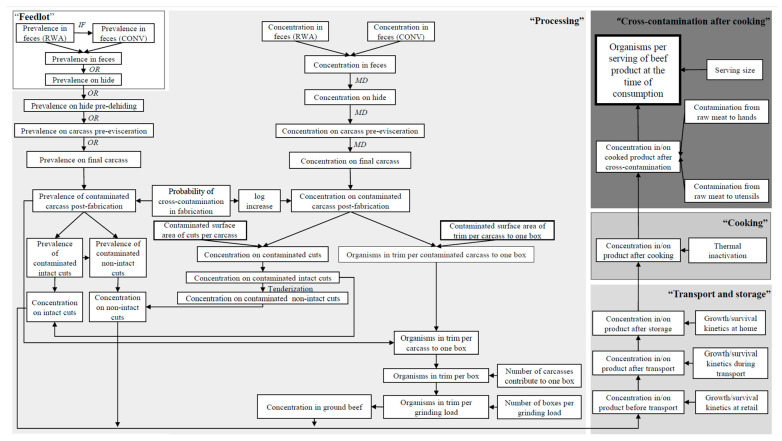
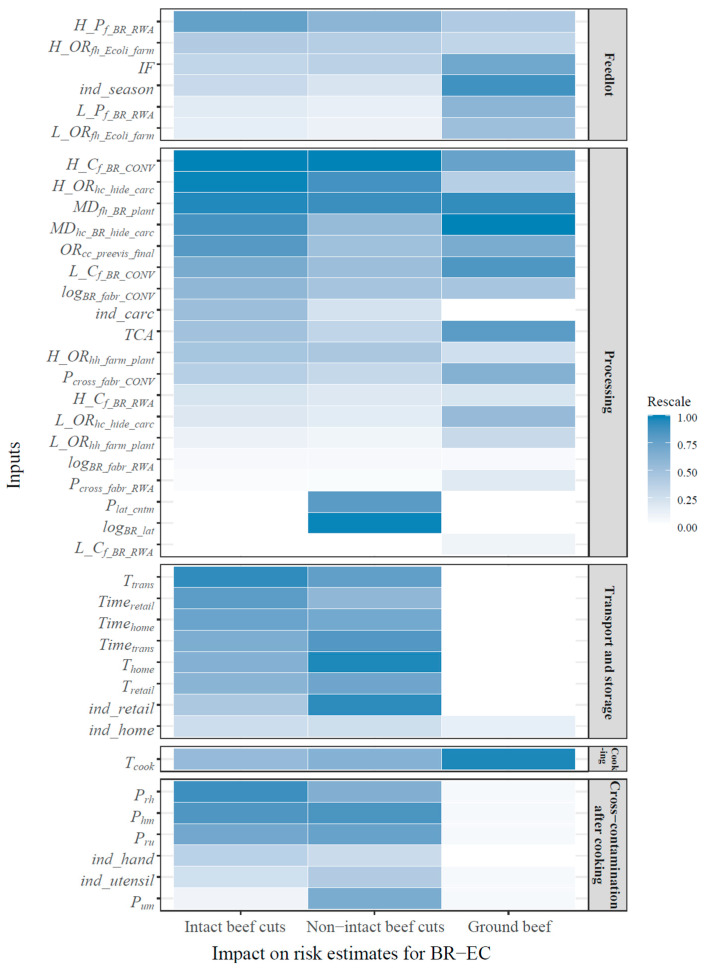
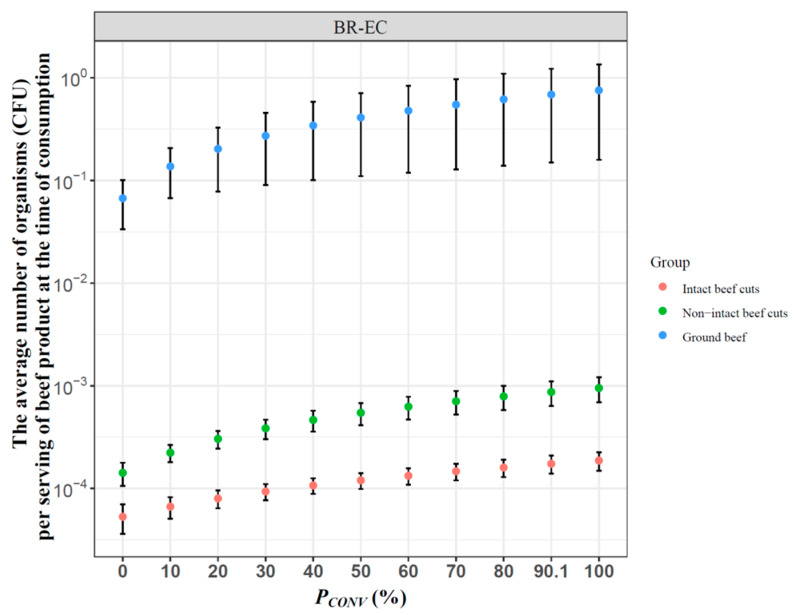
Integrated quantitative descriptions of the transmission of β-lactam-resistant (BR-EC) from commercial beef products to consumers are not available. Here, a quantitative microbial exposure assessment model was established to simulate the fate of BR-EC in a farm-to-fork continuum and provide an estimate of BR-EC exposure among beef consumers in the U.S. The model compared the per-serving exposures from the consumption of intact beef cuts, non-intact beef cuts, and ground beef. Additionally, scenario analysis was performed to evaluate the relative contribution of antibiotic use during beef cattle production to the level of human exposure to BR-EC. The model predicted mean numbers of BR-EC of 1.7 × 10, 8.7 × 10, and 6.9 × 10 CFU/serving for intact beef cuts, non-intact beef cuts, and ground beef, respectively, at the time of consumption. Sensitivity analyses using the baseline model suggested that factors related to sectors along the supply chain, i.e., feedlots, processing plants, retailers, and consumers, were all important for controlling human exposure to BR-EC. Interventions at the processing and post-processing stages are expected to be most effective. Simulation results showed that a decrease in antibiotic use among beef cattle might be associated with a reduction in exposure to BR-EC from beef consumption. However, the absolute reduction was moderate, indicating that the effectiveness of restricting antibiotic use as a standalone strategy for mitigating human exposure to BR-EC through beef consumption is still uncertain. Good cooking and hygiene practices at home and advanced safety management practices in the beef processing and post-processing continuum are more powerful approaches for reducing human exposure to antibiotic-resistant bacteria in beef products.
目前尚无关于β-内酰胺抗性大肠杆菌(BR-EC)从商业牛肉产品传播给消费者的综合定量描述。在此,建立了一个定量微生物暴露评估模型,以模拟BR-EC在从农场到餐桌连续过程中的命运,并估计美国牛肉消费者中BR-EC的暴露情况。该模型比较了食用完整牛肉切块、不完整牛肉切块和碎牛肉时每份的暴露量。此外,还进行了情景分析,以评估肉牛生产过程中抗生素使用对人类BR-EC暴露水平的相对贡献。该模型预测,在消费时,完整牛肉切块、不完整牛肉切块和碎牛肉每份的BR-EC平均数量分别为1.7×10、8.7×10和6.9×10 CFU。使用基线模型的敏感性分析表明,供应链各环节(即饲养场、加工厂、零售商和消费者)相关因素对于控制人类BR-EC暴露均很重要。预计在加工和加工后阶段进行干预最为有效。模拟结果表明,肉牛抗生素使用量的减少可能与牛肉消费中BR-EC暴露的减少有关。然而,绝对减少量适中,这表明将限制抗生素使用作为减轻人类通过牛肉消费接触BR-EC的单一策略的有效性仍不确定。在家中采用良好的烹饪和卫生习惯以及在牛肉加工和加工后连续过程中采用先进的安全管理做法是减少人类接触牛肉产品中抗生素抗性细菌的更有效方法。