Evers Eric G, Pielaat Annemarie, Smid Joost H, van Duijkeren Engeline, Vennemann Francy B C, Wijnands Lucas M, Chardon Jurgen E
Centre for Infectious Disease Control (CIb), National Institute for Public Health and the Environment (RIVM), Bilthoven, The Netherlands.
Institute for Risk Assessment Sciences (IRAS), Utrecht University, Utrecht, The Netherlands.
PLoS One. 2017 Jan 5;12(1):e0169589. doi: 10.1371/journal.pone.0169589. eCollection 2017.
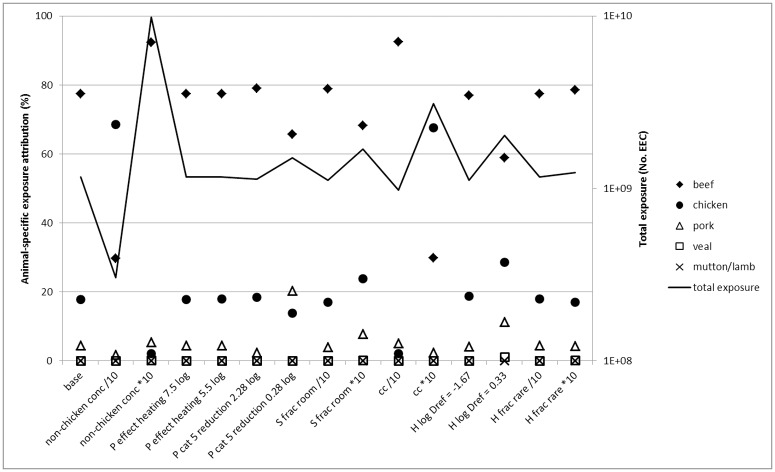
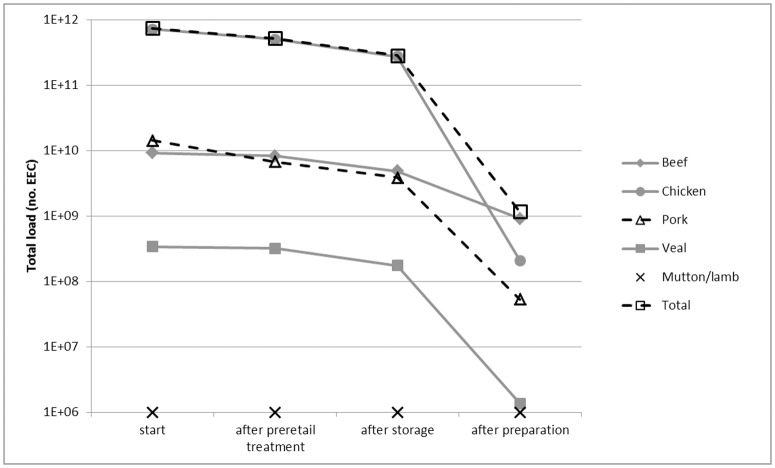
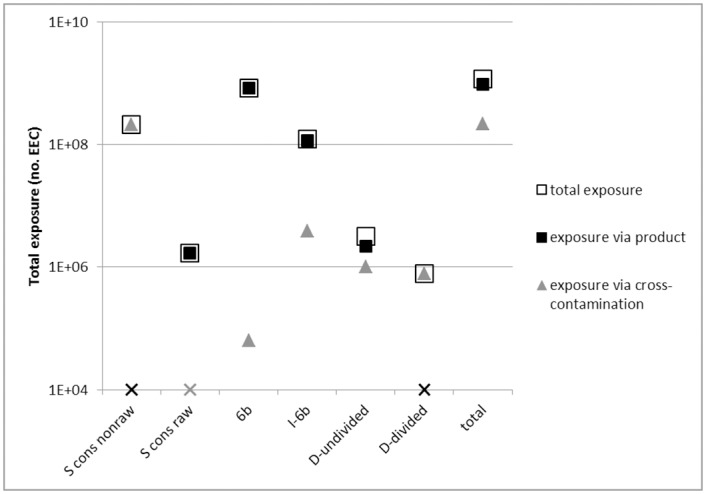
The presence of extended-spectrum β-lactamase (ESBL) and plasmidic AmpC (pAmpC) producing Escherichia coli (EEC) in food animals, especially broilers, has become a major public health concern. The aim of the present study was to quantify the EEC exposure of humans in The Netherlands through the consumption of meat from different food animals. Calculations were done with a simplified Quantitative Microbiological Risk Assessment (QMRA) model. The model took the effect of pre-retail processing, storage at the consumers home and preparation in the kitchen (cross-contamination and heating) on EEC numbers on/in the raw meat products into account. The contribution of beef products (78%) to the total EEC exposure of the Dutch population through the consumption of meat was much higher than for chicken (18%), pork (4.5%), veal (0.1%) and lamb (0%). After slaughter, chicken meat accounted for 97% of total EEC load on meat, but chicken meat experienced a relatively large effect of heating during food preparation. Exposure via consumption of filet americain (a minced beef product consumed raw) was predicted to be highest (61% of total EEC exposure), followed by chicken fillet (13%). It was estimated that only 18% of EEC exposure occurred via cross-contamination during preparation in the kitchen, which was the only route by which EEC survived for surface-contaminated products. Sensitivity analysis showed that model output is not sensitive for most parameters. However, EEC concentration on meat other than chicken meat was an important data gap. In conclusion, the model assessed that consumption of beef products led to a higher exposure to EEC than chicken products, although the prevalence of EEC on raw chicken meat was much higher than on beef. The (relative) risk of this exposure for public health is yet unknown given the lack of a modelling framework and of exposure studies for other potential transmission routes.
产超广谱β-内酰胺酶(ESBL)和质粒介导的AmpC酶(pAmpC)的大肠杆菌(EEC)存在于食用动物尤其是肉鸡中,已成为一个主要的公共卫生问题。本研究的目的是通过食用不同食用动物的肉类来量化荷兰人群的EEC暴露量。使用简化的定量微生物风险评估(QMRA)模型进行计算。该模型考虑了零售前加工、在消费者家中储存以及在厨房中制备(交叉污染和加热)对生肉产品上/内EEC数量的影响。牛肉产品对荷兰人群通过食用肉类产生的总EEC暴露量的贡献(78%)远高于鸡肉(18%)、猪肉(4.5%)、小牛肉(0.1%)和羊肉(0%)。屠宰后,鸡肉占肉类上EEC总负荷的97%,但鸡肉在食物制备过程中受到加热的影响相对较大。预计通过食用美式生牛肉片(一种生的牛肉末产品)的暴露量最高(占EEC总暴露量的61%),其次是鸡胸肉(13%)。据估计,只有18%的EEC暴露是在厨房制备过程中通过交叉污染发生的,这是表面受污染产品中EEC存活的唯一途径。敏感性分析表明,模型输出对大多数参数不敏感。然而,鸡肉以外的肉类上的EEC浓度是一个重要的数据缺口。总之,该模型评估得出,尽管生鸡肉上EEC的流行率远高于牛肉,但食用牛肉产品导致的EEC暴露量高于鸡肉产品。鉴于缺乏针对其他潜在传播途径的建模框架和暴露研究,这种暴露对公众健康的(相对)风险尚不清楚。