Wang Yi, Guo Xian, Liu Liangchao, Xie Minhao, Lam Wing-Kai
Department of Physical Education, Renmin University of China, Beijing 100872, China.
Sports and Social Development Research Center, Renmin University of China, Beijing 100872, China.
Biology (Basel). 2022 Feb 26;11(3):375. doi: 10.3390/biology11030375.
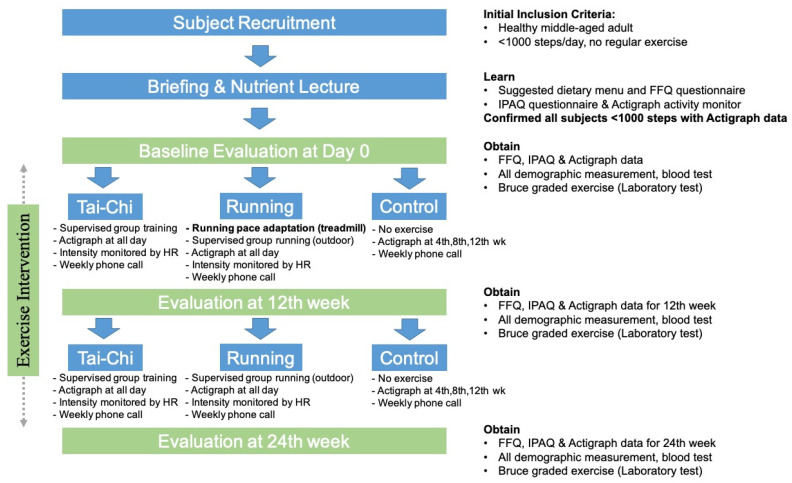
This study examined the effectiveness of Tai-Chi and running exercises on cardiorespiratory fitness and biomarkers in sedentary middle-aged adults under 24 weeks of supervised training. Methods Thirty-six healthy middle-aged adults (55.6 ± 5.3 yr) were randomly assigned into Tai-Chi, running and control groups. During a 24-week training period, the Tai-Chi and running groups were asked to perform exercises for 60 min/day and 5 days/week, which were supervised by Tai-Chi and running instructors throughout. Resting heart rate, lean mass, blood pressure and blood lipids were measured, and cardiorespiratory fitness (VO2max, Vmax and Peak heart rate) was assessed at the baseline and the 12- and 24-week interventions. Results Compared to the no-exercise control group, both the Tai-Chi and running groups significantly decreased resting heart rate, diastolic blood pressure and cardiorespiratory fitness and increased lean mass across the training session (p < 0.05). Compared to the Tai-Chi group, the running group showed greater improvement in VO2max and Vmax (p < 0.05) and reduced triglyceride and low-density lipoprotein cholesterol (p < 0.05). Conclusion Both Tai-Chi and running exercise showed beneficial effects on cardiorespiratory fitness and enhanced health-related outcomes in middle-aged adults. Although Tai-Chi exercises were less effective in VO2max than running, Tai-Chi may be considered as a plausible alternative to running exercises that can be achieved in the indoor-based setting.
本研究在24周的监督训练下,考察了太极拳和跑步运动对久坐不动的中年成年人心肺适能和生物标志物的影响。方法 将36名健康中年成年人(55.6±5.3岁)随机分为太极拳组、跑步组和对照组。在24周的训练期间,太极拳组和跑步组被要求每天进行60分钟、每周5天的运动,全程由太极拳和跑步教练监督。测量静息心率、瘦体重、血压和血脂,并在基线以及干预12周和24周时评估心肺适能(最大摄氧量、最大通气量和心率峰值)。结果 与无运动对照组相比,太极拳组和跑步组在整个训练期间静息心率、舒张压和心肺适能均显著降低,瘦体重增加(p<0.05)。与太极拳组相比,跑步组在最大摄氧量和最大通气量方面有更大改善(p<0.