Department of Research, Aspetar Orthopaedic and Sports Medicine Hospital, Doha, Qatar
Academic Center for Evidence Based Sports Medicine, Amsterdam UMC Locatie AMC, Amsterdam, North Holland, The Netherlands.
Br J Sports Med. 2022 Jul;56(14):792-800. doi: 10.1136/bjsports-2020-103405. Epub 2022 Mar 25.
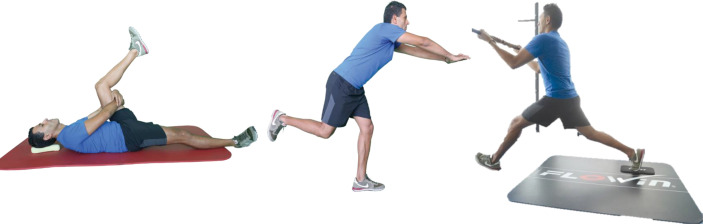
To evaluate the efficacy of early versus delayed introduction of lengthening (ie, eccentric strengthening) exercises in addition to an established rehabilitation programme on return to sport duration for acute hamstring injuries in a randomised controlled superiority trial.
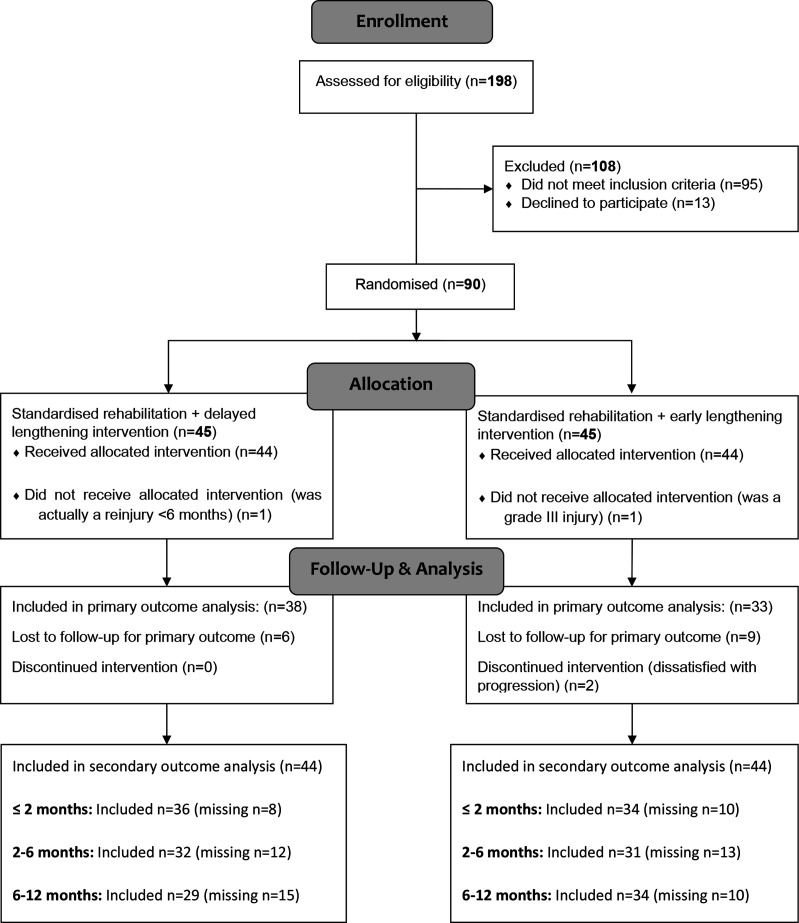
90 male participants (age: 18-36 years, median 26 years) with an MRI-confirmed acute hamstring injury were randomised into an early lengthening (at day 1 of rehabilitation) group or a delayed lengthening (after being able to run at 70% of maximal speed) group. Both groups received an established rehabilitation programme. The primary outcome was time to return to sport (ie, time from injury to full unrestricted training and/or match play). The secondary outcome was reinjury rate within 12 months after return to sport. Other outcomes at return to sport included the Askling H-test, hamstring strength, clinical examination and readiness questions.
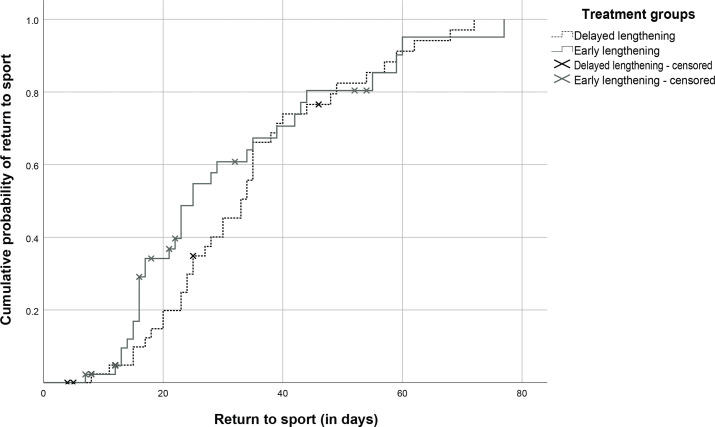
The return to sport in the early lengthening group was 23 (IQR 16-35) days and 33 (IQR 23-40) days in the delayed lengthening group. For return to sport (in days), the adjusted HR for the early lengthening group compared with the delayed lengthening group was 0.95 (95% CI 0.56 to 1.60, p=0.84). There was no significant difference between groups for reinjury rates within 2 months (OR=0.94, 95% CI 0.18 to 5.0, p=0.94), from 2 to 6 months (OR=2.00, 95% CI 0.17 to 23.3, p=0.58), and 6 to 12 months (OR=0.57, 95% CI 0.05 to 6.6, p=0.66).
Accelerating the introduction of lengthening exercises in the rehabilitation of hamstring injury in male athletes did not improve the time to return to sport nor the risk of reinjury.
在一项随机对照优效试验中,评估在既定康复方案的基础上,早期(即离心强化)拉长练习与延迟(可在 70%最大速度跑步后)引入拉长练习对急性腘绳肌损伤运动员重返运动时间的疗效。
90 名男性参与者(年龄 18-36 岁,中位数 26 岁)接受 MRI 确认的急性腘绳肌损伤,随机分为早期拉长(康复第 1 天)组或延迟拉长(能够以 70%最大速度跑步后)组。两组均接受既定康复方案。主要结局为重返运动时间(即从损伤到完全无限制训练和/或比赛的时间)。次要结局为 12 个月内重返运动后的再损伤率。重返运动的其他结局包括 Askling H 测试、腘绳肌力量、临床检查和准备问题。
早期拉长组的重返运动时间为 23(IQR 16-35)天,延迟拉长组为 33(IQR 23-40)天。对于重返运动(以天计),早期拉长组与延迟拉长组相比,调整后的 HR 为 0.95(95%CI 0.56-1.60,p=0.84)。两组 2 个月内(OR=0.94,95%CI 0.18-5.0,p=0.94)、2-6 个月(OR=2.00,95%CI 0.17-23.3,p=0.58)和 6-12 个月(OR=0.57,95%CI 0.05-6.6,p=0.66)的再损伤率无显著差异。
在男性运动员腘绳肌损伤康复中加速引入拉长练习并不能改善重返运动时间或再损伤风险。