Rolls Edmund T, Cheng Wei, Feng Jianfeng
Oxford Centre for Computational Neuroscience, Oxford, UK.
Department of Computer Science, University of Warwick, Coventry CV4 7AL, UK.
Brain Commun. 2020 Nov 16;2(2):fcaa196. doi: 10.1093/braincomms/fcaa196. eCollection 2020.
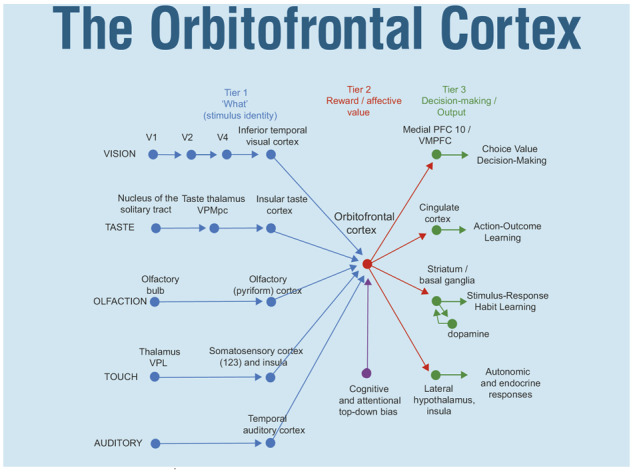
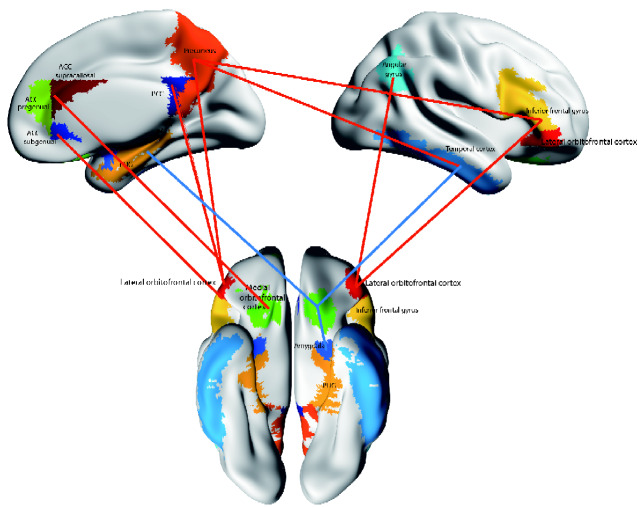
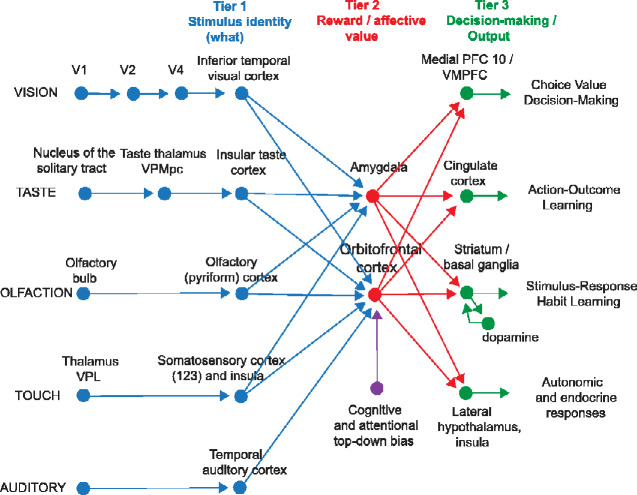
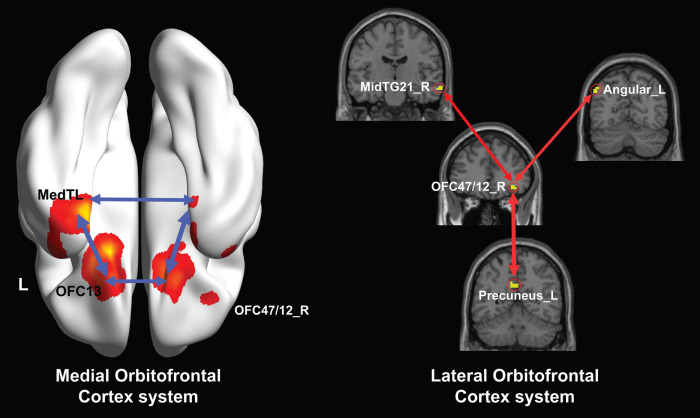
The orbitofrontal cortex in primates including humans is the key brain area in emotion, and in the representation of reward value and in non-reward, that is not obtaining an expected reward. Cortical processing before the orbitofrontal cortex is about the identity of stimuli, i.e. 'what' is present, and not about reward value. There is evidence that this holds for taste, visual, somatosensory and olfactory stimuli. The human medial orbitofrontal cortex represents many different types of reward, and the lateral orbitofrontal cortex represents non-reward and punishment. Not obtaining an expected reward can lead to sadness, and feeling depressed. The concept is advanced that an important brain region in depression is the orbitofrontal cortex, with depression related to over-responsiveness and over-connectedness of the non-reward-related lateral orbitofrontal cortex, and to under-responsiveness and under-connectivity of the reward-related medial orbitofrontal cortex. Evidence from large-scale voxel-level studies and supported by an activation study is described that provides support for this hypothesis. Increased functional connectivity of the lateral orbitofrontal cortex with brain areas that include the precuneus, posterior cingulate cortex and angular gyrus is found in patients with depression and is reduced towards the levels in controls when treated with medication. Decreased functional connectivity of the medial orbitofrontal cortex with medial temporal lobe areas involved in memory is found in patients with depression. Some treatments for depression may act by reducing activity or connectivity of the lateral orbitofrontal cortex. New treatments that increase the activity or connectivity of the medial orbitofrontal cortex may be useful for depression. These concepts, and that of increased activity in non-reward attractor networks, have potential for advancing our understanding and treatment of depression. The focus is on the orbitofrontal cortex in primates including humans, because of differences of operation of the orbitofrontal cortex, and indeed of reward systems, in rodents. Finally, the hypothesis is developed that the orbitofrontal cortex has a special role in emotion and decision-making in part because as a cortical area it can implement attractor networks useful in maintaining reward and emotional states online, and in decision-making.
包括人类在内的灵长类动物的眶额皮质是情感、奖励价值表征以及无奖励(即未获得预期奖励)方面的关键脑区。眶额皮质之前的皮层处理主要关乎刺激的特性,即呈现的“是什么”,而非奖励价值。有证据表明,味觉、视觉、体感和嗅觉刺激皆是如此。人类内侧眶额皮质代表多种不同类型的奖励,而外侧眶额皮质代表无奖励和惩罚。未获得预期奖励会导致悲伤和抑郁情绪。有一种观点认为,抑郁症的一个重要脑区是眶额皮质,抑郁症与无奖励相关的外侧眶额皮质反应过度和连接过度,以及奖励相关的内侧眶额皮质反应不足和连接不足有关。文中描述了来自大规模体素水平研究并得到一项激活研究支持的证据,为这一假说提供了支撑。抑郁症患者外侧眶额皮质与包括楔前叶、后扣带回皮质和角回在内的脑区之间的功能连接增强,而在接受药物治疗后会降至对照组水平。抑郁症患者内侧眶额皮质与参与记忆的内侧颞叶区域之间的功能连接减少。一些治疗抑郁症的方法可能通过降低外侧眶额皮质的活性或连接性来起作用。增加内侧眶额皮质活性或连接性的新疗法可能对抑郁症有用。这些概念以及无奖励吸引子网络活性增加的概念,有可能增进我们对抑郁症的理解和治疗。之所以关注包括人类在内的灵长类动物的眶额皮质,是因为啮齿动物的眶额皮质乃至奖励系统的运作存在差异。最后,提出的假说认为,眶额皮质在情感和决策中具有特殊作用,部分原因在于作为一个皮质区域,它能够实现有助于在线维持奖励和情绪状态以及进行决策的吸引子网络。