Department of Medical Physics, Memorial Sloan Kettering Cancer Center, New York, New York, USA.
Department of Radiation Oncology, Northwell Health, New Hyde Park, New York, USA.
J Appl Clin Med Phys. 2022 Jun;23(6):e13593. doi: 10.1002/acm2.13593. Epub 2022 Mar 26.
Motion management is critical for prostate stereotactic body radiotherapy (SBRT) due to its high fractional dose and proximity to organs at risk. This study seeks to quantify the advantages of MV-kV tracking over kV imaging alone through a retrospective analysis of over 300 patients who underwent prostate SBRT treatment using MV-kV tracking.
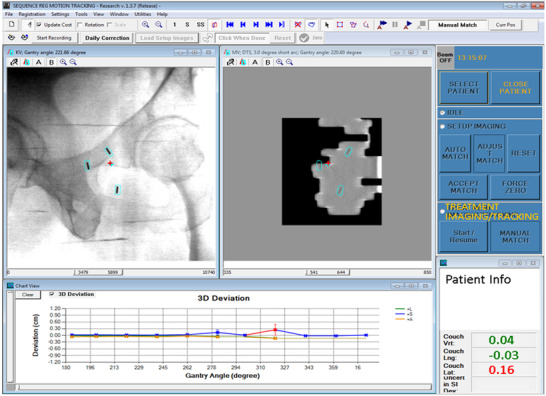
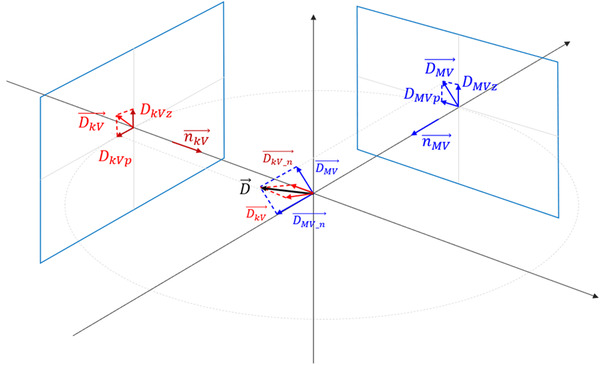
An MV-kV imaging-based fiducial tracking technique has been developed at our institute and become a standard clinical practice. This technique calculates three-dimensional (3D) fiducial displacement in real time from orthogonal kV and MV images acquired simultaneously. The patient will be repositioned if for two consecutive MV-kV data points, the motion is larger than a tolerance of 1.5 mm in any of the lateral, superior-inferior, and/or anterior-posterior directions. This study retrospectively analyzed detected 3D motions using an MV-kV approach of 324 patients who recently underwent prostate SBRT treatments. An algorithm was developed to recover the 2D motion components as if they were detected by kV or MV imaging alone.
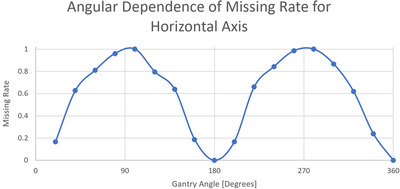
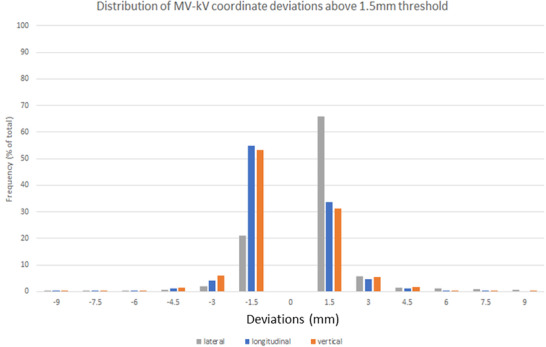
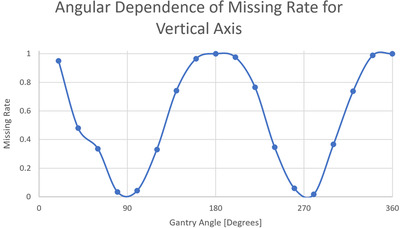
Our results indicated that out-of-tolerance motions were primarily limited to the range of 1.5-3 mm (>95%). The motions are primarily anterior-posterior and superior-inferior, with less than 14.8% of the occurrences in the lateral direction. Compared to out-of-tolerance occurrences detected by MV-kV approach, kV alone caught 46.6% of motions in all three directions, and MV alone caught 46.7%. kV alone shows an overall missing rate of 45.8% for superior-inferior motions and 38.6% for lateral motions. It is also demonstrated that the detectability of motion in specific directions greatly depends on gantry angles, as does the missing rate.
Our study demonstrated that MV-kV imaging-based intrafraction motion tracking is superior to single kV imaging for prostate SBRT in clinical practice.
由于前列腺立体定向体部放射治疗(SBRT)的分次剂量高且临近危及器官,因此运动管理至关重要。本研究通过对 300 多名接受 MV-kV 跟踪前列腺 SBRT 治疗的患者进行回顾性分析,旨在量化 MV-kV 跟踪优于单独千伏成像的优势。
我们所在的机构开发了一种基于 MV-kV 成像的基准点跟踪技术,该技术已成为一种标准的临床实践。该技术从同时获取的正交千伏和 MV 图像实时计算三维(3D)基准点位移。如果连续两个 MV-kV 数据点的运动在任何侧向、上下和/或前后方向上大于 1.5 毫米的容限,则患者将被重新定位。本研究回顾性分析了最近接受前列腺 SBRT 治疗的 324 名患者使用 MV-kV 方法检测到的 3D 运动。开发了一种算法来恢复 2D 运动分量,就像它们是由单独的千伏或 MV 成像检测到的一样。
我们的结果表明,超出容限的运动主要限于 1.5-3 毫米(>95%)范围内。运动主要是前后和上下方向的,只有不到 14.8%的发生在侧向方向上。与 MV-kV 方法检测到的超出容限的运动相比,单独的千伏在所有三个方向上捕捉到了 46.6%的运动,而单独的 MV 捕捉到了 46.7%。单独的千伏对上下方向的运动总体漏检率为 45.8%,对侧向运动的漏检率为 38.6%。还表明,运动在特定方向上的检测能力极大地取决于机架角度,漏检率也是如此。
本研究表明,在临床实践中,基于 MV-kV 成像的分次内运动跟踪对于前列腺 SBRT 优于单独的千伏成像。