Department of Cardiology, The 2nd Affiliated Hospital of Harbin Medical University, Harbin 150086, China; The Key Laboratory of Medical Ischemia, Chinese Ministry of Education, Harbin 150086, China.
Department of Life Sciences, Manchester Metropolitan University, Manchester M1 5GD, UK.
EBioMedicine. 2022 Apr;78:103964. doi: 10.1016/j.ebiom.2022.103964. Epub 2022 Mar 24.
Clonal haematopoiesis driven by mutations in DNMT3A or TET2 has recently been identified as a new risk factor for cardiovascular disease. Experimental studies suggest that these mutations may enhance inflammation which accelerates the disease progression. We aim to investigate the prevalence of mutations in DNMT3A and TET2 and their association with prognosis of patients with ST-segment elevation myocardial infarction (STEMI).
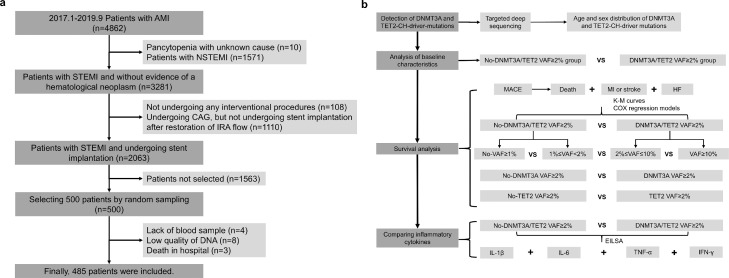
Targeted deep sequencing for DNMT3A and TET2 and inflammatory cytokines (IL-1β, IL-6, TNF-α, INF-γ) were analyzed in 485 patients with STEMI. Major adverse cardiac events (MACE) was a composite of death, myocardial infarction, stroke, or hospitalization due to heart failure.
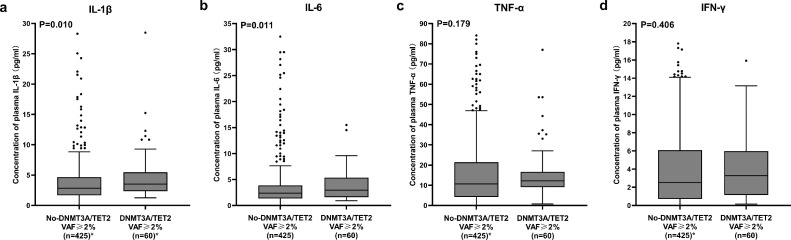
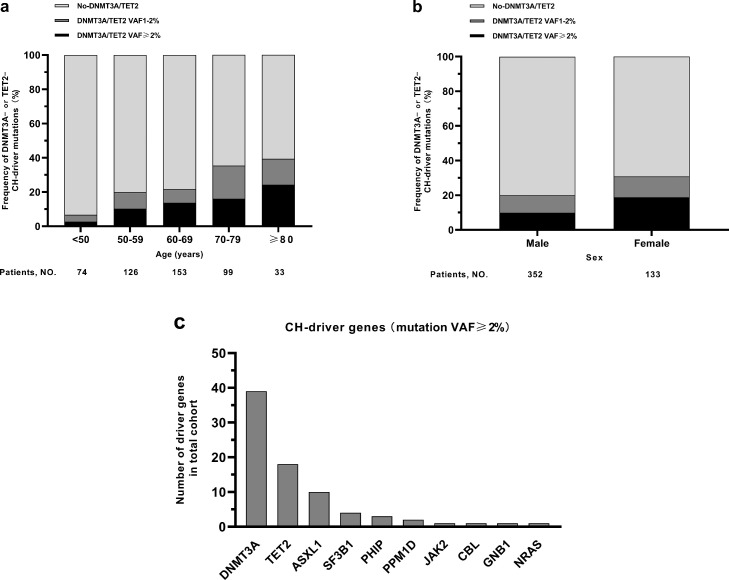
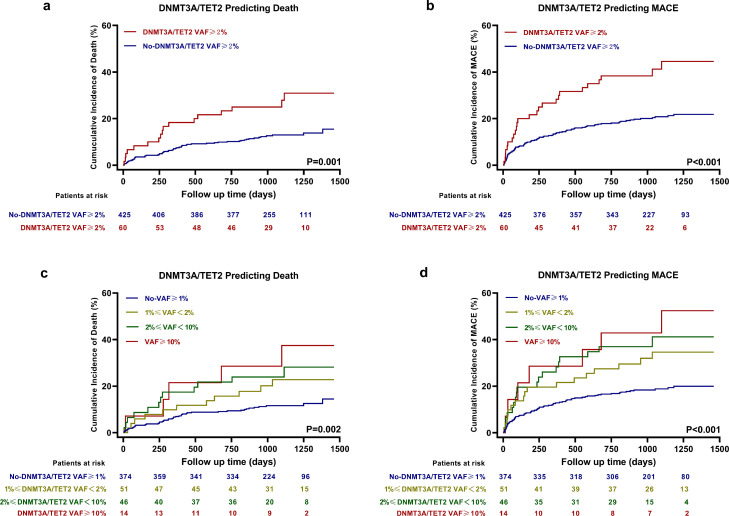
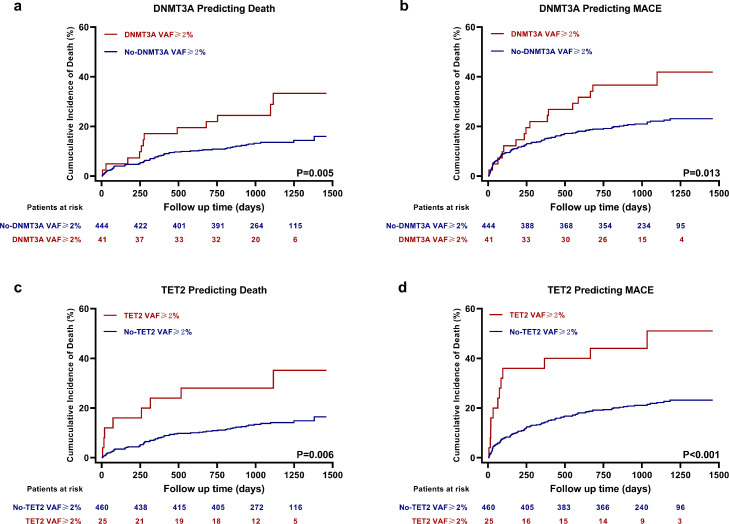
Patients carrying DNMT3A- or TET2-CH-driver mutations with a variant allele frequency (VAF) ≥2% were found in 12.4% (60 of 485) of STEMI patients and experienced an increased incidence of the death (30.9% vs 15.5%, P = 0.001) and MACE (44.5% vs 21.8%, P < 0.001) compared to those who did not, during a median follow up of 3.0 (interquartile range: 2.4-3.4) years. After adjusting for confounders, mutation remained an independent predictor of death (HR = 1.967, 95% CI 1.103-3.507, P = 0.022) and MACE (HR = 1.833, 95% CI 1.154-2.912, P = 0.010). Concentrations of plasma IL-1β (P = 0.010) and IL-6 (P = 0.011) were significantly elevated in DNMT3A/TET2 VAF≥2% group.
DNMT3A- or TET2-CH-driver mutations with a VAF≥2% were observed in over 10% STEMI patients, and were significantly associated with poorer prognosis, which might be explained by higher levels of inflammatory cytokines in mutations carriers.
National Natural Science Foundation of China; National Key R&D Program of China.
最近发现,DNMT3A 或 TET2 突变驱动的克隆性造血作用是心血管疾病的一个新的风险因素。实验研究表明,这些突变可能增强炎症,从而加速疾病进展。我们旨在研究 DNMT3A 和 TET2 突变的发生率及其与 ST 段抬高型心肌梗死(STEMI)患者预后的关系。
对 485 例 STEMI 患者进行了靶向深度测序以检测 DNMT3A 和 TET2 以及炎症细胞因子(IL-1β、IL-6、TNF-α、INF-γ)。主要不良心脏事件(MACE)是死亡、心肌梗死、卒中和因心力衰竭住院的复合终点。
在 485 例 STEMI 患者中,发现携带 DNMT3A 或 TET2-CH 驱动突变且等位基因变异频率(VAF)≥2%的患者占 12.4%(60 例),与未携带突变的患者相比,这些患者的死亡率(30.9%比 15.5%,P=0.001)和 MACE 发生率(44.5%比 21.8%,P<0.001)更高。在中位随访 3.0 年(四分位距:2.4-3.4)期间。在校正混杂因素后,突变仍然是死亡(HR=1.967,95%CI 1.103-3.507,P=0.022)和 MACE(HR=1.833,95%CI 1.154-2.912,P=0.010)的独立预测因素。DNMT3A/TET2 VAF≥2%组患者的血浆 IL-1β(P=0.010)和 IL-6(P=0.011)浓度显著升高。
在超过 10%的 STEMI 患者中观察到 DNMT3A 或 TET2-CH 驱动突变,且与预后不良显著相关,这可能是由于突变携带者中炎症细胞因子水平升高所致。
国家自然科学基金;国家重点研发计划。