Liao Hsiao-Mei, Liu Hebing, Chin Pei-Ju, Li Bingjie, Hung Guo-Chiuan, Tsai Shien, Otim Isaac, Legason Ismail D, Ogwang Martin D, Reynolds Steven J, Kerchan Patrick, Tenge Constance N, Were Pamela A, Kuremu Robert T, Wekesa Walter N, Masalu Nestory, Kawira Esther, Ayers Leona W, Pfeiffer Ruth M, Bhatia Kishor, Goedert James J, Lo Shyh-Ching, Mbulaiteye Sam M
Office of Tissues and Advanced Therapies, Center for Biologics Evaluation and Research, Food and Drug Administration, Silver Spring, MD, United States.
EMBLEM Study, St. Mary's Hospital, Lacor, Gulu & African Field Epidemiology Network, Kampala, Uganda.
Front Oncol. 2022 Mar 7;12:812224. doi: 10.3389/fonc.2022.812224. eCollection 2022.
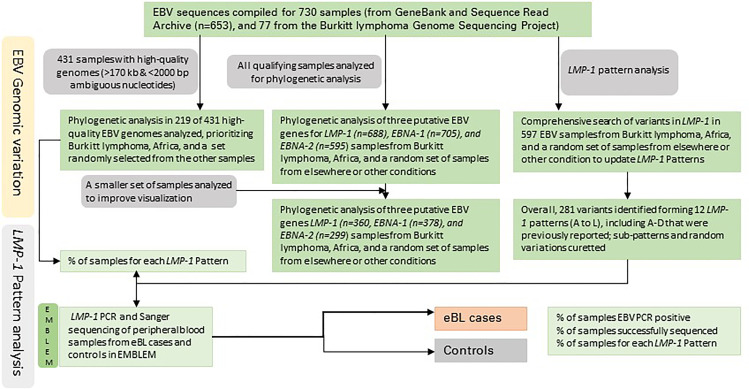
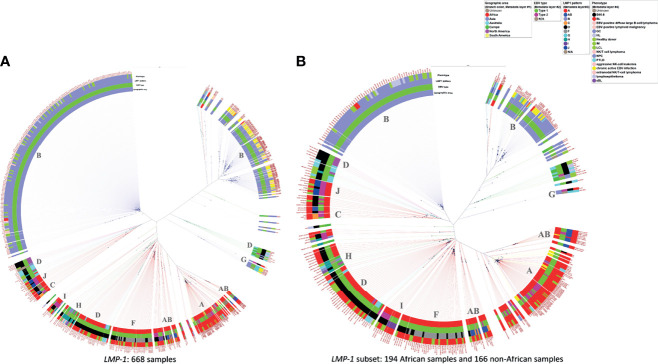
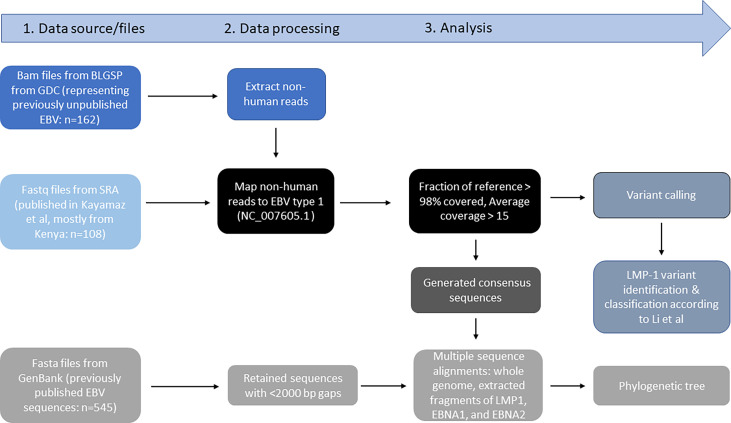
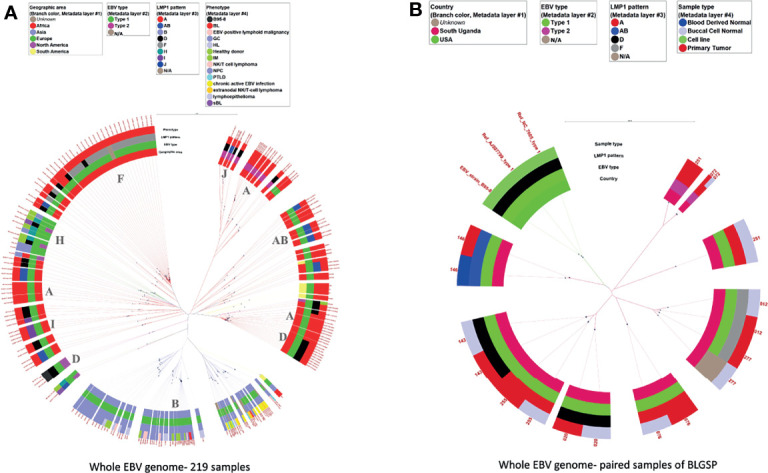
Epstein-Barr virus (EBV) is associated with endemic Burkitt lymphoma (eBL), but the contribution of EBV variants is ill-defined. Studies of EBV whole genome sequences (WGS) have identified phylogroups that appear to be distinct for Asian versus non-Asian EBV, but samples from BL or Africa, where EBV was first discovered, are under-represented. We conducted a phylogenetic analysis of EBV WGS and sequences obtained primarily from BL patients in Africa and representative non-African EBV from other conditions or regions using data from GenBank, Sequence Read Archive, or Genomic Data Commons for the Burkitt Lymphoma Genome Sequencing Project (BLGSP) to generate data to support the use of a simpler biomarker of geographic or phenotypic associations. We also investigated patterns in 414 eBL cases and 414 geographically matched controls in the Epidemiology of Burkitt Lymphoma in East African children and minors (EMBLEM) study using PCR and Sanger sequencing. Phylogenetic analysis revealed distinct genetic patterns of African versus Asian EBV sequences. We identified 281 single nucleotide variations (SNVs) in promoter and coding region, which formed 12 unique patterns (A to L). Nine patterns (A, AB, C, D, F, I, J, K and L) predominated in African EBV, of which four were found in 92% of BL samples (A, AB, D, and H). Predominant patterns were B and G in Asia and H in Europe. EBV positivity in peripheral blood was detected in 95.6% of EMBLEM eBL cases versus 79.2% of the healthy controls (odds ratio [OR] =3.83; 95% confidence interval 2.06-7.14). was successfully sequenced in 66.7% of the EBV DNA positive cases but in 29.6% of the controls (ORs ranging 5-11 for different patterns). Four patterns (A, AB, D, and K) were detected in 63.1% of the cases versus 27.1% controls (ORs ranges: 5.58-11.4). Dual strain EBV infections were identified in WGS and PCR-Sanger data. In conclusion, EBV from Africa is phylogenetically separate from EBV in Asia. Genetic diversity in formed 12 patterns, which showed promising geographic and phenotypic associations. Presence of multiple strain infection should be considered in efforts to refine or improve EBV markers of ancestry or phenotype.
Epstein-Barr virus (EBV) infection, a ubiquitous infection, contributes to the etiology of both Burkitt Lymphoma (BL) and nasopharyngeal carcinoma, yet their global distributions vary geographically with no overlap. Genomic variation in EBV is suspected to play a role in the geographical patterns of these EBV-associated cancers, but relatively few EBV samples from BL have been comprehensively studied. We sought to compare phylogenetic patterns of EBV genomes obtained from BL samples in Africa and from tumor and non-tumor samples from elsewhere. We concluded that EBV obtained from BL in Africa is genetically separate from EBV in Asia. Through comprehensive analysis of nucleotide variations in EBV's gene, we describe 12 patterns, two of which (B and G) were found mostly in Asia. Four patterns (A, AB, D, and F) accounted for 92% of EBVs sequenced from BL in Africa. Our results identified extensive diversity of EBV, but BL in Africa was associated with a limited number of variants identified, which were different from those identified in Asia. Further research is needed to optimize the use of PCR and sequencing to study diversity for classification of EBV variants and for use in epidemiologic studies to characterize geographic and/or phenotypic associations of EBV variants with EBV-associated malignancies, including eBL.
爱泼斯坦-巴尔病毒(EBV)与地方性伯基特淋巴瘤(eBL)相关,但EBV变异体的作用尚不明确。对EBV全基因组序列(WGS)的研究已经确定了似乎在亚洲与非亚洲EBV之间不同的系统发育群,但来自BL或非洲(EBV最初被发现的地方)的样本代表性不足。我们使用来自GenBank、序列读取存档库或基因组数据共享平台的伯基特淋巴瘤基因组测序项目(BLGSP)的数据,对EBV WGS以及主要从非洲的BL患者和来自其他疾病或地区的代表性非非洲EBV获得的序列进行了系统发育分析,以生成数据支持使用更简单的地理或表型关联生物标志物。我们还在东非儿童和未成年人伯基特淋巴瘤流行病学(EMBLEM)研究中,使用PCR和桑格测序法调查了414例eBL病例和414例地理匹配对照中的模式。系统发育分析揭示了非洲与亚洲EBV序列的不同遗传模式。我们在启动子和编码区鉴定出281个单核苷酸变异(SNV),它们形成了12种独特模式(A至L)。9种模式(A、AB、C、D、F、I、J、K和L)在非洲EBV中占主导,其中4种在92%的BL样本中被发现(A、AB、D和H)。亚洲的主要模式是B和G,欧洲的是H。EMBLEM eBL病例中95.6%的外周血EBV呈阳性,而健康对照中为79.2%(优势比[OR]=3.83;95%置信区间2.06 - 7.14)。在66.7%的EBV DNA阳性病例中成功测序,但在29.6%的对照中成功测序(不同模式的OR范围为5 - 11)。4种模式(A、AB、D和K)在63.1%的病例中被检测到,而对照中为27.1%(OR范围:5.58 - 11.4)。在WGS和PCR - 桑格数据中鉴定出双株EBV感染。总之,来自非洲的EBV在系统发育上与亚洲的EBV不同。的遗传多样性形成了12种模式,显示出有前景的地理和表型关联。在完善或改进EBV祖先或表型标志物的努力中,应考虑多株感染的存在。
爱泼斯坦-巴尔病毒(EBV)感染是一种普遍存在的感染,促成了伯基特淋巴瘤(BL)和鼻咽癌的病因,但它们的全球分布在地理上有所不同且无重叠。EBV的基因组变异被怀疑在这些EBV相关癌症的地理模式中起作用,但来自BL的EBV样本相对较少得到全面研究。我们试图比较从非洲的BL样本以及来自其他地方的肿瘤和非肿瘤样本中获得的EBV基因组的系统发育模式。我们得出结论,从非洲的BL中获得的EBV在基因上与亚洲的EBV不同。通过对EBV基因中核苷酸变异的全面分析,我们描述了12种模式,其中两种(B和G)主要在亚洲被发现。4种模式(A、AB、D和F)占从非洲BL中测序的EBV的92%。我们的结果确定了EBV的广泛多样性,但非洲的BL与有限数量的已鉴定变异相关,这些变异与在亚洲鉴定的不同。需要进一步研究以优化PCR和测序的使用,来研究多样性以对EBV变异体进行分类,并用于流行病学研究以表征EBV变异体与EBV相关恶性肿瘤(包括eBL)的地理和/或表型关联。