Gupta Anubhav, Furrer Reinhard, Petchey Owen L
Department of Evolutionary Biology and Environmental Studies University of Zurich Zurich Switzerland.
Department of Mathematics and Department of Computational Science University of Zurich Zurich Switzerland.
Ecol Evol. 2022 Mar 8;12(3):e8643. doi: 10.1002/ece3.8643. eCollection 2022 Mar.
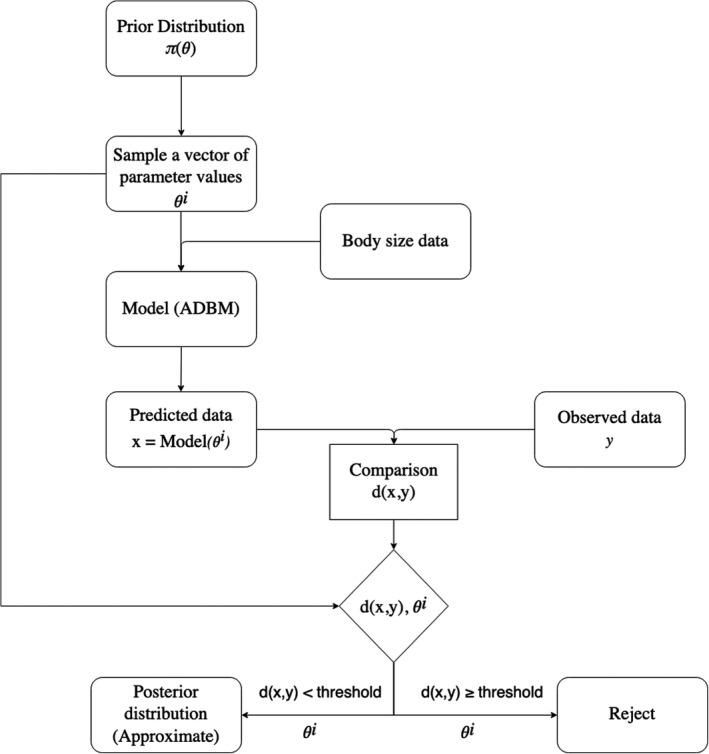
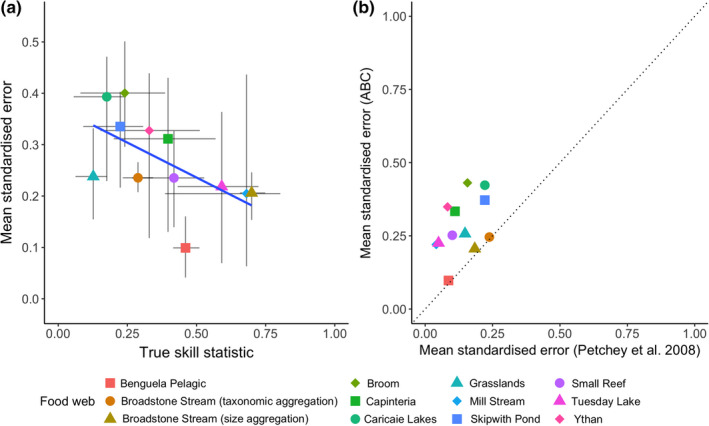
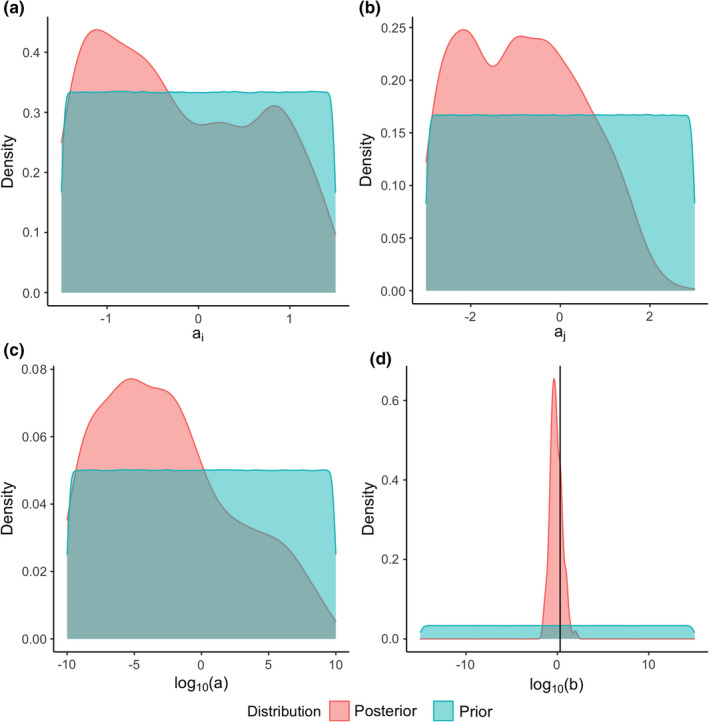
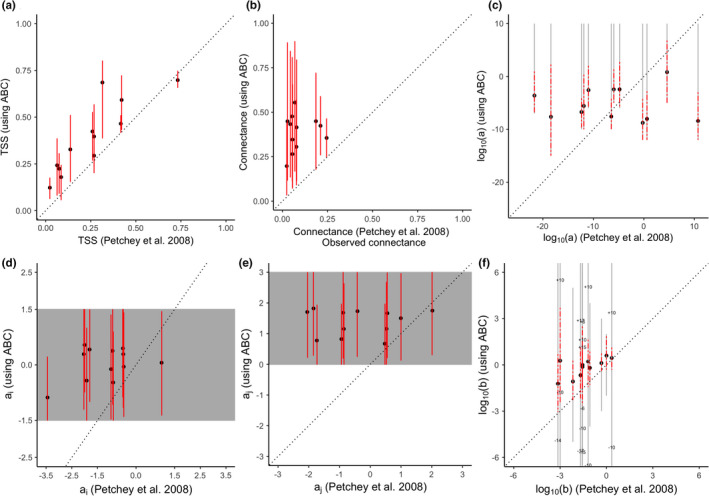
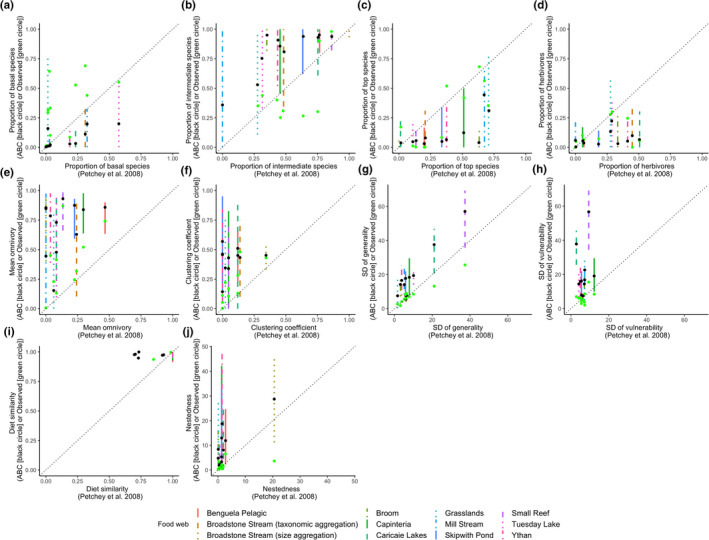
Food web models explain and predict the trophic interactions in a food web, and they can infer missing interactions among the organisms. The allometric diet breadth model (ADBM) is a food web model based on the foraging theory. In the ADBM, the foraging parameters are allometrically scaled to body sizes of predators and prey. In Petchey et al. (, 2008; 105: 4191), the parameterization of the ADBM had two limitations: (a) the model parameters were point estimates and (b) food web connectance was not estimated.The novelty of our current approach is: (a) We consider multiple predictions from the ADBM by parameterizing it with approximate Bayesian computation, to estimate parameter distributions and not point estimates. (b) Connectance emerges from the parameterization, by measuring model fit using the true skill statistic, which takes into account prediction of both the presences and absences of links.We fit the ADBM using approximate Bayesian computation to 12 observed food webs from a wide variety of ecosystems. Estimated connectance was consistently greater than previously found. In some of the food webs, considerable variation in estimated parameter distributions occurred and resulted in considerable variation (i.e., uncertainty) in predicted food web structure.These results lend weight to the possibility that the observed food web data is missing some trophic links that do actually occur. It also seems likely that the ADBM likely predicts some links that do not exist. The latter could be addressed by accounting in the ADBM for additional traits other than body size. Further work could also address the significance of uncertainty in parameter estimates for predicted food web responses to environmental change.
食物网模型用于解释和预测食物网中的营养相互作用,并且能够推断生物之间缺失的相互作用。异速生长饮食广度模型(ADBM)是一种基于觅食理论的食物网模型。在ADBM中,觅食参数根据捕食者和猎物的体型进行异速生长缩放。在佩奇等人(2008年;105:4191)的研究中,ADBM的参数化有两个局限性:(a)模型参数是点估计值;(b)未估计食物网的连通性。我们当前方法的新颖之处在于:(a)我们通过近似贝叶斯计算对ADBM进行参数化,考虑其多个预测结果,以估计参数分布而非点估计值。(b)通过使用真实技能统计量测量模型拟合度来确定连通性,该统计量考虑了对链接存在和不存在的预测。我们使用近似贝叶斯计算将ADBM应用于来自各种生态系统的12个观测到的食物网。估计的连通性始终高于先前发现的值。在一些食物网中,估计的参数分布出现了相当大的变化,并导致预测的食物网结构出现相当大的变化(即不确定性)。这些结果支持了这样一种可能性,即观测到的食物网数据缺失了一些实际存在的营养链接。ADBM似乎也可能预测了一些不存在的链接。后者可以通过在ADBM中考虑除体型之外的其他特征来解决。进一步的工作还可以探讨参数估计中的不确定性对预测食物网对环境变化响应的重要性。