Yang Ying, Zeng Chang, Yang Kun, Xu Shaohua, Zhang Zhou, Cai Qinyun, He Chuan, Zhang Wei, Liu Song-Mei
Department of Clinical Laboratory, Center for Gene Diagnosis & Program of Clinical Laboratory, Zhongnan Hospital of Wuhan University, Wuhan, Hubei Province, China.
Department of Preventive Medicine, Northwestern University Feinberg School of Medicine, Chicago, Illinois, USA.
Extracell Vesicles Circ Nucl Acids. 2022;3(1):49-60. doi: 10.20517/evcna.2022.03. Epub 2022 Mar 24.
Diabetic nephropathy (DN) has become the most common cause of end-stage renal disease (ESRD) in most countries. Elucidating novel epigenetic contributors to DN can not only enhance our understanding of this complex disorder, but also lay the foundation for developing more effective monitoring tools and preventive interventions in the future, thus contributing to our ultimate goal of improving patient care.
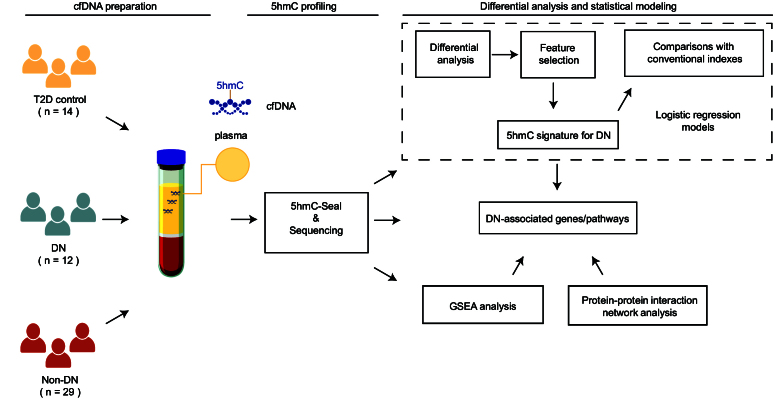
The 5hmC-Seal, a highly selective, chemical labeling technique, was used to profile genome-wide 5-hydroxymethylcytosines (5hmC), a stable cytosine modification type marking gene activation, in circulating cell-free DNA (cfDNA) samples from a cohort of patients recruited at Zhongnan Hospital, including T2D patients with nephropathy (DN, n = 12), T2D patients with non-DN vascular complications (non-DN, n = 29), and T2D patients without any complication (controls, n = 14). Differentially analysis was performed to find DN-associated 5hmC features, followed by the exploration of biomarker potential of 5hmC in cfDNA for DN using a machine learning approach.
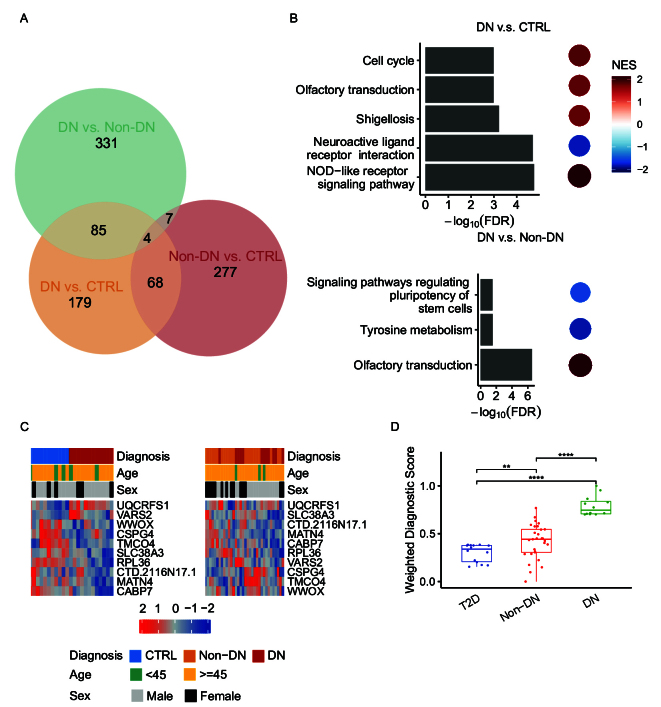
Genome-wide analyses of 5hmC in cfDNA detected 427 and 336 differential 5hmC modifications associated with DN, compared with non-DN individuals and controls, and suggested relevant pathways such as NOD-like receptor signaling pathway and tyrosine metabolism. Our exploration using a machine learning approach revealed an exploratory model comprised of ten 5hmC genes showing the possibility to distinguish DN from non-DN individuals or controls.
Genome-wide analysis suggests the possibility of exploiting novel 5hmC in patient-derived cfDNA as a non-invasive tool for monitoring DN in high risk T2D patients in the future.
在大多数国家,糖尿病肾病(DN)已成为终末期肾病(ESRD)最常见的病因。阐明DN新的表观遗传因素不仅能增进我们对这种复杂疾病的理解,还能为未来开发更有效的监测工具和预防性干预措施奠定基础,从而有助于实现我们改善患者护理的最终目标。
采用5hmC-Seal这一高度选择性的化学标记技术,对来自中南医院招募的一组患者的循环游离DNA(cfDNA)样本中的全基因组5-羟甲基胞嘧啶(5hmC)进行分析,5hmC是一种标记基因激活的稳定胞嘧啶修饰类型。这些患者包括患有肾病的2型糖尿病患者(DN,n = 12)、患有非DN血管并发症的2型糖尿病患者(非DN,n = 29)以及无任何并发症的2型糖尿病患者(对照组,n = 14)。进行差异分析以发现与DN相关的5hmC特征,随后使用机器学习方法探索cfDNA中5hmC对DN的生物标志物潜力。
与非DN个体和对照组相比,对cfDNA中5hmC的全基因组分析检测到427个和336个与DN相关的差异5hmC修饰,并提示了相关通路,如NOD样受体信号通路和酪氨酸代谢。我们使用机器学习方法进行的探索揭示了一个由十个5hmC基因组成的探索性模型,该模型显示出区分DN与非DN个体或对照组的可能性。
全基因组分析表明,未来有可能利用患者来源的cfDNA中的新型5hmC作为监测高危2型糖尿病患者DN的非侵入性工具。