Department of Internal Medicine, Hematology-Oncology, Tufts Medical Center Cancer Center, Stoneham, Massachusetts.
Division of Hematology/Oncology, Department of Medicine, Vanderbilt University, Nashville, Tennessee.
JAMA Netw Open. 2022 Mar 1;5(3):e224304. doi: 10.1001/jamanetworkopen.2022.4304.
Non-Hispanic Black individuals experience a higher burden of COVID-19 than the general population; hence, there is an urgent need to characterize the unique clinical course and outcomes of COVID-19 in Black patients with cancer.
To investigate racial disparities in severity of COVID-19 presentation, clinical complications, and outcomes between Black patients and non-Hispanic White patients with cancer and COVID-19.
DESIGN, SETTING, AND PARTICIPANTS: This retrospective cohort study used data from the COVID-19 and Cancer Consortium registry from March 17, 2020, to November 18, 2020, to examine the clinical characteristics and outcomes of COVID-19 in Black patients with cancer. Data analysis was performed from December 2020 to February 2021.
Black and White race recorded in patient's electronic health record.
An a priori 5-level ordinal scale including hospitalization intensive care unit admission, mechanical ventilation, and all-cause death.
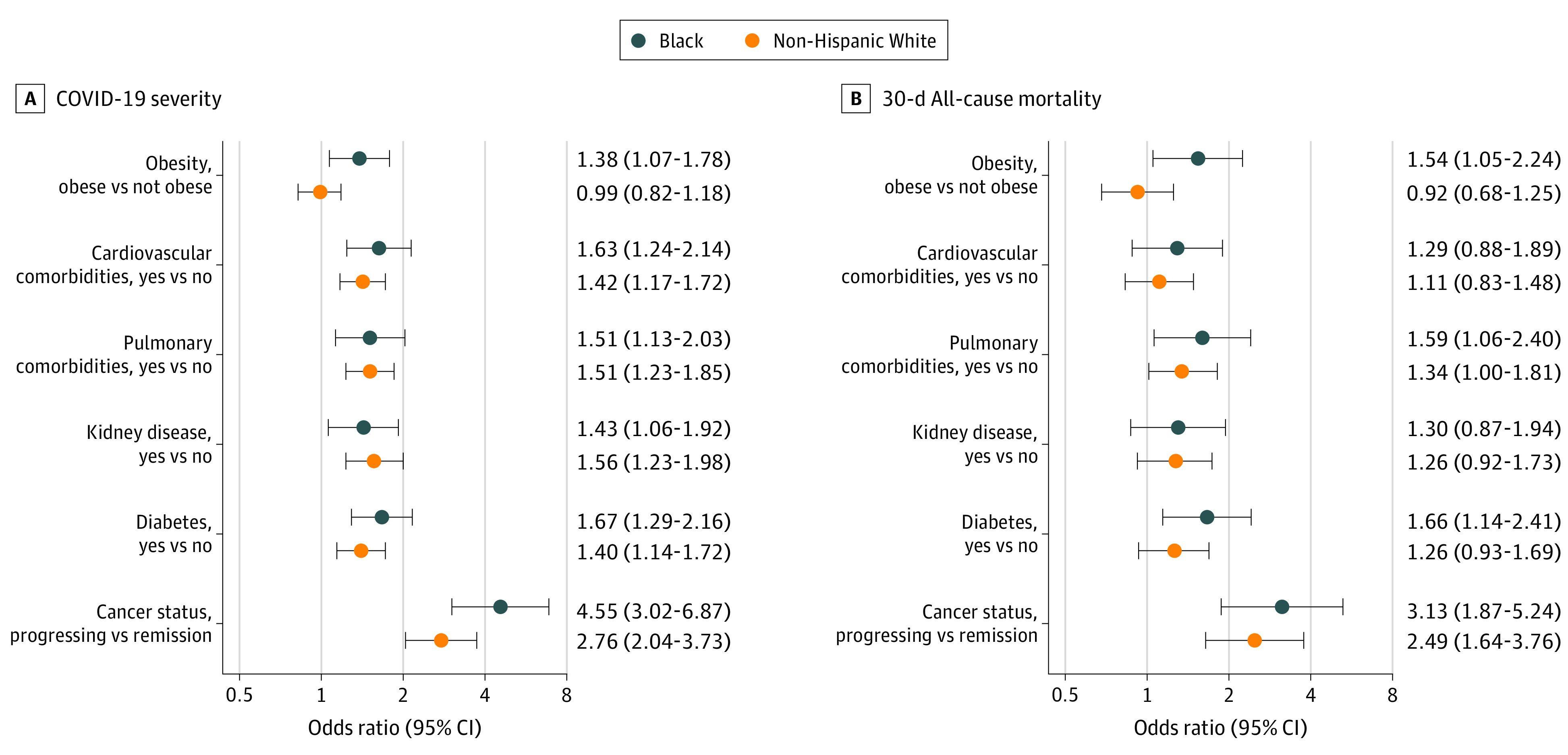
Among 3506 included patients (1768 women [50%]; median [IQR] age, 67 [58-77] years), 1068 (30%) were Black and 2438 (70%) were White. Black patients had higher rates of preexisting comorbidities compared with White patients, including obesity (480 Black patients [45%] vs 925 White patients [38%]), diabetes (411 Black patients [38%] vs 574 White patients [24%]), and kidney disease (248 Black patients [23%] vs 392 White patients [16%]). Despite the similar distribution of cancer type, cancer status, and anticancer therapy at the time of COVID-19 diagnosis, Black patients presented with worse illness and had significantly worse COVID-19 severity (unweighted odds ratio, 1.34 [95% CI, 1.15-1.58]; weighted odds ratio, 1.21 [95% CI, 1.11-1.33]).
These findings suggest that Black patients with cancer experience worse COVID-19 outcomes compared with White patients. Understanding and addressing racial inequities within the causal framework of structural racism is essential to reduce the disproportionate burden of diseases, such as COVID-19 and cancer, in Black patients.
非西班牙裔黑种人比一般人群更容易受到 COVID-19 的影响;因此,迫切需要描述 COVID-19 黑人患者的独特临床过程和结果。
研究 COVID-19 黑人患者和非西班牙裔白种人患者之间 COVID-19 严重程度、临床并发症和结局的种族差异。
设计、设置和参与者:本回顾性队列研究使用了 2020 年 3 月 17 日至 2020 年 11 月 18 日 COVID-19 和癌症联合会登记处的数据,以检查黑人癌症患者 COVID-19 的临床特征和结局。数据分析于 2020 年 12 月至 2021 年 2 月进行。
患者电子病历中记录的黑人和白种人种族。
一个事先设定的 5 级有序量表,包括住院、重症监护病房入院、机械通气和全因死亡。
在 3506 名纳入的患者(1768 名女性[50%];中位数[IQR]年龄,67[58-77]岁)中,1068 名(30%)为黑人,2438 名(70%)为白人。黑人患者比白人患者有更高的合并症发生率,包括肥胖症(480 名黑人患者[45%]与 925 名白人患者[38%])、糖尿病(411 名黑人患者[38%]与 574 名白人患者[24%])和肾脏疾病(248 名黑人患者[23%]与 392 名白人患者[16%])。尽管 COVID-19 诊断时癌症类型、癌症状况和抗癌治疗的分布相似,但黑人患者的病情更严重,COVID-19 严重程度明显更差(未加权比值比,1.34[95%CI,1.15-1.58];加权比值比,1.21[95%CI,1.11-1.33])。
这些发现表明,与白人患者相比,黑人癌症患者的 COVID-19 结局更差。在结构种族主义的因果框架内理解和解决种族不平等问题,对于减少 COVID-19 和癌症等疾病在黑人患者中的不成比例负担至关重要。