Beller Johannes, Schäfers Jürgen, Haier Jörg, Geyer Siegfried, Epping Jelena
Hannover Medical School, Carl-Neuberg-Str. 1, 30625 Hannover, Germany.
Z Gesundh Wiss. 2022 Mar 24:1-10. doi: 10.1007/s10389-022-01705-3.
We examined predictors of trust in the healthcare system during the COVID-19 pandemic in 27 European countries.
We used population-based data drawn from the Living, working and COVID-19 survey ( = 21,884, 52% female, ages 18 to 92 years) covering 27 European countries dated June and July 2020. Multilevel linear regression, linear regression, and regression-tree analyses were conducted.
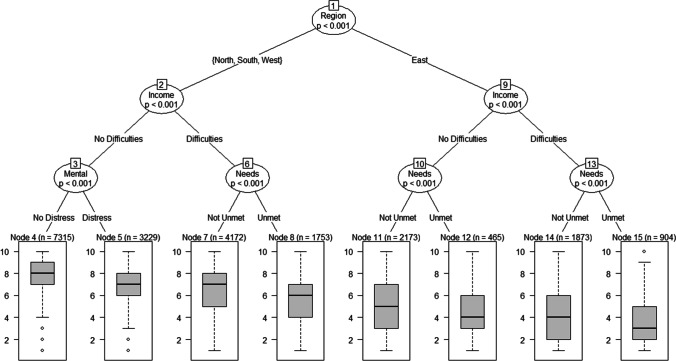
We found that most participants tended to trust the healthcare system, although a substantial part could still be classified as distrusting (approx. 21%). Multiple variables, including being middle-aged or of older age, being female, lower levels of education, unemployment, worse general health status, having income difficulties, having unmet needs for healthcare, no healthcare contact during the COVID-19 pandemic, higher mental distress, and loneliness, were significantly associated with lower levels of trust. Among these variables mental distress, income difficulties, and unmet needs for healthcare emerged as especially important and, across European regions and countries, consistent predictors for lower trust in the healthcare system during the COVID-19 pandemic.
Medically vulnerable subgroups, such as individuals with unmet healthcare needs, higher levels of mental distress, and older age, as well as people living in socially and economically vulnerable situations, such as higher levels of loneliness and financial difficulties, were the least trusting of the healthcare system during the COVID-19 pandemic. As these vulnerable subgroups are also at highest risk for contracting COVID-19 and experiencing negative COVID-19-related outcomes, more targeted prevention and intervention efforts should be implemented in these groups.
The online version contains supplementary material available at 10.1007/s10389-022-01705-3.
我们研究了27个欧洲国家在新冠疫情期间民众对医疗体系信任度的预测因素。
我们使用了来自“生活、工作与新冠疫情”调查的基于人群的数据(样本量=21884,女性占52%,年龄在18至92岁之间),该调查涵盖了2020年6月和7月的27个欧洲国家。进行了多水平线性回归、线性回归和回归树分析。
我们发现,尽管仍有相当一部分人(约21%)可被归类为不信任,但大多数参与者倾向于信任医疗体系。多个变量与较低的信任度显著相关,包括中年或老年、女性、教育程度较低、失业、总体健康状况较差、有收入困难、医疗需求未得到满足、在新冠疫情期间没有医疗接触、较高的心理困扰以及孤独感。在这些变量中,心理困扰、收入困难和医疗需求未得到满足显得尤为重要,并且在欧洲各地区和国家中,都是新冠疫情期间对医疗体系信任度较低的一致预测因素。
在新冠疫情期间,医疗上易受伤害的亚群体,如医疗需求未得到满足、心理困扰程度较高以及年龄较大的个体,以及处于社会和经济脆弱状况的人群,如孤独感较强和经济困难的人群,对医疗体系的信任度最低。由于这些脆弱亚群体感染新冠病毒并出现与新冠相关负面结果的风险也最高,因此应针对这些群体开展更具针对性的预防和干预措施。
在线版本包含可在10.1007/s10389-022-01705-3获取的补充材料。