Department of Pharmacy, The Second Xiangya Hospital, Central South University, Changsha, China.
Hunan Provincial Engineering Research Centre of Translational Medicine and Innovative Drug, Changsha, China.
J Immunother Cancer. 2022 Mar;10(3). doi: 10.1136/jitc-2021-004026.
Immune checkpoint blockade (ICB) targeting programmed death ligand-1 (PD-L1)/programmed cell death protein-1 (PD-1) pathway has become an attractive strategy for cancer treatment; however, unsatisfactory efficacy has limited its clinical benefits. Therefore, a more comprehensive understanding of the regulation of PD-L1 expression is essential for developing more effective cancer immunotherapy. Recent studies have revealed the important roles of eukaryotic elongation factor 2 kinase (eEF2K) in promoting epithelial-mesenchymal transition (EMT), angiogenesis, tumor cell migration and invasion; nevertheless, the exact role of eEF2K in the regulation of tumor immune microenvironment (TIME) remains largely unknown.
In this study, we used a cohort of 38 patients with melanoma who received anti-PD-1 treatment to explore the association between eEF2K expression and immunotherapy efficacy against melanoma. Immunoprecipitation-mass spectrometry analysis and in vitro assays were used to examine the role and molecular mechanism of eEF2K in regulating PD-L1 expression. We also determined the effects of eEF2K on tumor growth and cytotoxicity of CD8 T cells in TIME in a mouse melanoma model. We further investigated the efficacy of the eEF2K inhibition in combination with anti-PD-1 treatment in vivo.
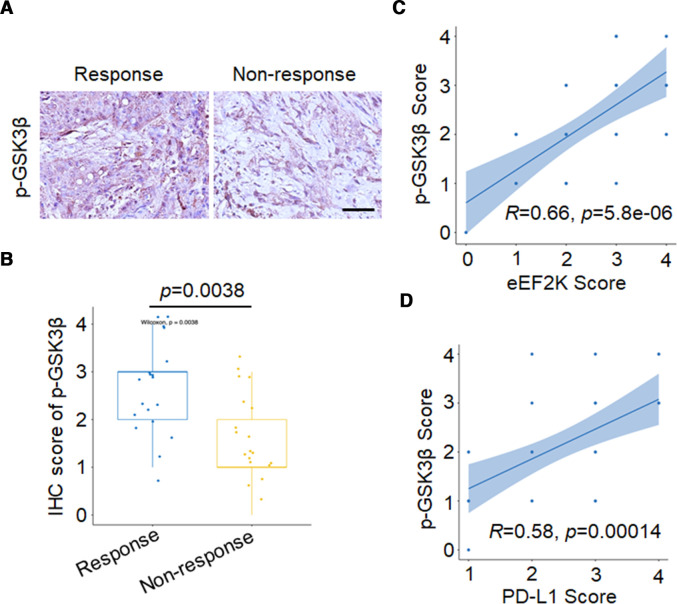
High eEF2K expression is correlated with better therapeutic response and longer survival in patients with melanoma treated with PD-1 monoclonal antibody (mAb). Moreover, eEF2K protein expression is positively correlated with PD-L1 protein expression. Mechanistically, eEF2K directly bound to and inactivated glycogen synthase kinase 3 beta (GSK3β) by phosphorylating it at serine 9 (S9), leading to PD-L1 protein stabilization and upregulation, and subsequently tumor immune evasion. Knockdown of eEF2K decreased PD-L1 expression and enhanced CD8 T cell activity, thus dramatically attenuating murine B16F10 melanoma growth in vivo. Clinically, p-GSK3β/S9 expression is positively correlated with the expressions of eEF2K and PD-L1, and the response to anti-PD-1 immunotherapy. Furthermore, eEF2K inhibitor, NH125 treatment or eEF2K knockdown enhanced the efficacy of PD-1 mAb therapy in a melanoma mouse model.
Our results suggest that eEF2K may serve as a biomarker for predicting therapeutic response and prognosis in patients receiving anti-PD-1 therapy, reveal a vital role of eEF2K in regulating TIME by controlling PD-L1 expression and provide a potential combination therapeutic strategy of eEF2K inhibition with ICB therapy.
针对程序性死亡配体 1(PD-L1)/程序性细胞死亡蛋白 1(PD-1)通路的免疫检查点阻断(ICB)已成为癌症治疗的一种有吸引力的策略;然而,疗效不佳限制了其临床获益。因此,更全面地了解 PD-L1 表达的调控对于开发更有效的癌症免疫疗法至关重要。最近的研究表明,真核延伸因子 2 激酶(eEF2K)在促进上皮-间充质转化(EMT)、血管生成、肿瘤细胞迁移和侵袭方面发挥着重要作用;然而,eEF2K 在肿瘤免疫微环境(TIME)调节中的确切作用在很大程度上尚不清楚。
在这项研究中,我们使用了一组接受抗 PD-1 治疗的 38 名黑色素瘤患者的队列,以探讨 eEF2K 表达与抗黑色素瘤免疫治疗疗效之间的关系。免疫沉淀-质谱分析和体外实验用于研究 eEF2K 在调节 PD-L1 表达中的作用和分子机制。我们还在小鼠黑色素瘤模型中确定了 eEF2K 对 TIME 中肿瘤生长和 CD8 T 细胞细胞毒性的影响。我们进一步研究了 eEF2K 抑制与抗 PD-1 治疗联合在体内的疗效。
高表达 eEF2K 与接受 PD-1 单克隆抗体(mAb)治疗的黑色素瘤患者的治疗反应更好和生存时间更长相关。此外,eEF2K 蛋白表达与 PD-L1 蛋白表达呈正相关。在机制上,eEF2K 通过磷酸化丝氨酸 9(S9)直接与糖原合酶激酶 3β(GSK3β)结合并使其失活,导致 PD-L1 蛋白稳定和上调,从而逃避肿瘤免疫。eEF2K 敲低降低了 PD-L1 表达并增强了 CD8 T 细胞的活性,从而显著抑制了体内 B16F10 黑色素瘤的生长。临床上,p-GSK3β/S9 的表达与 eEF2K 和 PD-L1 的表达呈正相关,与抗 PD-1 免疫治疗的反应相关。此外,eEF2K 抑制剂 NH125 治疗或 eEF2K 敲低增强了黑色素瘤小鼠模型中 PD-1 mAb 治疗的疗效。
我们的结果表明,eEF2K 可作为预测接受抗 PD-1 治疗的患者治疗反应和预后的生物标志物,揭示了 eEF2K 通过控制 PD-L1 表达在调节 TIME 中的重要作用,并提供了一种将 eEF2K 抑制与 ICB 治疗相结合的潜在联合治疗策略。