School of Medicine, South China University of Technology, Guangzhou, 510006, China.
Guangdong Provincial People's Hospital, Guangdong Academy of Medical Sciences, Guangdong Provincial Geriatrics Institute, Guangzhou, 510080, China.
Sleep Breath. 2023 Mar;27(1):205-212. doi: 10.1007/s11325-022-02599-x. Epub 2022 Mar 26.
Due to the lack of an objective population-based screening tool for obstructive sleep apnea (OSA), a large number of patients with potential OSA have not been identified in the general population. Our study compared an objective wearable sleep monitoring device with polysomnography (PSG) to provide a reference for OSA screening in a large population.
Using a self-control method, patients admitted to our sleep center from July 2020 to March 2021 were selected for overnight PSG and wearable intelligent sleep monitor (WISM) at the same time. The sensitivity and specificity of the device for the diagnosis of OSA were evaluated.
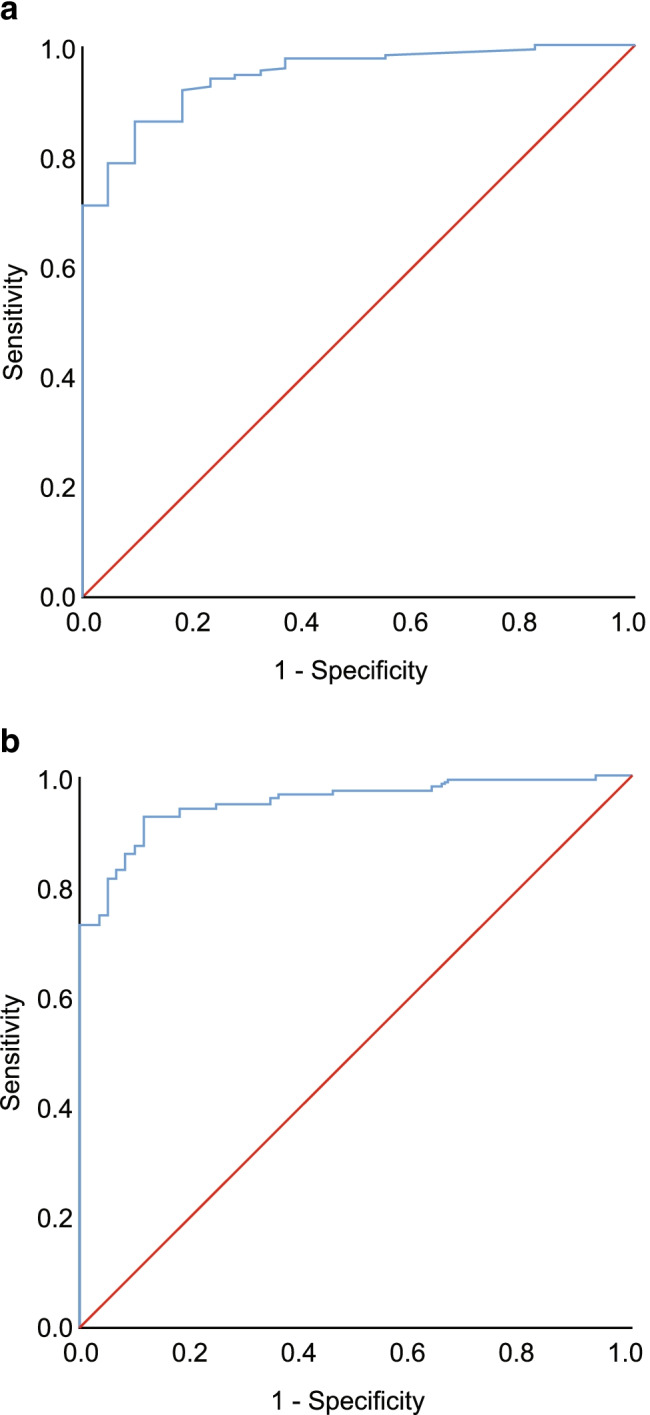
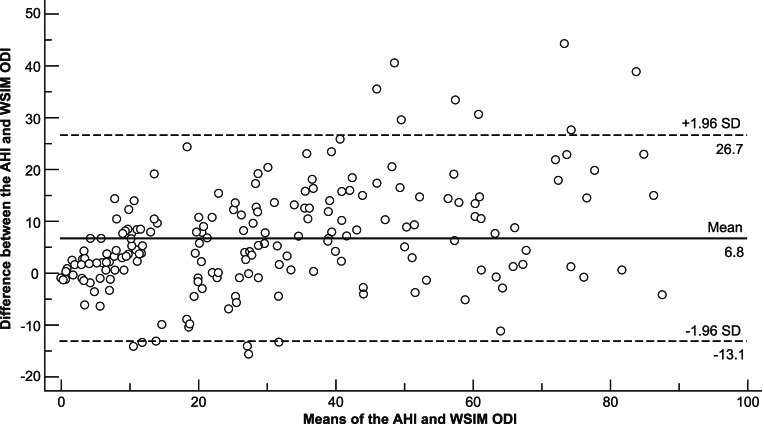
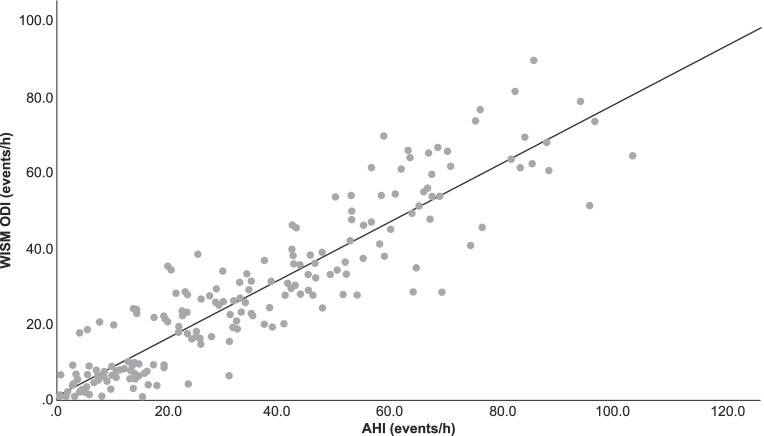
A total of 196 participants (mean age: 45.1 ± 12.3 years [18-80 years]; 168 men [86%]) completed both PSG and WISM monitoring. Using an apnea-hypopnea index (AHI) ≥ 5 events/h as the diagnostic criterion, the sensitivity, specificity, kappa value, and area under the receiver operating characteristic curve of the WISM for OSA diagnosis were 93%, 77%, 0.6, and 0.95, respectively. Using an AHI ≥ 15 events/h as the diagnostic criterion for moderate-to-severe OSA, these values were 92%, 89%, 0.8, and 0.95, respectively. The mean difference in the AHI between PSG and the artificial intelligence oxygen desaturation index from the WISM was 6.8 events/h (95% confidence interval: - 13.1 to 26.7).
Compared with the PSG, WISM exhibits good sensitivity and specificity for the diagnosis of OSA. This small, simple, and easy-to-use device is more suitable for OSA screening in a large population because of its single-step application procedure.
由于缺乏客观的阻塞性睡眠呼吸暂停(OSA)人群筛查工具,大量有潜在 OSA 的患者在普通人群中未被发现。本研究比较了一种客观的可穿戴睡眠监测设备与多导睡眠图(PSG),为在大人群中进行 OSA 筛查提供参考。
采用自身对照法,选取 2020 年 7 月至 2021 年 3 月期间我院睡眠中心收治的患者,同时行 overnight PSG 和可穿戴智能睡眠监测仪(WISM)监测。评估该设备诊断 OSA 的灵敏度和特异度。
共 196 名参与者(平均年龄:45.1±12.3 岁[18-80 岁];男 168 例[86%])完成了 PSG 和 WISM 监测。以呼吸暂停低通气指数(AHI)≥5 次/小时为诊断标准,WISM 诊断 OSA 的灵敏度、特异度、kappa 值和受试者工作特征曲线下面积分别为 93%、77%、0.6 和 0.95。以 AHI≥15 次/小时为中重度 OSA 的诊断标准,这些值分别为 92%、89%、0.8 和 0.95。PSG 与 WISM 人工智能氧减指数之间的 AHI 平均差值为 6.8 次/小时(95%可信区间:-13.1 至 26.7)。
与 PSG 相比,WISM 对 OSA 的诊断具有较好的灵敏度和特异度。这种小巧、简单、易于使用的设备由于其单步应用程序,更适合大人群的 OSA 筛查。