Villarreal-Zegarra David, Alarcon-Ruiz Christoper A, Melendez-Torres G J, Torres-Puente Roberto, Navarro-Flores Alba, Cavero Victoria, Ambrosio-Melgarejo Juan, Rojas-Vargas Jefferson, Almeida Guillermo, Albitres-Flores Leonardo, Romero-Cabrera Alejandra B, Huarcaya-Victoria Jeff
Escuela de Medicina, Universidad César Vallejo, Trujillo, Peru.
Dirección de Investigación, Desarrollo e Innovación, Instituto Peruano de Orientación Psicológica, Lima, Peru.
JMIR Ment Health. 2022 Mar 29;9(3):e34760. doi: 10.2196/34760.
The use of technologies has served to reduce gaps in access to treatment, and digital health interventions show promise in the care of mental health problems. However, to understand what and how these interventions work, it is imperative to document the aspects related to their challenging implementation.
The aim of this study was to determine what evidence is available for synchronous digital mental health implementation and to develop a framework, informed by a realist review, to explain what makes digital mental health interventions work for people with mental health problems.
The SPIDER (Sample, Phenomenon of Interest, Design, Evaluation, and Research type) framework was used to develop the following review question: What makes digital mental health interventions with a synchronous component work on people with mental health problems, including depression, anxiety, or stress, based on implementation, economic, quantitative, qualitative, and mixed methods studies? The MEDLINE, EBM Reviews, PsycINFO, EMBASE, SCOPUS, CINAHL Complete, and Web of Science databases were searched from January 1, 2015, to September 2020 with no language restriction. A Measurement Tool to Assess Systematic Reviews-2 (AMSTAR-2) was used to assess the risk of bias and Confidence in Evidence from Reviews of Qualitative Research (CERQual) was used to assess the confidence in cumulative evidence. Realist synthesis analysis allowed for developing a framework on the implementation of synchronous digital mental health using a grounded-theory approach with an emergent approach.
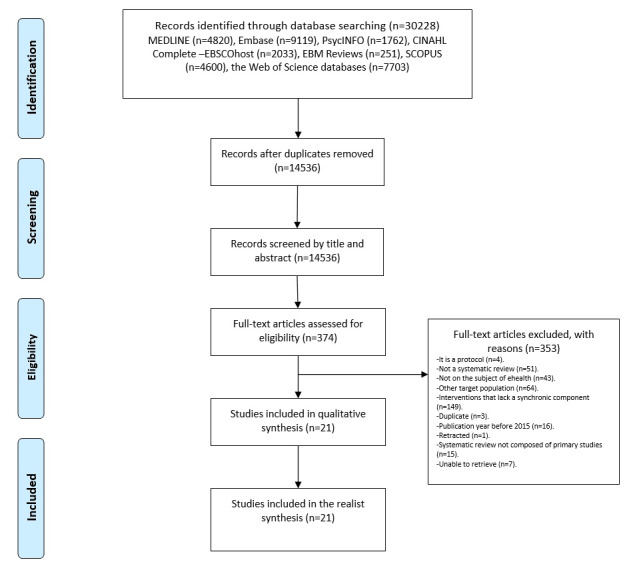
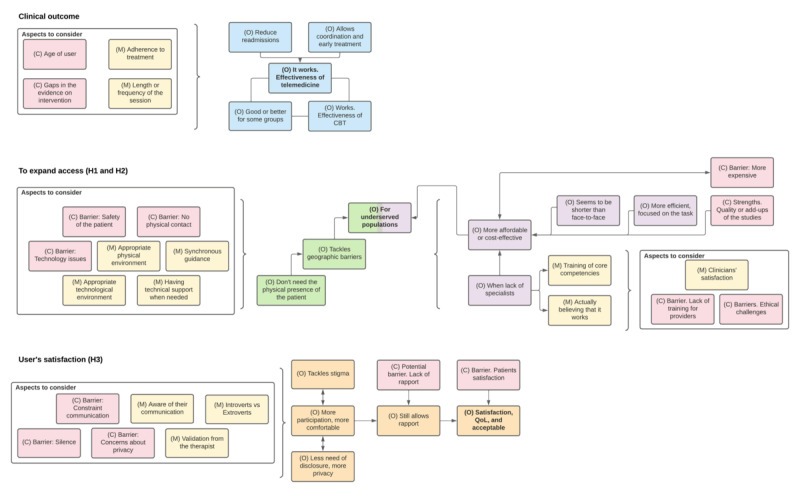
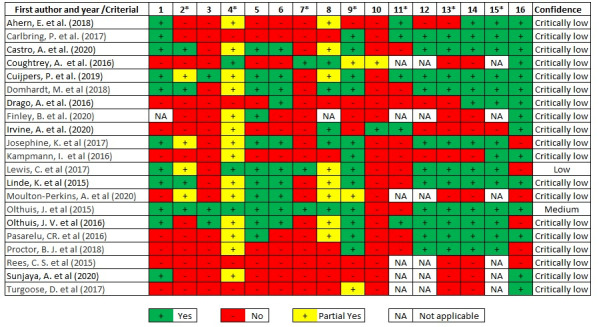
A total of 21 systematic reviews were included in the study. Among these, 90% (n=19) presented a critically low confidence level as assessed with AMSTAR-2. The realist synthesis allowed for the development of three hypotheses to identify the context and mechanisms in which these interventions achieve these outcomes: (1) these interventions reach populations otherwise unable to have access because they do not require the physical presence of the therapist nor the patient, thereby tackling geographic barriers posed by in-person therapy; (2) these interventions reach populations otherwise unable to have access because they can be successfully delivered by nonspecialists, which makes them more cost-effective to implement in health services; and (3) these interventions are acceptable and show good results in satisfaction because they require less need of disclosure and provide more privacy, comfortability, and participation, enabling the establishment of rapport with the therapist.
We developed a framework with three hypotheses that explain what makes digital mental health interventions with a synchronous component work on people with mental health problems. Each hypothesis represents essential outcomes in the implementation process.
PROSPERO International Prospective Register of Systematic Reviews CRD42020203811; https://www.crd.york.ac.uk/prospero/display_record.php?ID=CRD42020203811.
INTERNATIONAL REGISTERED REPORT IDENTIFIER (IRRID): RR2-10.12688/f1000research.27150.2.
技术的应用有助于缩小治疗可及性方面的差距,数字健康干预在心理健康问题的护理中显示出前景。然而,为了理解这些干预措施的作用内容及方式,记录与其具有挑战性的实施相关的方面至关重要。
本研究的目的是确定关于同步数字心理健康实施有哪些可用证据,并在实证主义综述的基础上制定一个框架,以解释数字心理健康干预对有心理健康问题的人有效的原因。
采用SPIDER(样本、感兴趣现象、设计、评估和研究类型)框架来制定以下综述问题:基于实施、经济、定量、定性和混合方法研究,具有同步组件的数字心理健康干预对有心理健康问题(包括抑郁、焦虑或压力)的人有效的原因是什么?检索了MEDLINE、循证医学综述、心理学文摘数据库、荷兰医学文摘数据库、Scopus数据库、护理学与健康领域数据库以及科学引文索引数据库,检索时间范围为2015年1月1日至2020年9月,无语言限制。使用评估系统评价的测量工具2(AMSTAR - 2)评估偏倚风险,使用定性研究综述证据的可信度(CERQual)评估累积证据的可信度。实证主义综合分析允许使用扎根理论方法和涌现方法来制定关于同步数字心理健康实施的框架。
该研究共纳入21项系统评价。其中,90%(n = 19)的研究在使用AMSTAR - 2评估时呈现出极低的置信水平。实证主义综合分析允许制定三个假设,以确定这些干预措施实现这些结果的背景和机制:(1)这些干预措施能够覆盖那些原本因不需要治疗师和患者同时在场而无法获得治疗的人群,从而解决了面对面治疗所带来的地理障碍;(2)这些干预措施能够覆盖那些原本因非专业人员也能成功实施而无法获得治疗的人群,这使得它们在卫生服务中的实施更具成本效益;(3)这些干预措施是可接受的,并且在满意度方面显示出良好的效果,因为它们需要较少的自我披露,提供了更多的隐私、舒适度和参与度,从而能够与治疗师建立融洽的关系。
我们制定了一个包含三个假设的框架,该框架解释了具有同步组件的数字心理健康干预对有心理健康问题的人有效的原因。每个假设代表了实施过程中的关键结果。
国际系统评价前瞻性注册库PROSPERO,注册号CRD42020203811;https://www.crd.york.ac.uk/prospero/display_record.php?ID = CRD42020203811。
国际注册报告标识符(IRRID):RR2 - 10.12688/f1000research.27150.2。