Mayo Clinic Cancer Center, Phoenix, AZ, USA.
Clinical Trials and Biostatistics, Mayo Clinic, Phoenix, AZ, USA.
Oncologist. 2022 Jul 5;27(7):573-578. doi: 10.1093/oncolo/oyac049.
Pancreatic neuroendocrine tumors (pNETs) are rare cancers with outcomes determined by multiple factors including grade, stage, and clinical presentation. In this study, we aimed to determine the prognosis of patients with pNETs using a large population-based database.
In this population-based study, we identified patients with pNETs from the SEER 18 registry (2000-2016) using a combination of ICD-O-3 and histology codes. We calculated age-adjusted incidence rates using SEER*Stat 8.3.5. In addition, we analyzed overall survival (OS) using the Kaplan-Meier method, and investigated prognostic factors using a multivariable Cox proportional hazards model.
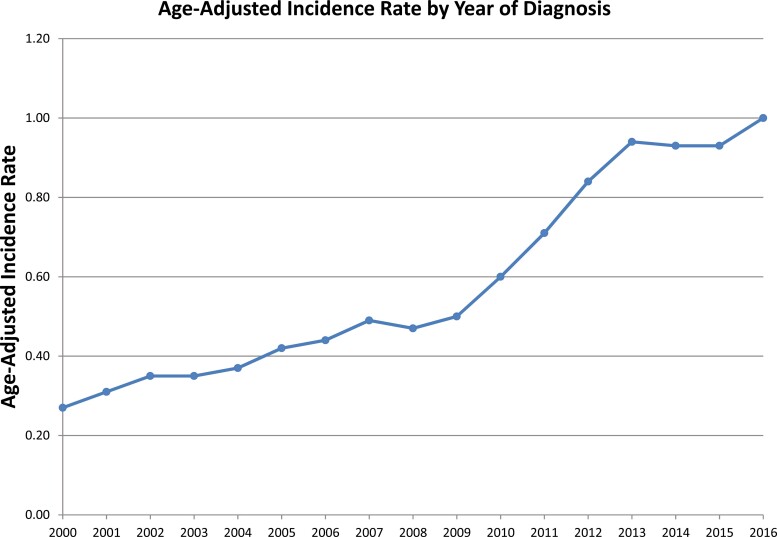
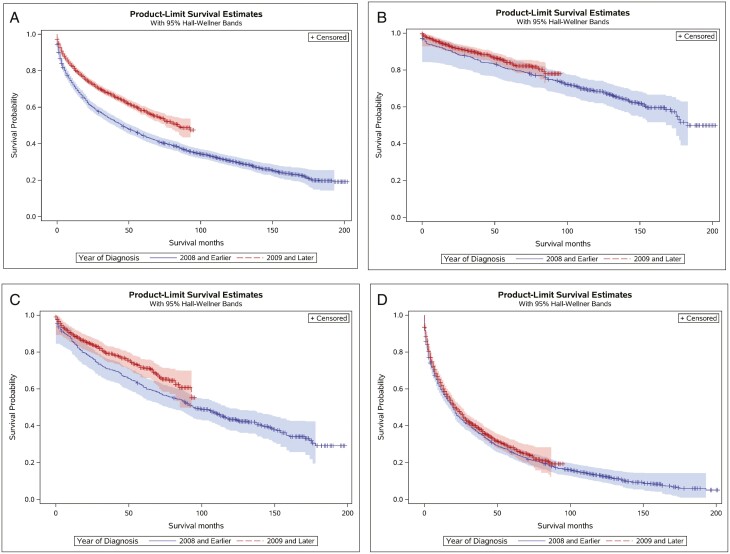
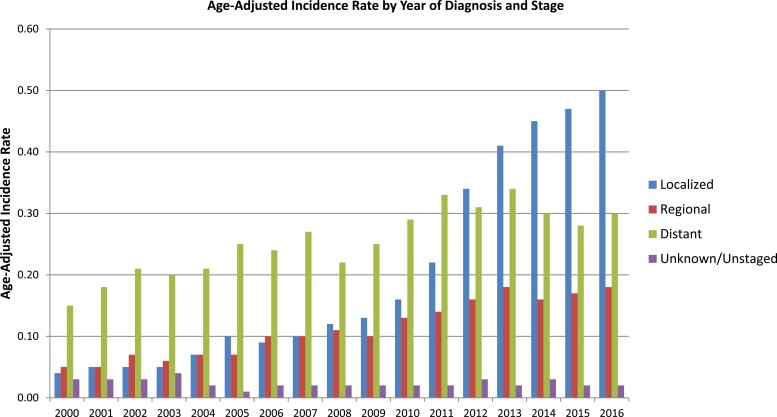
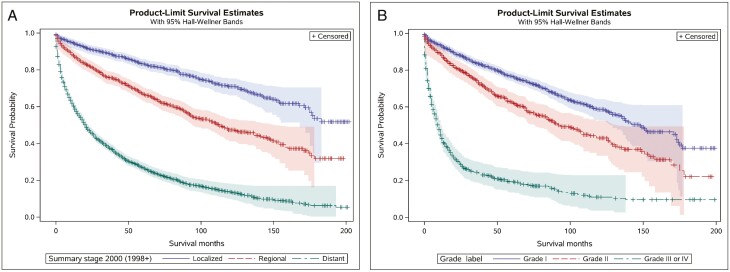
A total of 8944 pNETs patients were identified. Annual incidence rates increased from 0.27 to 1.00 per 100 000. This was largely explained by an increase in number of patients diagnosed with localized disease in more recent years (2012-2016). Median OS was 68 months (95% CI [64, 73]) and 5-year OS rates in localized, regional, and metastatic disease were 83%, 67%, and 28%, respectively. There was a significant improvement in OS for patients diagnosed between 2009 and 2016 (median OS 85 months) compared with those diagnosed between 2000 and 2008 (median OS 46 months) (HR 0.66; 95% CI [0.62, 0.70]). This improvement in OS was consistent across all stages.
This study shows a steady increase pNETs incidence with notable stage migration to earlier stages in recent years. This increase in incidence is accompanied by a significant improvement in survival across different disease stages.
胰腺神经内分泌肿瘤(pNETs)是一种罕见的癌症,其预后取决于多个因素,包括分级、分期和临床表现。在本研究中,我们旨在使用大型基于人群的数据库来确定 pNETs 患者的预后。
在这项基于人群的研究中,我们使用 ICD-O-3 和组织学代码的组合,从 SEER 18 登记处(2000-2016 年)中确定了 pNETs 患者。我们使用 SEER*Stat 8.3.5 计算了年龄调整后的发病率。此外,我们使用 Kaplan-Meier 方法分析了总生存率(OS),并使用多变量 Cox 比例风险模型研究了预后因素。
共确定了 8944 例 pNETs 患者。发病率从 0.27 增加到 1.00/100000。这在很大程度上是由于近年来局部疾病患者数量的增加(2012-2016 年)。中位 OS 为 68 个月(95%CI [64,73]),局限性、区域性和转移性疾病的 5 年 OS 率分别为 83%、67%和 28%。与 2000-2008 年相比(中位 OS 46 个月),2009-2016 年诊断的患者的 OS 显著改善(中位 OS 85 个月)(HR 0.66;95%CI [0.62,0.70])。这种 OS 的改善在所有分期中都是一致的。
本研究显示,pNETs 的发病率稳步上升,近年来明显向早期阶段转移。发病率的增加伴随着不同疾病阶段生存的显著改善。