National Institute for Medical Research, Muhimbili Medical Research Centre, Dar es Salaam, Tanzania.
World Health Organization, Global TB Programme, Geneva, Switzerland.
BMC Public Health. 2022 Mar 29;22(1):600. doi: 10.1186/s12889-022-12987-3.
Although tuberculosis (TB) care is free in Tanzania, TB-associated costs may compromise access to services and treatment adherence resulting in poor outcomes and increased risk of transmission in the community. TB can impact economically patients and their households. We assessed the economic burden of TB on patients and their households in Tanzania and identified cost drivers to inform policies and programs for potential interventions to mitigate costs.
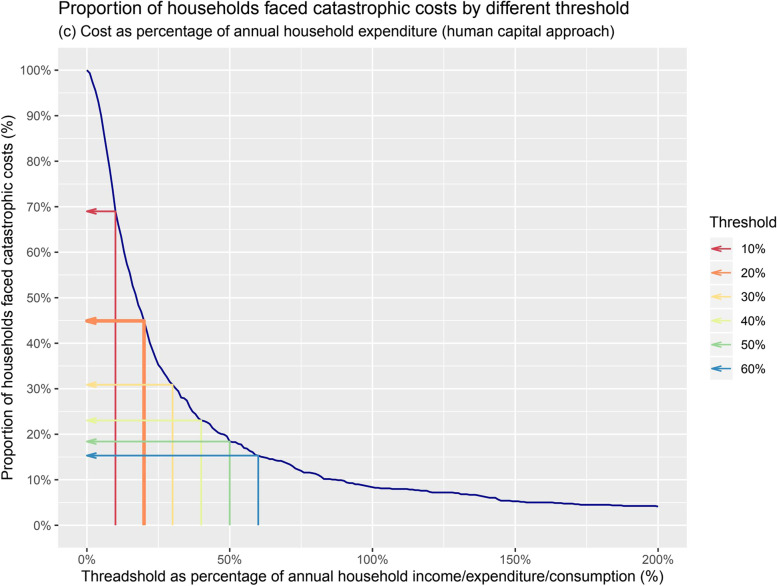
We conducted a nationally representative cross-sectional survey using a standard methodology recommended by World Health Organization. TB patients of all ages and with all types of TB from 30 clusters across Tanzania were interviewed during July - September 2019. We used the human capital approach to assess the indirect costs and a threshold of 20% of the household annual expenditure to determine the proportion of TB-affected households experiencing catastrophic cost. We descriptively analyzed the cost data and fitted multivariable logistic regression models to identify potential predictors of catastrophic costs.
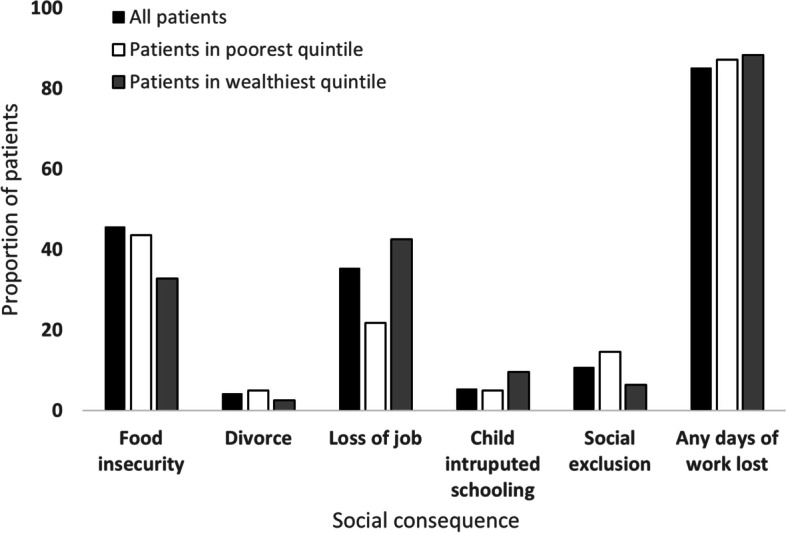
Of the 777 TB-affected households, 44.9% faced catastrophic costs due to TB. This proportion was higher (80.0%) among households of patients with multi-drug resistant TB (MDR-TB). Overall, cost was driven by income loss while accessing TB services (33.7%), nutritional supplements (32.6%), and medical costs (15.1%). Most income loss was associated with hospitalization and time for picking up TB drugs. Most TB patients (85.9%) reported worsening financial situations due to TB, and over fifty percent (53.0%) borrowed money or sold assets to finance TB treatment. In multivariable analysis, the factors associated with catastrophic costs included hospitalization (adjusted odds ratio [aOR] = 34.9; 95% confidence interval (CI):12.5-146.17), living in semi-urban (aOR = 1.6; 95% CI:1.0-2.5) or rural areas (aOR = 2.6; 95% CI:1.8-3.7), having MDR-TB (aOR = 3.4; 95% CI:1.2-10.9), and facility-based directly-observed treatment (DOT) (aOR = 7.2; 95% CI:2.4-26.6).
We found that the cost of TB care is catastrophic for almost half of the TB-affected households in Tanzania; our findings support the results from other surveys recently conducted in sub-Saharan Africa. Collaborative efforts across health, employment and social welfare sectors are imperative to minimize household costs due to TB disease and improve access to care, patient adherence and outcomes.
尽管坦桑尼亚的结核病(TB)治疗是免费的,但与结核病相关的费用可能会影响服务的可及性和治疗的依从性,从而导致治疗效果不佳,并增加社区传播的风险。结核病会对患者及其家庭的经济造成影响。我们评估了坦桑尼亚结核病对患者及其家庭的经济负担,并确定了成本驱动因素,以为潜在的干预措施提供信息,以减轻成本。
我们使用世界卫生组织推荐的标准方法进行了一项全国代表性的横断面调查。2019 年 7 月至 9 月,从坦桑尼亚 30 个集群的所有年龄和所有类型的结核病患者中抽取了 777 个结核病患者进行访谈。我们使用人力资本方法评估间接成本,并以家庭年支出的 20%作为确定受结核病影响家庭发生灾难性费用的比例的标准。我们对成本数据进行描述性分析,并拟合多变量逻辑回归模型,以确定灾难性费用的潜在预测因素。
在 777 个受结核病影响的家庭中,有 44.9%的家庭因结核病而面临灾难性费用。耐多药结核病(MDR-TB)患者家庭的这一比例更高(80.0%)。总的来说,成本主要由获取结核病服务时的收入损失(33.7%)、营养补充剂(32.6%)和医疗费用(15.1%)驱动。大多数收入损失与住院和取药有关。大多数结核病患者(85.9%)报告因结核病而导致经济状况恶化,超过一半(53.0%)借钱或出售资产来支付结核病治疗费用。多变量分析显示,与灾难性费用相关的因素包括住院治疗(调整后的优势比[aOR] = 34.9;95%置信区间[CI]:12.5-146.17)、居住在半城市(aOR = 1.6;95% CI:1.0-2.5)或农村地区(aOR = 2.6;95% CI:1.8-3.7)、患有 MDR-TB(aOR = 3.4;95% CI:1.2-10.9)和接受机构直接观察治疗(DOT)(aOR = 7.2;95% CI:2.4-26.6)。
我们发现,坦桑尼亚近一半受结核病影响的家庭因结核病治疗费用而面临灾难性支出;我们的发现支持了最近在撒哈拉以南非洲进行的其他调查结果。卫生、就业和社会福利部门之间必须开展协作,尽量减少结核病给家庭带来的成本,并改善获得治疗的机会、患者的依从性和治疗效果。