Department of Cardiology, The Affiliated Hospital of Xuzhou Medical University, Xuzhou, Jiangsu, China.
Clin Cardiol. 2022 May;45(5):574-582. doi: 10.1002/clc.23818. Epub 2022 Mar 30.
Due to the lack of research, this study aimed to assess the association between the specific range of heart rate and cardiovascular (CV) death in coronary heart disease (CHD) patients.
Heart rate of 70-79 bpm may be associated with reduced risk of CV death in CHD patients.
This retrospective cohort study collected the data of CHD patients from the eight cycles of the Health and Nutrition Examination Survey (NHANES). The included patients were divided into four groups: <60, 60-69, 70-79, and ≥80 bpm. The start of follow-up date was the mobile examination center date, the last follow-up date was December 31, 2015. The average follow-up time was 81.70 months, and the longest follow-up time was 200 months. Competing risk models were developed to evaluate the association between heart rate and CV death, with hazard ratios (HRs) and 95% confidence intervals (CIs) calculated.
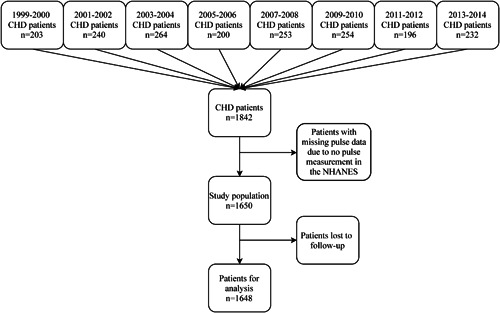
A total of 1648 patients with CHD were included in this study. CHD patients at heart rate of <60 (HR, 1.35; 95% CI, 1.34-1.36), 60-69 (HR, 1.05; 95% CI, 1.04-1.06) or ≥80 (HR, 1.39; 95% CI, 1.38-1.41) bpm had a higher risk of CV death than those at heart rate of 70-79 bpm.
Heart rate of <70 or ≥80 bpm was associated with an elevated risk of CV death among CHD patients. Continuous monitoring of heart rate may help to screen for health risks and offer early interventions to corresponding patients.
由于缺乏研究,本研究旨在评估特定心率范围与冠心病(CHD)患者心血管(CV)死亡之间的关联。
心率在 70-79 bpm 可能与 CHD 患者 CV 死亡风险降低相关。
本回顾性队列研究从健康与营养检查调查(NHANES)的八个周期中收集了 CHD 患者的数据。纳入的患者被分为四组:<60、60-69、70-79 和≥80 bpm。随访开始日期为移动体检中心日期,最后随访日期为 2015 年 12 月 31 日。平均随访时间为 81.70 个月,最长随访时间为 200 个月。使用竞争风险模型评估心率与 CV 死亡之间的关联,计算风险比(HRs)和 95%置信区间(CIs)。
本研究共纳入 1648 例 CHD 患者。与心率为 70-79 bpm 的患者相比,心率<60(HR,1.35;95%CI,1.34-1.36)、60-69(HR,1.05;95%CI,1.04-1.06)或≥80 bpm(HR,1.39;95%CI,1.38-1.41)的 CHD 患者发生 CV 死亡的风险更高。
心率<70 或≥80 bpm 与 CHD 患者 CV 死亡风险增加相关。连续监测心率可能有助于筛查健康风险,并为相应患者提供早期干预。