Office of National Central Cancer Registry, National Cancer Center/National Clinical Research Center for Cancer/Cancer Hospital, Chinese Academy of Medical Sciences and Peking Union Medical College, Beijing, China.
Key Laboratory of Carcinogenesis and Translational Research (MOE/Beijing), Division of Etiology, Peking University Cancer Hospital and Institute, Beijing, China.
Cancer Med. 2022 Nov;11(21):4033-4042. doi: 10.1002/cam4.4718. Epub 2022 Mar 29.
Early diagnosis and treatment of esophageal squamous cell dysplasia (ESCdys) and esophageal squamous cell carcinoma (ESCC) could significantly reduce the incidence and mortality of ESCC. This pilot study aimed to investigate whether P16/CDKN2A methylation could serve as a cytologic biomarker for early detection of ESCdys and ESCC.
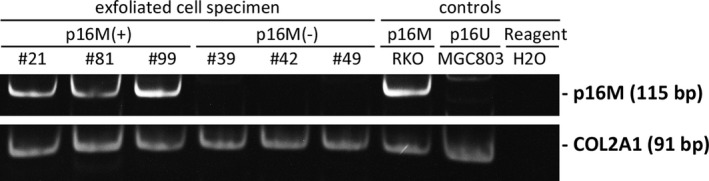
Paired esophageal biopsy and cytology specimens (exfoliated cells) were obtained from subjects at different stages of ESCC development. The methylation status of P16 gene in these two specimen types was determined using a 115-bp MethyLight assay. Categorical data were compared by the Chi-square test. Logistic regression was performed to assess adjusted odds ratios of P16 methylation associated with ESCC and ESCdys. Prediction models for identifying individuals at risk of ESCC and high-grade ESCdys (high-grade intraepithelial neoplasia, HGIN) were developed by multivariable logistic regression. Diagnostic performance was evaluated using receiver operating characteristic (ROC) analysis. Internal validation of the prediction models was performed using the 1000-bootstrap resample.
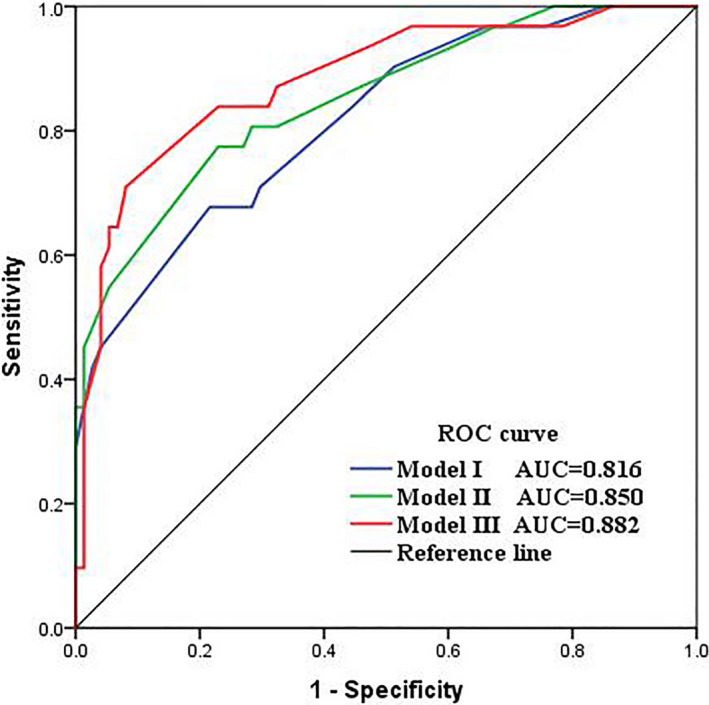
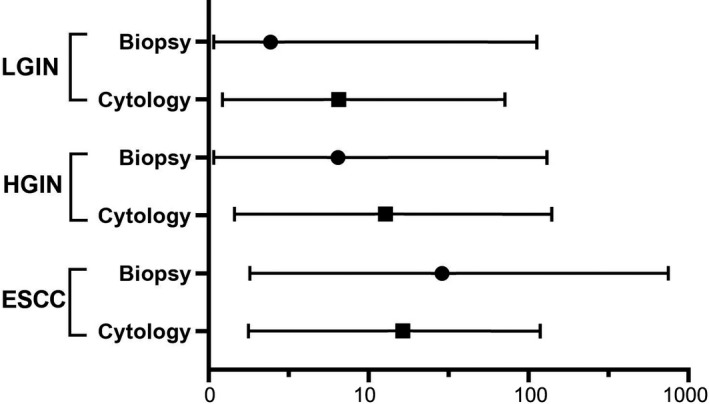
A total of 105 subjects with diagnoses ranging from normal mucosa through ESCC were included in this study. An increase in P16 methylation frequency was observed with increasing severity of esophageal lesions (p for trend <0.001). In the adjusted logistic regression models, P16 methylation in cytology specimens was positively associated with ESCC and ESCdys risk, whereas P16 methylation in biopsy specimens was only associated with a higher risk of developing ESCC. The predictive capacity of base model I (AUC, 0.816) for ESCC and HGIN was significantly increased by adding P16 methylation in cytology specimens (model III; AUC, 0.882; p = 0.043), but not P16 methylation in biopsy specimens (model II; AUC, 0.850; p = 0.225). Bootstrap validation showed optimism-corrected AUC of 0.789 for model I, 0.822 for model II, and 0.854 for model III.
P16 methylation as a cytologic marker was associated with the ESCC development and has the potential for application in minimally invasive ESCC screening.
早期诊断和治疗食管鳞状细胞异型增生(ESCdys)和食管鳞状细胞癌(ESCC)可以显著降低 ESCC 的发病率和死亡率。本研究旨在探讨 P16/CDKN2A 甲基化是否可以作为细胞学标志物,用于早期检测 ESCDys 和 ESCC。
对不同 ESCC 发展阶段患者的食管活检和细胞学标本(脱落细胞)进行配对,采用 115 个碱基对 MethyLight 法检测 P16 基因的甲基化状态。采用卡方检验比较分类资料。采用 logistic 回归评估 P16 甲基化与 ESCC 和 ESCdys 的关联调整比值比。采用多变量 logistic 回归建立识别 ESCC 和高级别 ESCdys(高级别上皮内瘤变,HGIN)风险个体的预测模型。采用受试者工作特征(ROC)曲线分析评估诊断性能。采用 1000 次 bootstrap 重采样进行预测模型的内部验证。
共纳入 105 例诊断从正常黏膜至 ESCC 的患者。随着食管病变严重程度的增加,P16 甲基化频率逐渐升高(趋势检验 P<0.001)。在调整后的 logistic 回归模型中,细胞学标本中的 P16 甲基化与 ESCC 和 ESCdys 风险呈正相关,而活检标本中的 P16 甲基化仅与 ESCC 发病风险较高相关。基础模型 I(AUC,0.816)对 ESCC 和 HGIN 的预测能力通过加入细胞学标本中的 P16 甲基化(模型 III;AUC,0.882;P=0.043)得到显著提高,但加入活检标本中的 P16 甲基化(模型 II;AUC,0.850;P=0.225)则不然。bootstrap 验证显示模型 I 的校正 AUC 为 0.789,模型 II 的为 0.822,模型 III 的为 0.854。
P16 甲基化为细胞学标志物与 ESCC 发生相关,具有在微创 ESCC 筛查中应用的潜力。