Centre for BioSystems Science and Engineering, Indian Institute of Science, Bangalore 560012, India.
Department of Biotechnology, National Institute of Technology, Durgapur 713216, India.
Mol Biol Cell. 2022 May 15;33(6):ar46. doi: 10.1091/mbc.E21-10-0521. Epub 2022 Mar 30.
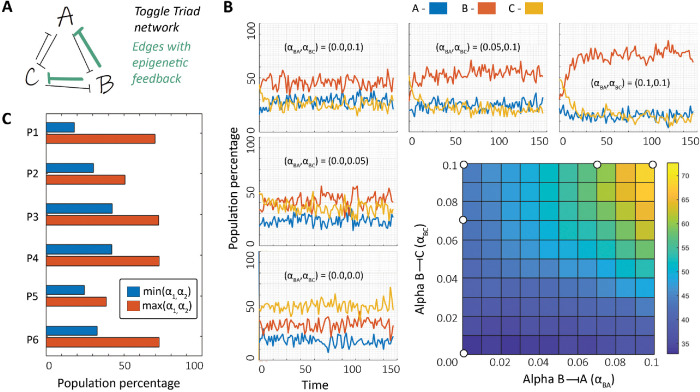
Naïve helper (CD4+) T-cells can differentiate into distinct functional subsets including Th1, Th2, and Th17 phenotypes. Each of these phenotypes has a "master regulator"-T-bet (Th1), GATA3 (Th2), and RORγT (Th17)-that inhibits the other two master regulators. Such mutual repression among them at a transcriptional level can enable multistability, giving rise to six experimentally observed phenotype, Th1, Th2, Th17, hybrid Th/Th2, hybrid Th2/Th17, and hybrid Th1/Th17. However, the dynamics of switching among these phenotypes, particularly in the case of epigenetic influence, remain unclear. Here through mathematical modeling, we investigated the coupled transcription-epigenetic dynamics in a three-node mutually repressing network to elucidate how epigenetic changes mediated by any master regulator can influence the transition rates among different cellular phenotypes. We show that the degree of plasticity exhibited by one phenotype depends on relative strength and duration of mutual epigenetic repression mediated among the master regulators in a three-node network. Further, our model predictions can offer putative mechanisms underlying relatively higher plasticity of Th17 phenotype as observed in vitro and in vivo. Together, our modeling framework characterizes phenotypic plasticity and heterogeneity as an outcome of emergent dynamics of a three-node regulatory network, such as the one mediated by T-bet/GATA3/RORγT.
幼稚辅助 (CD4+) T 细胞可分化为不同的功能亚群,包括 Th1、Th2 和 Th17 表型。这些表型中的每一种都有一个“主调控因子”-T-bet(Th1)、GATA3(Th2)和 RORγT(Th17)-抑制其他两个主调控因子。它们之间在转录水平上的这种相互抑制可以实现多稳定性,从而产生六种实验观察到的表型,Th1、Th2、Th17、混合 Th/Th2、混合 Th2/Th17 和混合 Th1/Th17。然而,这些表型之间的转换动态,特别是在表观遗传影响的情况下,仍然不清楚。在这里,我们通过数学建模,研究了一个三节点相互抑制网络中的耦合转录-表观遗传动力学,以阐明由任何主调控因子介导的表观遗传变化如何影响不同细胞表型之间的转换速率。我们表明,一个表型表现出的可塑性程度取决于三节点网络中主调控因子之间介导的相互表观遗传抑制的相对强度和持续时间。此外,我们的模型预测可以为体外和体内观察到的 Th17 表型相对较高的可塑性提供潜在的机制。总之,我们的建模框架将表型可塑性和异质性描述为由 T-bet/GATA3/RORγT 介导的三节点调控网络的涌现动力学的结果。