Klinik für Kardiologie II - Rhythmologie, Universitätsklinikum Münster, Albert-Schweitzer-Campus 1, 48149, Münster, Germany.
Institut für Medizinische Informatik, Westfälische-Wilhelms-Universität Münster, Albert-Schweitzer-Campus 1, 48149, Münster, Germany.
Clin Res Cardiol. 2022 Sep;111(9):1010-1017. doi: 10.1007/s00392-022-02012-3. Epub 2022 Mar 30.
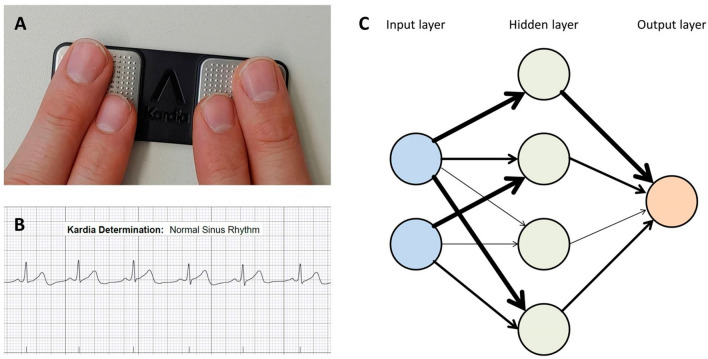
Machine learning has immense novel but also disruptive potential for medicine. Numerous applications have already been suggested and evaluated concerning cardiovascular diseases. One important aspect is the detection and management of potentially thrombogenic arrhythmias such as atrial fibrillation. While atrial fibrillation is the most common arrhythmia with a lifetime risk of one in three persons and an increased risk of thromboembolic complications such as stroke, many atrial fibrillation episodes are asymptomatic and a first diagnosis is oftentimes only reached after an embolic event. Therefore, screening for atrial fibrillation represents an important part of clinical practice. Novel technologies such as machine learning have the potential to substantially improve patient care and clinical outcomes. Additionally, machine learning applications may aid cardiologists in the management of patients with already diagnosed atrial fibrillation, for example, by identifying patients at a high risk of recurrence after catheter ablation. We summarize the current state of evidence concerning machine learning and, in particular, artificial neural networks in the detection and management of atrial fibrillation and describe possible future areas of development as well as pitfalls. Typical data flow in machine learning applications for atrial fibrillation detection.
机器学习在医学领域具有巨大的新颖性和颠覆性潜力。已经提出并评估了许多与心血管疾病相关的应用。一个重要方面是检测和管理潜在的血栓形成性心律失常,如心房颤动。虽然心房颤动是最常见的心律失常,终生风险为三分之一,并且血栓栓塞并发症(如中风)的风险增加,但许多心房颤动发作是无症状的,首次诊断通常仅在栓塞事件后才做出。因此,筛查心房颤动是临床实践的重要组成部分。机器学习等新技术有可能极大地改善患者的护理和临床结果。此外,机器学习应用程序可以帮助心脏病专家管理已经诊断出的心房颤动患者,例如,通过识别导管消融后复发风险高的患者。我们总结了关于机器学习的当前证据状态,特别是关于人工神经网络在心房颤动检测和管理中的应用,并描述了可能的未来发展领域和陷阱。用于心房颤动检测的机器学习应用程序的典型数据流。