PROMENTA Research Center, Department of Psychology, University of Oslo, Forskningsveien 3A, 0373, Oslo, Norway.
Norwegian Institute of Public Health, Oslo, Norway.
Sci Rep. 2022 Mar 30;12(1):5402. doi: 10.1038/s41598-022-09253-2.
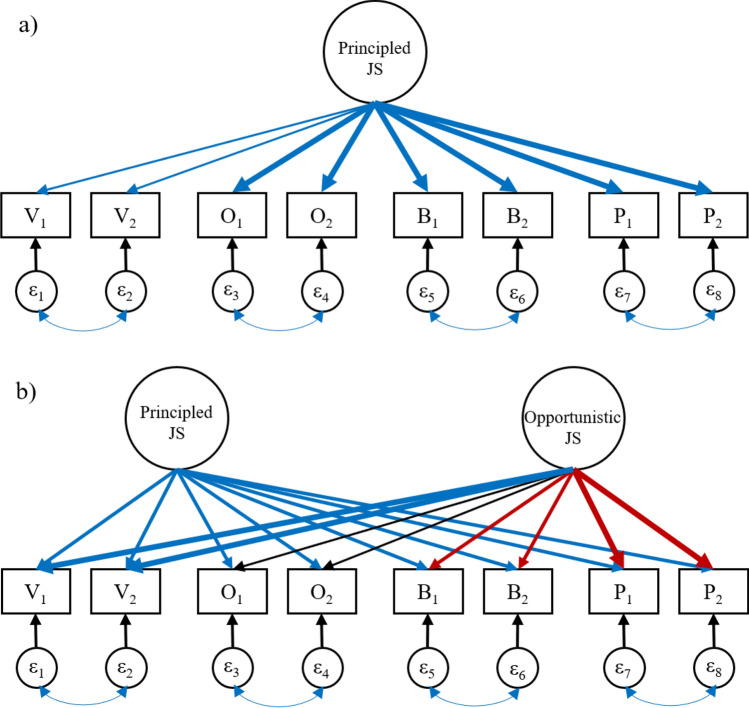
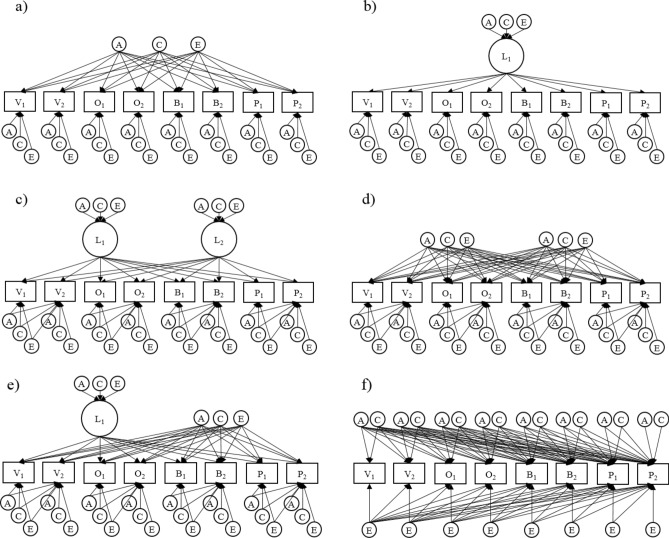
Injustice typically involves some people benefitting at the expense of others. An opportunist might then be selectively motivated to amend only the injustice that is harmful to them, while someone more principled would respond consistently regardless of whether they stand to gain or lose. Here, we disentangle such principled and opportunistic motives towards injustice. With a sample of 312 monozygotic- and 298 dizygotic twin pairs (N = 1220), we measured people's propensity to perceive injustice as victims, observers, beneficiaries, and perpetrators of injustice, using the Justice Sensitivity scale. With a biometric approach to factor analysis, that provides increased stringency in inferring latent psychological traits, we find evidence for two substantially heritable factors explaining correlations between Justice Sensitivity facets. We interpret these factors as principled justice sensitivity (h = 0.45) leading to increased sensitivity to injustices of all categories, and opportunistic justice sensitivity (h = 0.69) associated with increased sensitivity to being a victim and a decreased propensity to see oneself as a perpetrator. These novel latent constructs share genetic substrate with psychological characteristics that sustain broad coordination strategies that capture the dynamic tension between honest cooperation versus dominance and defection, namely altruism, interpersonal trust, agreeableness, Social Dominance Orientation and opposition to immigration and foreign aid.
不公正通常涉及一些人受益而另一些人受损。那么,一个机会主义者可能会有选择性地只纠正对自己有害的不公正,而一个更有原则的人则会始终如一地做出反应,无论他们是否会受益或损失。在这里,我们梳理了这种对不公正的有原则和机会主义动机。通过对 312 对同卵双胞胎和 298 对异卵双胞胎(N=1220)的样本进行测量,我们使用正义敏感性量表衡量了人们作为不公正的受害者、观察者、受益者和加害者的感知倾向。通过生物识别方法进行因素分析,这为推断潜在心理特征提供了更高的严格性,我们发现有证据表明,有两个具有实质性遗传的因素可以解释正义敏感性方面之间的相关性。我们将这些因素解释为有原则的正义敏感性(h=0.45),导致对所有类别的不公正更加敏感,以及机会主义的正义敏感性(h=0.69),与对受害者的敏感性增加和对自己作为加害者的倾向降低有关。这些新的潜在结构与维持诚实合作与支配和背叛之间动态紧张关系的广泛协调策略的心理特征具有遗传基础,即利他主义、人际信任、随和、社会支配倾向以及反对移民和外国援助。