School of Biosciences, University of Sheffield, Sheffield, South Yorkshire, United Kingdom.
School of Zoology, Tel Aviv University, Tel Aviv, Israel.
Evolution. 2022 Jun;76(6):1195-1208. doi: 10.1111/evo.14482. Epub 2022 May 16.
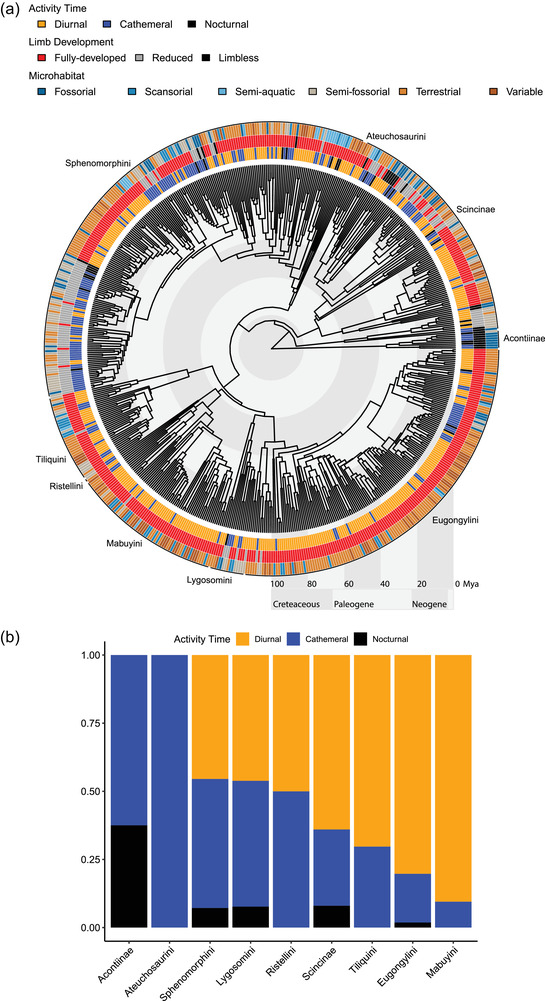
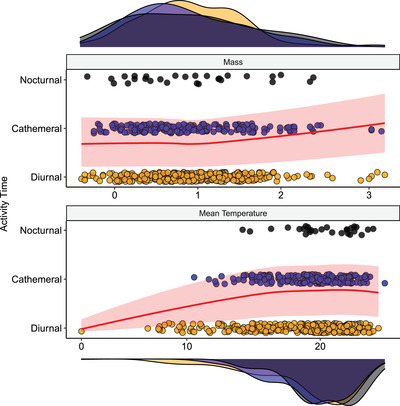
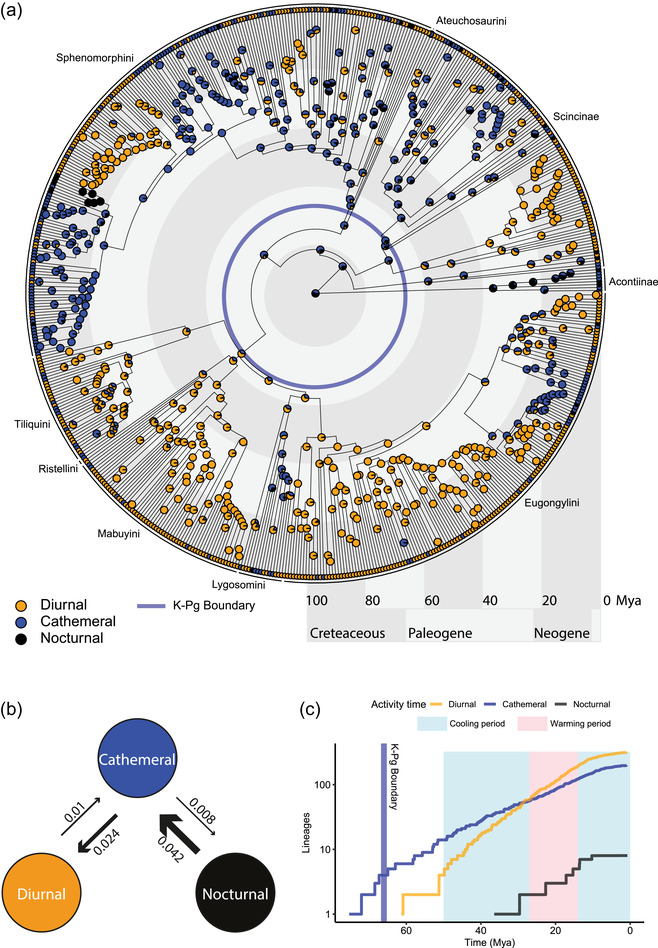
Many animals have strict diel activity patterns, with unique adaptations for either diurnal or nocturnal activity. Diel activity is phylogenetically conserved, yet evolutionary shifts in diel activity occur and lead to important changes in an organism's morphology, physiology, and behavior. We use phylogenetic comparative methods to examine the evolutionary history of diel activity in skinks, one of the largest families of terrestrial vertebrates. We examine how diel patterns are associated with microhabitat, ambient temperatures, and morphology. We found support for a nondiurnal ancestral skink. Strict diurnality in crown group skinks only evolved during the Paleogene. Nocturnal habits are associated with fossorial activity, limb reduction and loss, and warm temperatures. Our results shed light on the evolution of diel activity patterns in a large radiation of terrestrial ectotherms and reveal how both intrinsic biotic and extrinsic abiotic factors can shape the evolution of animal activity patterns.
许多动物都有严格的昼夜活动模式,具有适应昼行或夜行活动的独特适应性。昼夜活动在系统发育上是保守的,但昼夜活动的进化转变确实发生了,并导致生物体形态、生理和行为的重要变化。我们使用系统发育比较方法来研究蜥蜴(最大的陆生脊椎动物家族之一)中昼夜活动的进化历史。我们研究了昼夜模式如何与微生境、环境温度和形态相关联。我们发现支持非昼行性祖先蜥蜴的证据。在冠群蜥蜴中,严格的昼行性仅在古近纪进化而来。夜行习性与穴居活动、肢体减少和丧失以及温暖的温度有关。我们的结果揭示了在一个大型陆地变温动物辐射中昼夜活动模式的进化,并揭示了内在生物和外在非生物因素如何塑造动物活动模式的进化。