Department of Pharmacy Practice, College of Pharmacy, Qassim University, Qassim, Saudi Arabia.
College of Pharmacy, University of Shaqra, Al Dawadmi, Saudi Arabia.
Front Endocrinol (Lausanne). 2022 Mar 9;13:856958. doi: 10.3389/fendo.2022.856958. eCollection 2022.
Previous reports suggest that the Coronavirus Disease-2019 (COVID-19) pandemic might have affected incidences of diabetic ketoacidosis (DKA) and new diagnoses of type 1 diabetes. This systematic review and meta-analysis aimed to estimate the risk of DKA, including severe DKA, during the COVID-19 pandemic versus the prior-to-COVID-19 period among pediatric patients with type 1 diabetes.
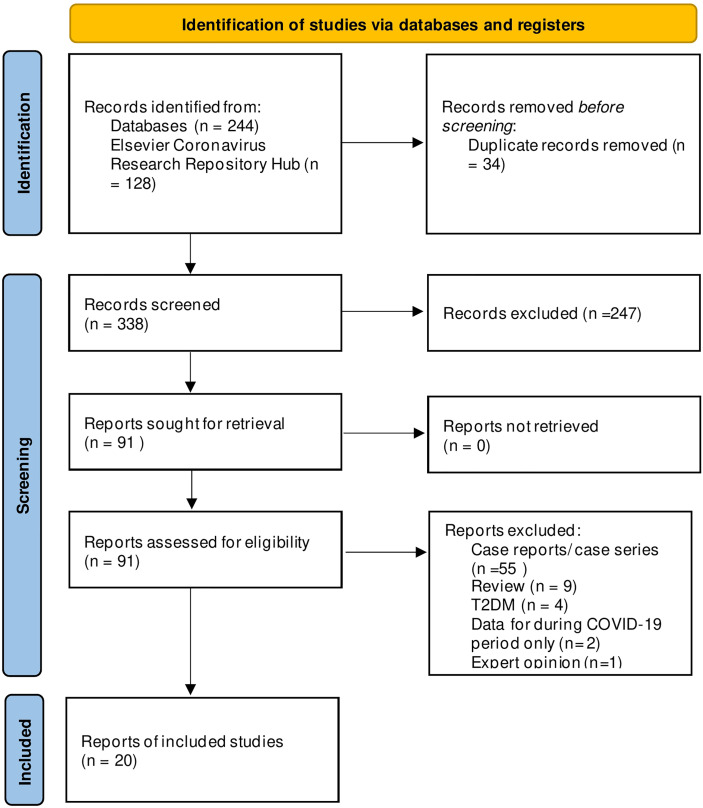
PubMed and EMBASE were searched for observational studies investigating the risk of DKA among pediatric patients with type 1 diabetes during the COVID-19 pandemic and the prior-to-COVID-19 period. A random meta-analysis model was performed to estimate the relative risk of DKA during the COVID-19 pandemic compared to before the pandemic. Subgroup analyses were conducted based on the type 1 diabetes status, established or newly diagnosed. In addition, sensitivity analysis was conducted for studies that reported results from adjusted analysis for potential confounders using fixed effect model.
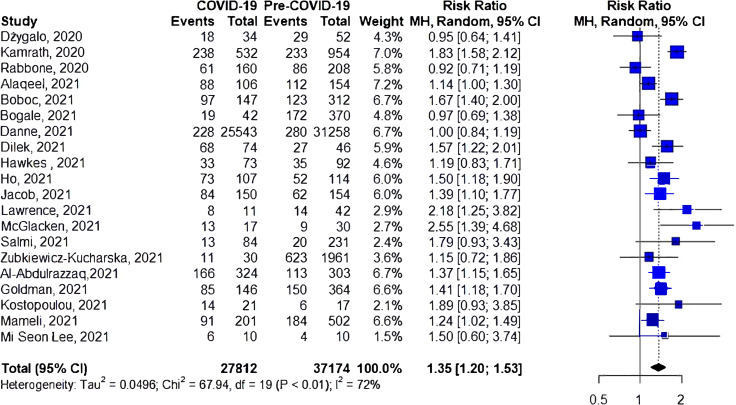
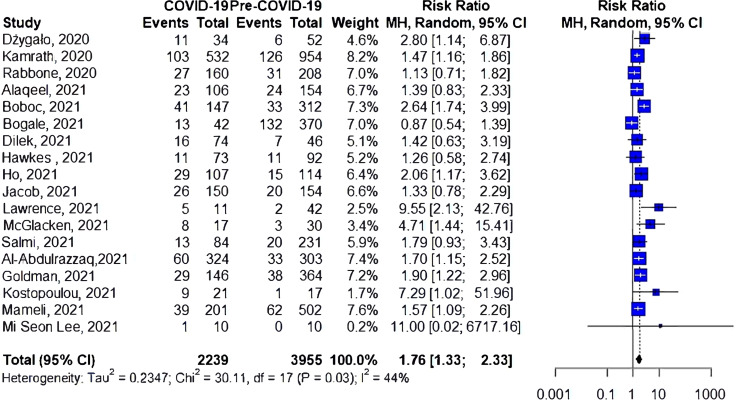
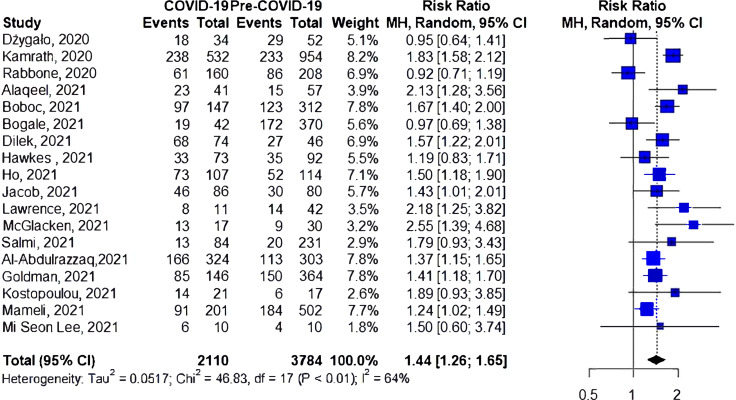
A total of 20 observational studies reported the risk of DKA, of which 18 reported the risk of severe DKA. The risks of DKA and severe DKA were 35% (RR 1.35, 95%CI 1.2-1.53, = 71%) and 76% (RR 1.76, 95%CI 1.33-2.33, 44%) higher in the during-COVID-19 group compared to the prior-to-COVID-19 group, respectively. Among patients with newly diagnosed type 1 diabetes, the risk of DKA was 44% higher for the during-COVID-19 group compared to the prior-to-COVID-19 group (RR 1.44, 95%CI 1.26-1.65; = 64%). Only two studies reported the risk of DKA among patients with established type 1 diabetes and the cumulative risk was not statistically significant. In the sensitivity analysis, four studies reported an adjusted odds ratio (aOR) of the risk of DKA during COVID-19 compared to the prior-to-COVID-19 period. The fixed estimate from the meta-analysis found an increase in the risk of DKA in the during-COVID-19 group compared to the prior-to-COVID-19 group (aOR 2.04, 95%CI 1.66-2.50).
This study showed that DKA risk, especially the risk of severe DKA, has increased significantly during the pandemic. Healthcare systems must be aware and prepared for such an increase in DKA cases and take all necessary measures to prevent future spikes during the pandemic.
https://www.crd.york.ac.uk/prospero/display_record.php?RecordID=272775, identifier PROSPERO [CRD42021272775].
先前的报告表明,2019 年冠状病毒病(COVID-19)大流行可能影响了糖尿病酮症酸中毒(DKA)的发病率和 1 型糖尿病的新诊断。本系统评价和荟萃分析旨在评估在 COVID-19 大流行期间和 COVID-19 大流行之前,患有 1 型糖尿病的儿科患者中 DKA(包括严重 DKA)的风险。
在 PubMed 和 EMBASE 上搜索了观察性研究,以调查 COVID-19 大流行期间和 COVID-19 大流行之前患有 1 型糖尿病的儿科患者中 DKA 的风险。使用随机荟萃分析模型估计 COVID-19 大流行期间与大流行前相比 DKA 的相对风险。根据 1 型糖尿病的状态(已确诊或新确诊)进行亚组分析。此外,对于报告了使用固定效应模型对潜在混杂因素进行调整分析结果的研究,进行了敏感性分析。
共有 20 项观察性研究报告了 DKA 的风险,其中 18 项报告了严重 DKA 的风险。与 COVID-19 大流行前相比,COVID-19 大流行期间 DKA 和严重 DKA 的风险分别高 35%(RR 1.35,95%CI 1.2-1.53, = 71%)和 76%(RR 1.76,95%CI 1.33-2.33, 44%)。在新诊断为 1 型糖尿病的患者中,COVID-19 大流行期间 DKA 的风险比 COVID-19 大流行前高 44%(RR 1.44,95%CI 1.26-1.65; = 64%)。只有两项研究报告了已确诊 1 型糖尿病患者中 DKA 的风险,累积风险无统计学意义。在敏感性分析中,四项研究报告了 COVID-19 期间与 COVID-19 大流行前相比 DKA 的风险调整比值比(aOR)。荟萃分析的固定估计发现,与 COVID-19 大流行前相比,COVID-19 大流行期间 DKA 的风险增加(aOR 2.04,95%CI 1.66-2.50)。
本研究表明,DKA 风险,特别是严重 DKA 的风险,在大流行期间显著增加。医疗保健系统必须意识到并为 DKA 病例的这种增加做好准备,并采取一切必要措施,以防止大流行期间未来出现 DKA 病例激增。
https://www.crd.york.ac.uk/prospero/display_record.php?RecordID=272775,标识符 PROSPERO [CRD42021272775]。