Wuxi Cancer Institute Affiliated Hospital of Jiangnan University Wuxi 214062 China.
Laboratory of Cancer Epigenetics Wuxi School of Medicine Jiangnan University Wuxi 214122 China.
Adv Sci (Weinh). 2022 Jan 17;9(9):2102620. doi: 10.1002/advs.202102620. eCollection 2022 Mar.
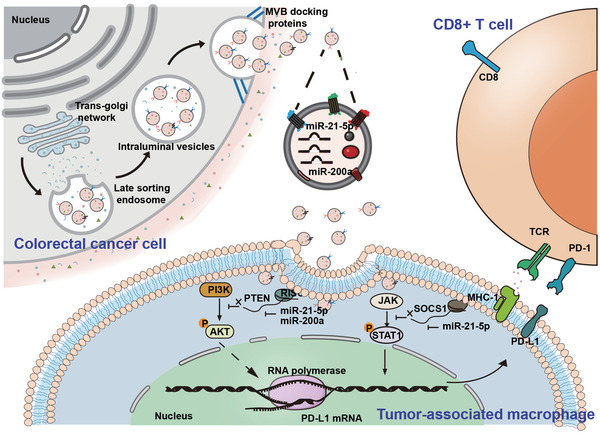
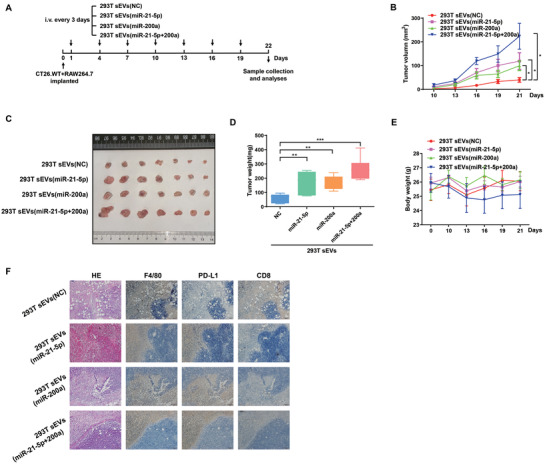
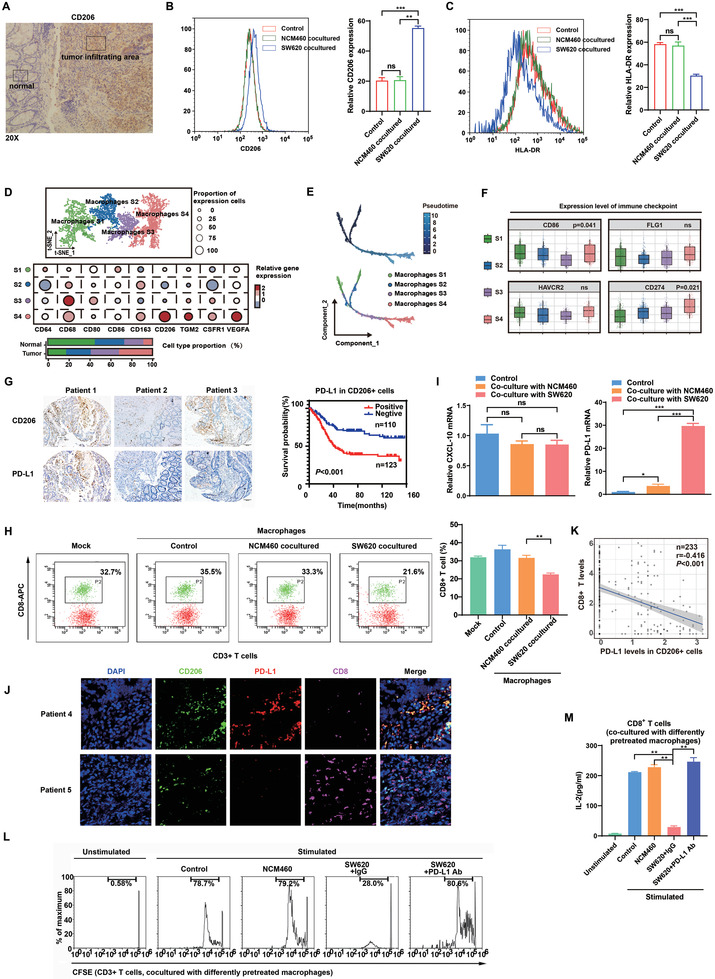
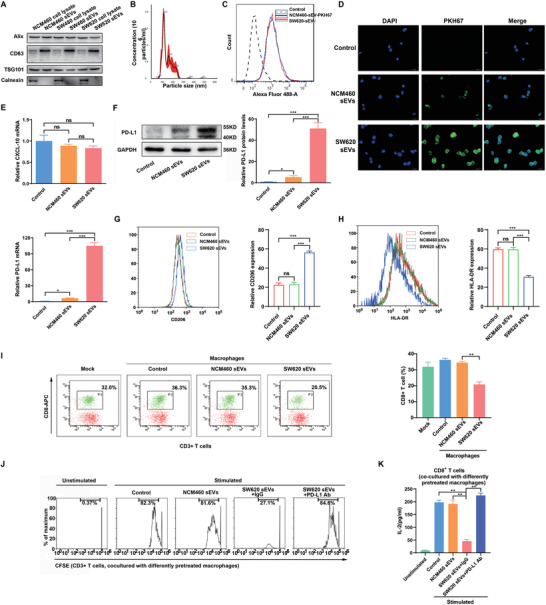
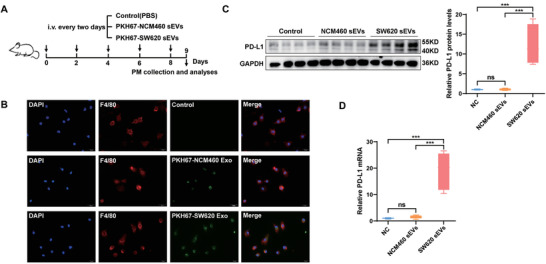
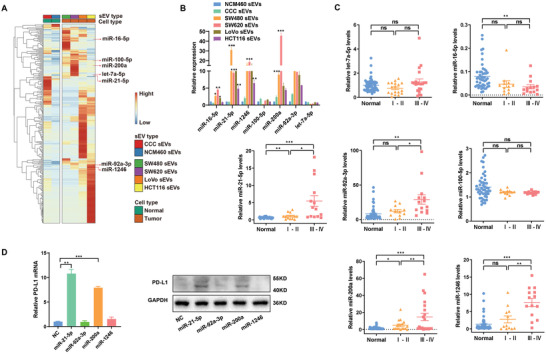
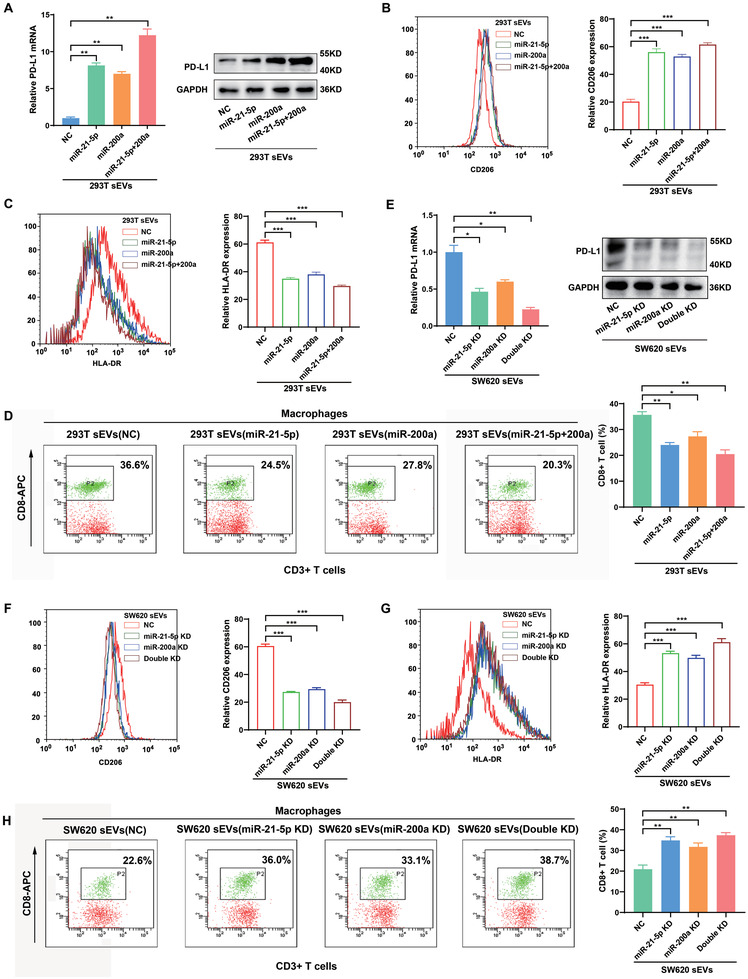
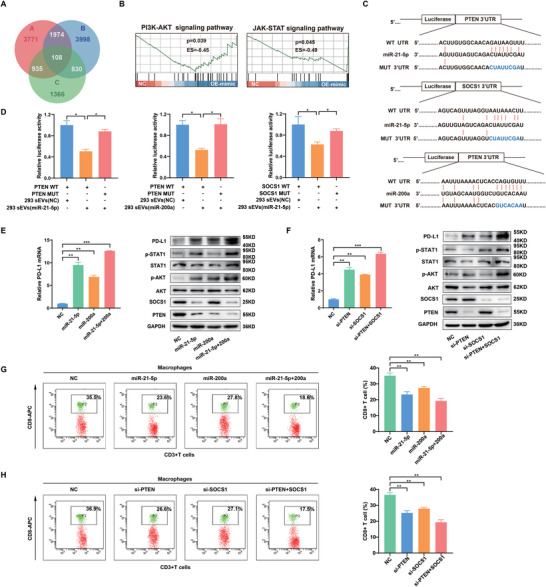
Tumor-associated macrophages (TAMs) are one of the most abundant cell types in colorectal cancer (CRC) tumor microenvironment (TME). Recent studies observed complicated "cross-talks" between cancer cells and macrophages in TME. However, the underlying mechanisms are still poorly elucidated. Here, PD-L1 levels are very low in CRC cells but highly abundant in TAMs, and a specific PD-L1CD206 macrophage subpopulation are identified, which is induced by tumor cells and associated with a poor prognosis. Mechanistic investigations reveal that CRC cells can secrete small extracellular vesicles (sEVs) taken up by macrophages that induce M2 like polarization and PD-L1 expression, resulting in increased PD-L1CD206 macrophage abundance and decreased T cell activity in CRC TME. sEV-derived miR-21-5p and miR-200a are identified as key signaling molecules mediating the regulatory effects of CRC on macrophages. Further studies reveal that CRC-derived miR-21-5p and miR-200a synergistically induces macrophage M2 like polarization and PD-L1 expression by regulating the PTEN/AKT and SCOS1/STAT1 pathways, resulting in decreased CD8 T cell activity and increased tumor growth. This study suggests that inhibiting the secretion of specific sEV-miRNAs from CRC and targeting PD-L1 in TAMs may serve as novel methods for CRC treatment as well as a sensitization method for anti-PD-L1 therapy in CRC.
肿瘤相关巨噬细胞(TAMs)是结直肠癌(CRC)肿瘤微环境(TME)中最丰富的细胞类型之一。最近的研究观察到肿瘤细胞和巨噬细胞之间在 TME 中存在复杂的“串扰”。然而,其潜在机制仍未得到充分阐明。在这里,CRC 细胞中的 PD-L1 水平很低,但在 TAMs 中却非常丰富,并且鉴定出一种特定的 PD-L1+CD206 巨噬细胞亚群,该亚群由肿瘤细胞诱导,与预后不良相关。机制研究表明,CRC 细胞可以分泌被巨噬细胞摄取的小细胞外囊泡(sEVs),诱导 M2 样极化和 PD-L1 表达,导致 CRC TME 中 PD-L1+CD206 巨噬细胞增多和 T 细胞活性降低。sEV 衍生的 miR-21-5p 和 miR-200a 被鉴定为介导 CRC 对巨噬细胞调控作用的关键信号分子。进一步的研究表明,CRC 衍生的 miR-21-5p 和 miR-200a 通过调节 PTEN/AKT 和 SCOS1/STAT1 通路协同诱导巨噬细胞 M2 样极化和 PD-L1 表达,导致 CD8 T 细胞活性降低和肿瘤生长增加。这项研究表明,抑制 CRC 特定 sEV-miRNA 的分泌并靶向 TAMs 中的 PD-L1,可能成为 CRC 治疗的新方法,以及 CRC 抗 PD-L1 治疗的增敏方法。