Chen Chao, Guan Jun, Gu Xinyu, Chu Qingfei, Zhu Haihong
State Key Laboratory for Diagnosis and Treatment of Infectious Diseases, National Clinical Research Center for Infectious Diseases, National Medical Center for Infectious Diseases, Collaborative Innovation Center for Diagnosis and Treatment of Infectious Diseases, The First Affiliated Hospital, Zhejiang University School of Medicine, Hangzhou, China.
Front Cell Dev Biol. 2022 Mar 10;10:834859. doi: 10.3389/fcell.2022.834859. eCollection 2022.
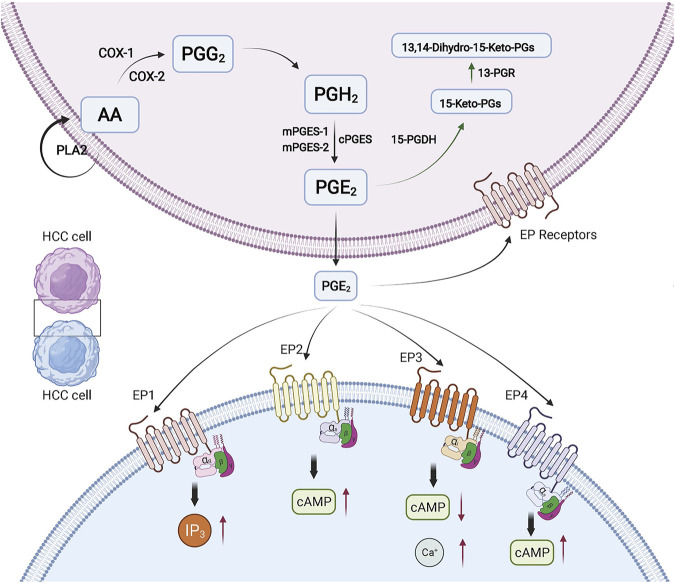
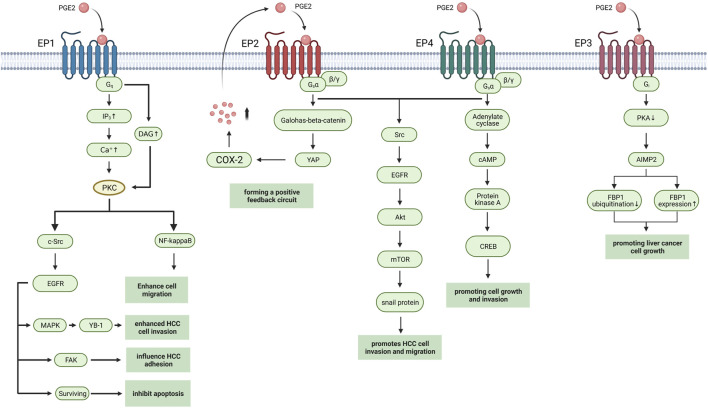
Hepatocellular carcinoma (HCC) is a common primary liver cancer with ∼750,000 annual incidence rates globally. PGE2, usually known as a pro-inflammatory cytokine, is over-expressed in various human malignancies including HCC. PGE2 binds to EP receptors in HCC cells to influence tumorigenesis or enhance tumor progression through multiple pathways such as EP1-PKC-MAPK, EP2-PKA-GSK3β, and EP4-PKA-CREB. In the progression of hepatocellular carcinoma, PGE2 can promote the proliferation and migration of liver cancer cells by affecting hepatocytes directly and the tumor microenvironment (TME) through ERK/COX-2/PGE2 signal pathway in hepatic stellate cells (HSC). For the treatment of hepatocellular carcinoma, there are drugs such as T7 peptide and EP1 antagonist ONO-8711 targeting Cox-2/PGE2 axis to inhibit tumor progression. In conclusion, PGE2 has been shown to be a traditional target with pleiotropic effects in tumorigenesis and progression of HCC that could be used to develop a new potential clinical impact. For the treatment study focusing on the COX-PGE2 axis, the exclusive usage of non-steroidal anti-inflammatory agents (NSAIDs) or COX-2-inhibitors may be replaced by a combination of selective EP antagonists and traditional anti-tumoral drugs to alleviate severe side effects and achieve better outcomes.
肝细胞癌(HCC)是一种常见的原发性肝癌,全球年发病率约为75万例。PGE2通常被认为是一种促炎细胞因子,在包括HCC在内的各种人类恶性肿瘤中过度表达。PGE2与HCC细胞中的EP受体结合,通过多种途径影响肿瘤发生或促进肿瘤进展,如EP1-PKC-MAPK、EP2-PKA-GSK3β和EP4-PKA-CREB。在肝细胞癌的进展过程中,PGE2可通过肝星状细胞(HSC)中的ERK/COX-2/PGE2信号通路直接影响肝细胞和肿瘤微环境(TME),从而促进肝癌细胞的增殖和迁移。对于肝细胞癌的治疗,有T7肽和EP1拮抗剂ONO-8711等药物靶向Cox-2/PGE2轴以抑制肿瘤进展。总之,PGE2已被证明是HCC肿瘤发生和进展中具有多效性作用的传统靶点,可用于开发具有新的潜在临床影响的药物。对于专注于COX-PGE2轴的治疗研究,非甾体抗炎药(NSAIDs)或COX-2抑制剂的单独使用可能会被选择性EP拮抗剂与传统抗肿瘤药物的联合使用所取代,以减轻严重的副作用并取得更好的疗效。