Cann Rachel Fiona, Sinnema Claire, Daly Alan J, Rodway Joelle, Liou Yi-Hwa
Faculty of Education and Social Work, The University of Auckland, Auckland, New Zealand.
Department of Education Studies, University of California, San Diego, San Diego, CA, United States.
Front Psychol. 2022 Mar 9;13:775614. doi: 10.3389/fpsyg.2022.775614. eCollection 2022.
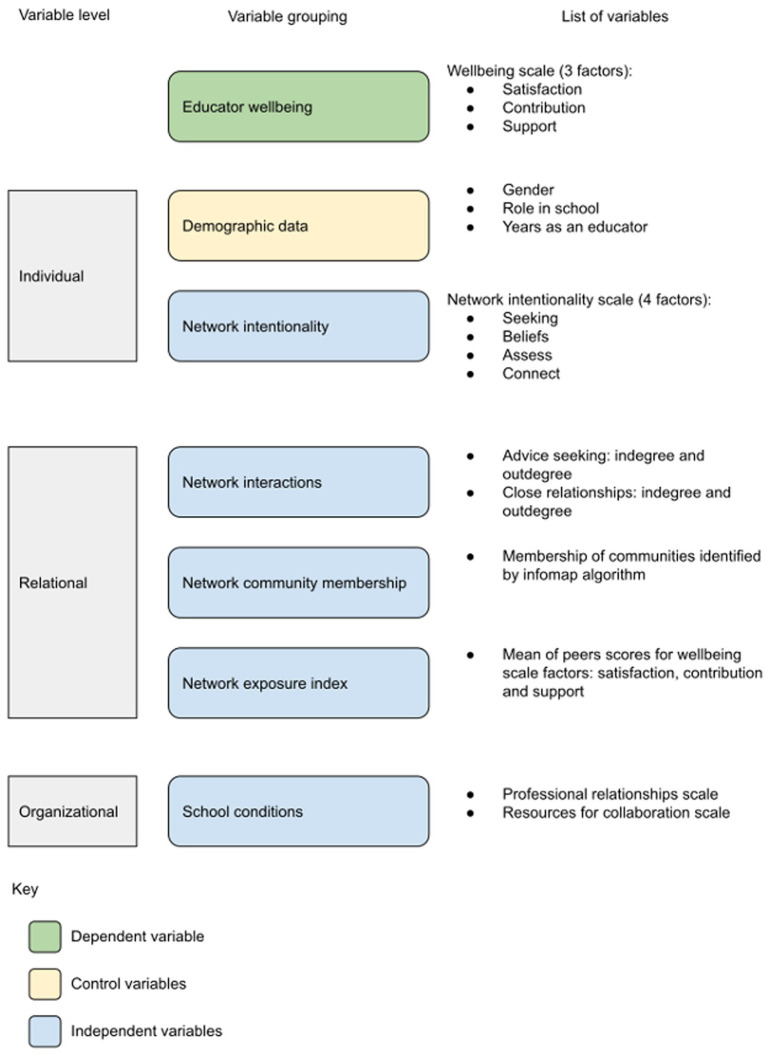
Wellbeing in schools is often focused at the individual level, exploring students' or teachers' individual traits, habits, or actions that influence wellbeing. However, studies rarely take a whole-school approach that includes staff wellbeing, and frequently ignore relational and organizational level variables. We take a systems informed positive psychology approach and argue that it is essential to build greater understanding about organizational and relational influences on wellbeing in order for schools to support educator wellbeing. Our study evaluated the relative contributions of individual, relational, and organizational factors to educator wellbeing. Our measure of wellbeing focused on the life satisfaction and flourishing of 559 educators in 12 New Zealand schools. We used a social network analysis approach to capture educators' relational ties, and demographic data and psychometric scales to capture individual and organizational level variables. Results of hierarchical blockwise regressions showed that individual, relational, and organizational factors were all significantly associated with educator wellbeing; however, it was educators' perceptions of trusting and collaborative school conditions that were most strongly associated with their wellbeing. The number of relational ties educators had explained the least amount of variance in wellbeing. Educators were more likely to experience high levels of support when their close contacts also experienced high levels of support. However, for many educators, there was a negative association between their most frequent relational ties and their reported levels of support. Our results suggest that attending to the organizational factors that influence wellbeing, through creating trusting and collaborative school conditions, may be one of the most influential approaches to enhancing educator wellbeing. We call for whole-school approaches to wellbeing that not only consider how to support and enhance the wellbeing of school staff as well as students, but also view the conditions created within a school as a key driver of wellbeing within schools.
学校中的幸福感通常聚焦于个体层面,探究影响幸福感的学生或教师的个人特质、习惯或行为。然而,研究很少采用涵盖教职工幸福感的全校性方法,并且常常忽略关系层面和组织层面的变量。我们采用一种基于系统的积极心理学方法,并认为为了让学校支持教育工作者的幸福感,有必要加深对组织和关系对幸福感影响的理解。我们的研究评估了个体、关系和组织因素对教育工作者幸福感的相对贡献。我们对幸福感的衡量聚焦于新西兰12所学校中559名教育工作者的生活满意度和蓬勃发展状况。我们使用社会网络分析方法来捕捉教育工作者的关系纽带,并使用人口统计学数据和心理测量量表来捕捉个体和组织层面的变量。分层逐块回归的结果表明,个体、关系和组织因素均与教育工作者的幸福感显著相关;然而,与他们的幸福感最密切相关的是教育工作者对信任和协作的学校环境的感知。教育工作者拥有的关系纽带数量对幸福感差异的解释最少。当他们的亲密联系人也获得高水平支持时,教育工作者更有可能体验到高水平的支持。然而,对许多教育工作者来说,他们最频繁的关系纽带与他们报告的支持水平之间存在负相关。我们的研究结果表明,通过营造信任和协作的学校环境来关注影响幸福感的组织因素,可能是提升教育工作者幸福感最具影响力的方法之一。我们呼吁采用全校性的幸福感方法,这种方法不仅要考虑如何支持和提升学校教职工以及学生的幸福感,还要将学校内部营造的环境视为学校幸福感的关键驱动因素。