Section of Clinical Genetics and Metabolism, Department of Pediatrics, University of Colorado, Aurora, Colorado, USA.
Department of Pediatrics, Child Health Biostatistics Core, University of Colorado and Children's Hospital Colorado, Aurora, Colorado, USA.
J Inherit Metab Dis. 2022 Jul;45(4):734-747. doi: 10.1002/jimd.12500. Epub 2022 Apr 6.
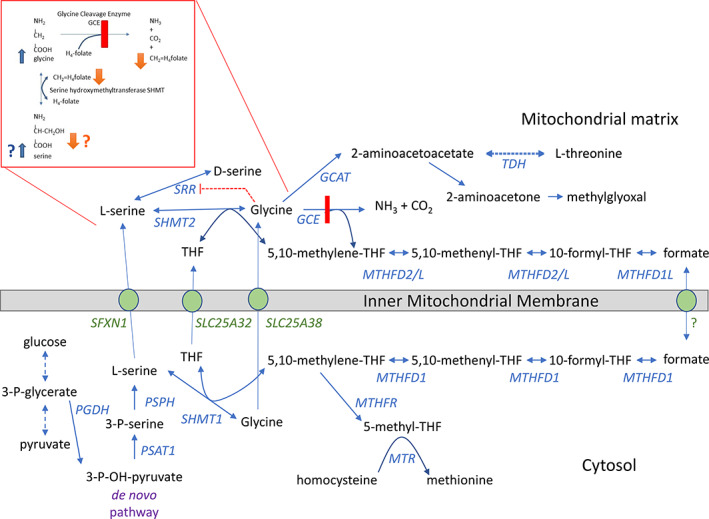
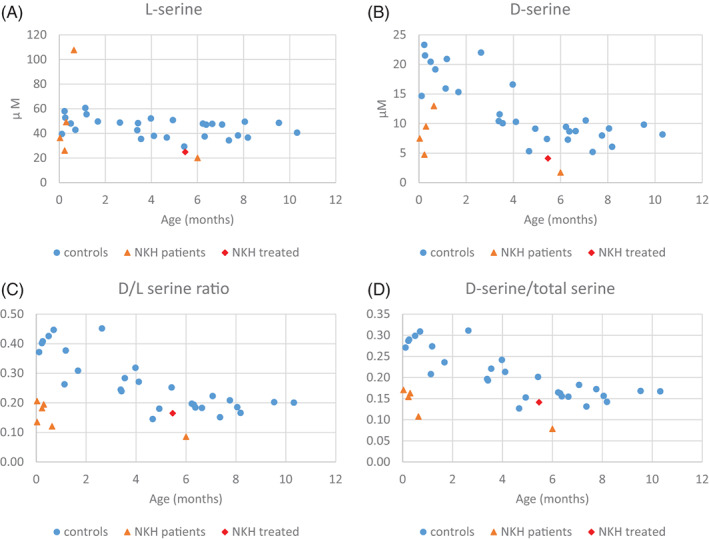
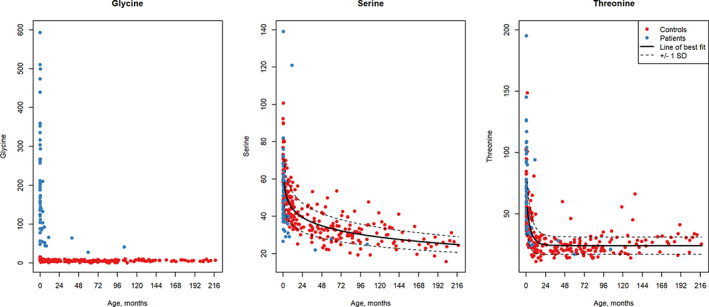
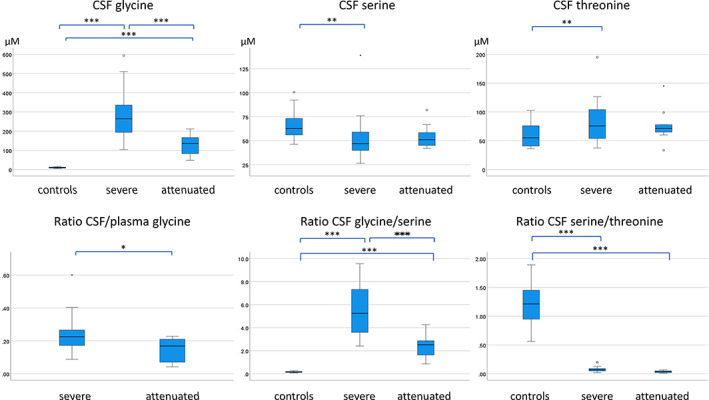
Nonketotic hyperglycinemia (NKH) is caused by deficient glycine cleavage enzyme activity and characterized by elevated brain glycine. Metabolism of glycine is connected enzymatically to serine through serine hydroxymethyltransferase and shares transporters with serine and threonine. We aimed to evaluate changes in serine and threonine in NKH patients, and relate this to clinical outcome severity. Age-related reference values were developed for cerebrospinal fluid (CSF) serine and threonine from 274 controls, and in a cross-sectional study compared to 61 genetically proven NKH patients, categorized according to outcome. CSF d-serine and l-serine levels were stereoselectively determined in seven NKH patients and compared to 29 age-matched controls. In addition to elevated CSF glycine, NKH patients had significantly decreased levels of CSF serine and increased levels of CSF threonine, even after age-adjustment. The CSF serine/threonine ratio discriminated between NKH patients and controls. The CSF glycine/serine aided in discrimination between severe and attenuated neonates with NKH. Over all ages, the CSF glycine, serine and threonine had moderate to fair correlation with outcome classes. After age-adjustment, only the CSF glycine level provided good discrimination between outcome classes. In untreated patients, d-serine was more reduced than l-serine, with a decreased d/l-serine ratio, indicating a specific impact on d-serine metabolism. We conclude that in NKH the elevation of glycine is accompanied by changes in l-serine, d-serine and threonine, likely reflecting a perturbation of the serine shuttle and metabolism, and of one-carbon metabolism. This provides additional guidance on diagnosis and prognosis, and opens new therapeutic avenues to be explored.
非酮症高甘氨酸血症(NKH)是由于甘氨酸裂解酶活性缺乏引起的,其特征是脑甘氨酸升高。甘氨酸的代谢通过丝氨酸羟甲基转移酶与丝氨酸连接,并与丝氨酸和苏氨酸共享转运体。我们旨在评估 NKH 患者中丝氨酸和苏氨酸的变化,并将其与临床结局严重程度相关联。从 274 名对照者中得出了脑脊液(CSF)丝氨酸和苏氨酸的年龄相关参考值,并在一项横断面研究中与 61 名经基因证实的 NKH 患者进行了比较,这些患者根据结果进行了分类。在 7 名 NKH 患者中选择性地确定了 CSF d-丝氨酸和 l-丝氨酸的立体异构体,并与 29 名年龄匹配的对照者进行了比较。除了 CSF 甘氨酸升高外,NKH 患者的 CSF 丝氨酸水平显著降低,CSF 苏氨酸水平升高,即使在年龄调整后也是如此。CSF 丝氨酸/苏氨酸比值可区分 NKH 患者和对照者。CSF 甘氨酸/丝氨酸有助于区分严重和缓解的新生儿 NKH。在所有年龄段,CSF 甘氨酸、丝氨酸和苏氨酸与结局类别之间具有中度至良好的相关性。在年龄调整后,只有 CSF 甘氨酸水平可以很好地区分结局类别。在未治疗的患者中,d-丝氨酸比 l-丝氨酸减少更多,d/l-丝氨酸比值降低,表明对 d-丝氨酸代谢有特异性影响。我们的结论是,在 NKH 中,甘氨酸的升高伴随着 l-丝氨酸、d-丝氨酸和苏氨酸的变化,可能反映了丝氨酸穿梭和代谢以及一碳代谢的紊乱。这为诊断和预后提供了更多指导,并为探索新的治疗途径开辟了新的途径。