Parthasarathy Srinivasan, Krishnapriyanka K J, Saravanan Balachandar
Department of Anaesthesiology, Mahatma Gandhi Medical College and Research Institute, Puducherry, India.
Department of Anaesthesiology, Jawaharlal Institute of Postgraduate Medical Education and Research, Karaikal, Puducherry, India.
Indian J Anaesth. 2022 Feb;66(2):133-139. doi: 10.4103/ija.ija_813_21. Epub 2022 Feb 24.
The efficacy of bilateral nasociliary and maxillary nerve blocks combined with general anaesthesia on intraoperative opioids consumption, emergence and recovery outcomes in adult patients is not well established. We conducted this study to test the hypothesis that the above blocks, combined with general anaesthesia, decrease the intraoperative opioid consumption following nasal surgery.
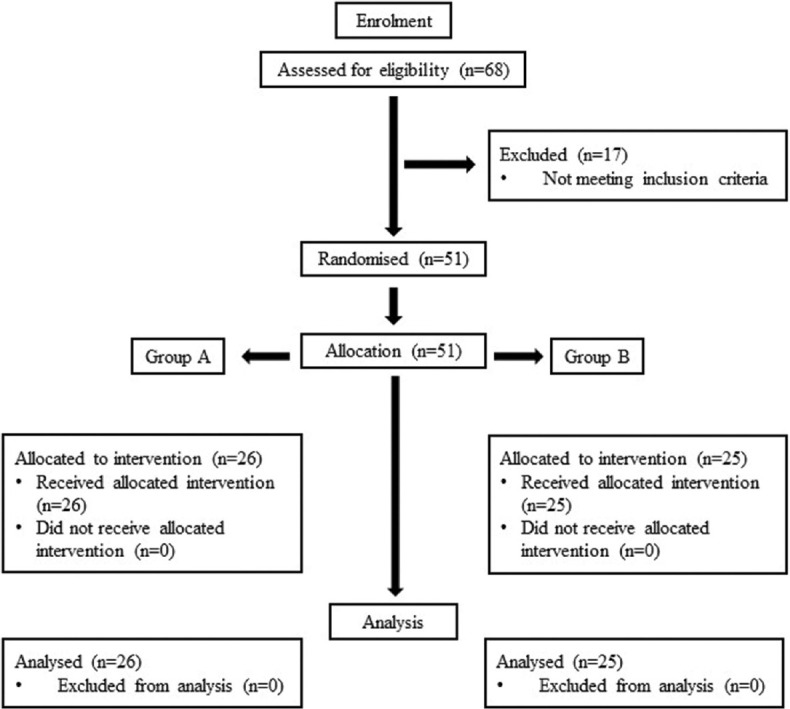
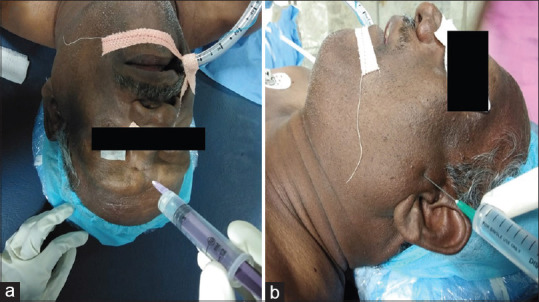
In this prospective, double-blinded, randomised controlled study, 51 adult patients undergoing elective nasal surgery under general anaesthesia were randomised into one of two groups. Group A ( = 26) received bilateral nasociliary and maxillary nerve blocks with 12 mL of equal volumes of 0.5% bupivacaine and 2% lignocaine after induction of general anaesthesia. Group B ( = 25) did not receive any block (control group). The primary endpoint was the total intraoperative dose of fentanyl consumed. The secondary endpoints were the grade of cough, emergence agitation, the grade of post-operative nausea and vomiting, time to the first analgesia and time to post-anaesthesia care unit discharge.
The mean total intraoperative fentanyl dose (μg) was significantly lower in group A than in group B (2.31 ± 11.76 vs. 41.20 ± 31.00, = 0.00). The incidence of emergence agitation was lower in group A than group B (11.5% vs. 88%, = 0.00). The time to the first analgesia was significantly longer in group A than group B (543.27 vs. 199.84 min, = 0.017).
The pre-emptive administration of bilateral nasociliary and maxillary nerve block for nasal surgery is an effective technique for reducing the intraoperative dose of fentanyl and emergence agitation.
双侧鼻睫状神经和上颌神经阻滞联合全身麻醉对成年患者术中阿片类药物消耗量、苏醒及恢复情况的疗效尚未明确。我们开展本研究以验证上述阻滞联合全身麻醉可减少鼻科手术术中阿片类药物消耗量这一假设。
在这项前瞻性、双盲、随机对照研究中,51例接受全身麻醉下择期鼻科手术的成年患者被随机分为两组。A组(n = 26)在全身麻醉诱导后接受双侧鼻睫状神经和上颌神经阻滞,使用12 mL等体积的0.5%布比卡因和2%利多卡因混合液。B组(n = 25)不接受任何阻滞(对照组)。主要终点是术中芬太尼的总消耗量。次要终点包括咳嗽分级、苏醒期躁动、术后恶心呕吐分级、首次镇痛时间及麻醉后监护病房出院时间。
A组术中芬太尼平均总剂量(μg)显著低于B组(2.31 ± 11.76 vs. 41.20 ± 31.00,P = 0.00)。A组苏醒期躁动发生率低于B组(11.5% vs. 88%,P = 0.00)。A组首次镇痛时间显著长于B组(543.27 vs. 199.84分钟,P = 0.017)。
鼻科手术中预防性应用双侧鼻睫状神经和上颌神经阻滞是减少术中芬太尼剂量及苏醒期躁动的有效技术。