Duong Tran Thi Thuy, Tsai Ya-Min, Wen Li-Li, Chiu Hui-Chuan, Chen Pek Kee, Thuy Tran Thi Dieu, Kuo Pei-Yun, Hidrosollo Jazon Harl, Wang Shining, Zhang Yen-Zhen, Lin Wei-Hung, Wang Ming-Cheng, Kao Cheng-Yen
Institute of Microbiology and Immunology, School of Life Sciences, National Yang Ming Chiao Tung University, Taipei, Taiwan.
Department of Clinical Laboratory, En Chu Kong Hospital, New Taipei City, Taiwan.
Front Microbiol. 2022 Mar 11;13:703113. doi: 10.3389/fmicb.2022.703113. eCollection 2022.
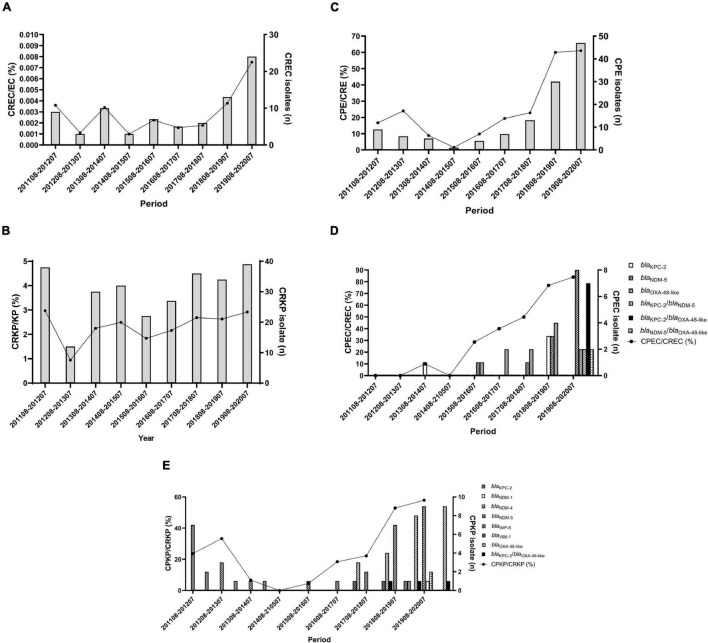
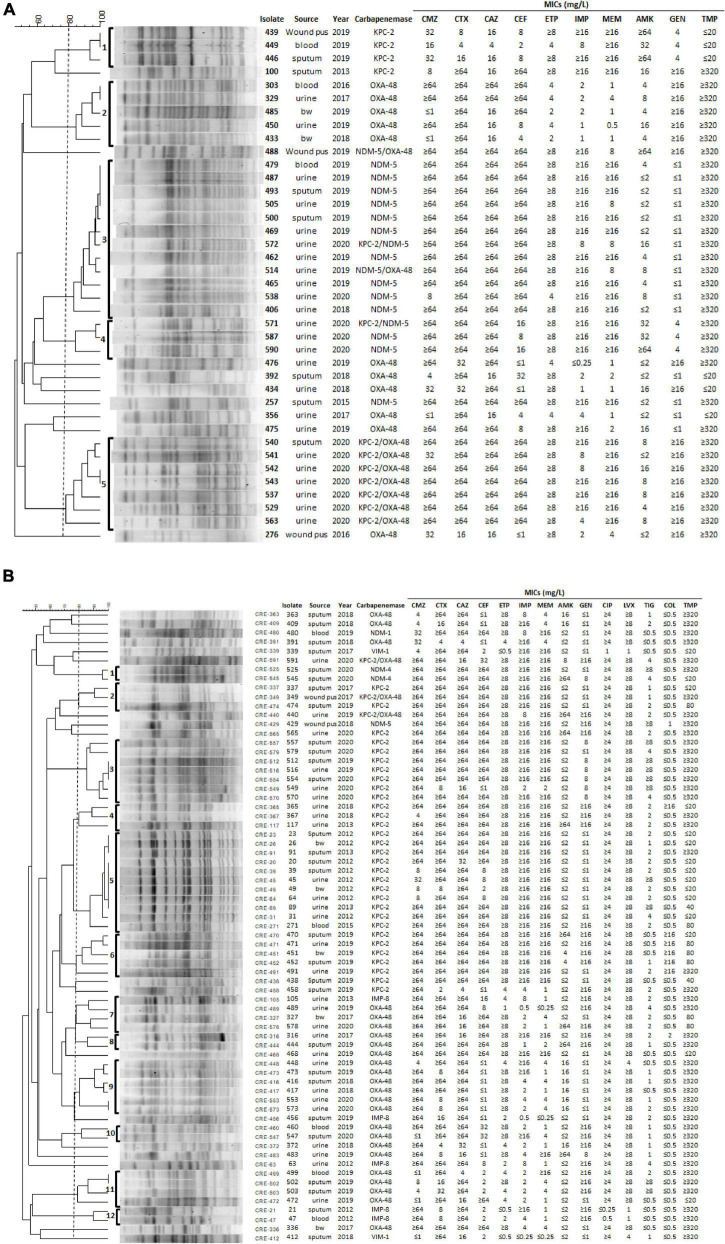
Enterobacterales clinical isolates are now being resistant to clinically achievable concentrations of most commonly used antibiotics that makes treatment of hospitalized patients very challenging. We hereby determine the molecular characteristics of carbapenemase genes in carbapenem-resistant (CRE) isolates in Taiwan. A total of 455 CRE isolates were identified between August 2011 to July 2020. Minimum inhibitory concentrations for selected carbapenems were tested using Vitek 2, and carbapenemase genes were determined using polymerase chain reaction in combination with sequencing. Phenotypic detection of carbapenemase was determined by modified carbapenem inactivation method (mCIM) and EDTA-modified carbapenem inactivation method (eCIM) to validate our PCR screening results. Pulsed-field gel electrophoresis (PFGE) was used to determine the clonality of carbapenemase-producing (CPE) isolates, and the transferability of carbapenemase-carrying plasmids was determined by conjugation assays. A slight increase in carbapenem-resistant (CREC) was observed, however, the prevalence of carbapenem-resistant (CRKP) was steady, during 2011-2020. The dominant species among our CRE was (270/455, 59.3%), followed by (81/455, 17.8%), (32/455, 7.0%), and (25/455, 5.5%). From 2011 to 2020, the total percentage of CPE increased steadily, accounting for 61.0% of CRE in 2020. Moreover, 122 of 455 CRE isolates (26.8%) were CPE. Among the CPE isolates, the dominant carbapenemase gene was (54/122, 44.3%), and the second most common carbapenemase gene was (47/122, 38.5%). The sensitivity and specificity for mCIM to detect carbapenemase in the 455 isolates were both 100% in this study. The PFGE results showed that 39 carbapenemase-producing and 69 carbapenemase-producing isolates carrying and/or could be classified into 5 and 12 clusters, respectively. In conclusion, our results showed an increase in CPE isolates in Taiwan. Moreover, the distribution of carbapenemase and antimicrobial susceptibility in CPE were associated with PFGE typing.
肠杆菌科临床分离株现在对大多数常用抗生素的临床可达到浓度具有耐药性,这使得住院患者的治疗极具挑战性。我们在此确定台湾碳青霉烯类耐药(CRE)分离株中碳青霉烯酶基因的分子特征。在2011年8月至2020年7月期间共鉴定出455株CRE分离株。使用Vitek 2检测选定碳青霉烯类药物的最低抑菌浓度,并使用聚合酶链反应结合测序确定碳青霉烯酶基因。通过改良碳青霉烯灭活法(mCIM)和EDTA改良碳青霉烯灭活法(eCIM)进行碳青霉烯酶的表型检测,以验证我们的PCR筛选结果。脉冲场凝胶电泳(PFGE)用于确定产碳青霉烯酶(CPE)分离株的克隆性,通过接合试验确定携带碳青霉烯酶质粒的可转移性。在2011 - 2020年期间,观察到碳青霉烯类耐药(CREC)略有增加,然而,碳青霉烯类耐药(CRKP)的流行率保持稳定。我们的CRE分离株中优势菌种是(270/455,59.3%),其次是(81/455,17.8%)、(32/455,7.0%)和(25/455,5.5%)。从2011年到2020年,CPE的总百分比稳步上升,2020年占CRE的61.0%。此外,455株CRE分离株中有122株(26.8%)为CPE。在CPE分离株中,优势碳青霉烯酶基因是(54/122,44.3%),第二常见的碳青霉烯酶基因是(47/122,38.5%)。在本研究中,mCIM检测455株分离株中碳青霉烯酶的敏感性和特异性均为100%。PFGE结果显示,39株携带和/或的产碳青霉烯酶和69株产碳青霉烯酶分离株可分别分为5个和12个簇。总之,我们的结果显示台湾CPE分离株有所增加。此外,CPE中碳青霉烯酶的分布和抗菌药物敏感性与PFGE分型相关。