Rodrigues Bruno, Barboza Catarina A, Moura Eliezer G, Ministro Gabriela, Ferreira-Melo Silvia E, Castaño Javier B, Nunes Wilton M S, Mostarda Cristiano, Coca Antonio, Vianna Lauro C, Moreno-Junior Heitor
Laboratory of Cardiovascular Investigation & Exercise, School of Physical Education, University of Campinas (UNICAMP), Campinas, Brazil.
Laboratory of Cardiovascular Pharmacology & Hypertension, School of Medical Sciences, University of Campinas (UNICAMP), Campinas, Brazil.
Front Cardiovasc Med. 2022 Mar 11;9:853427. doi: 10.3389/fcvm.2022.853427. eCollection 2022.
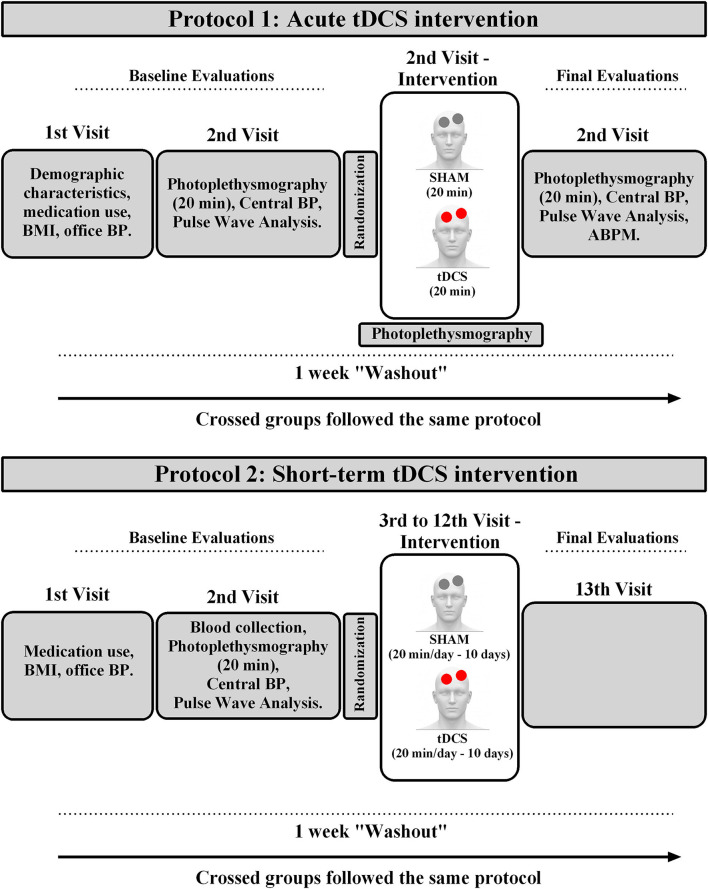
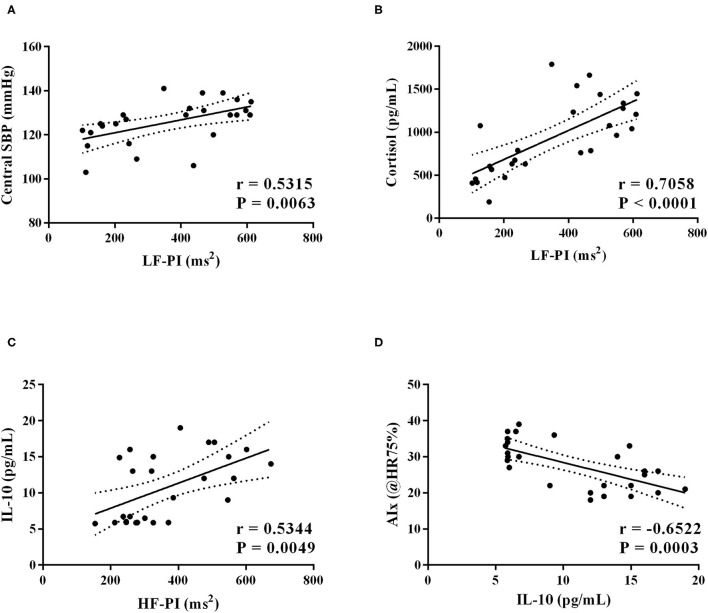
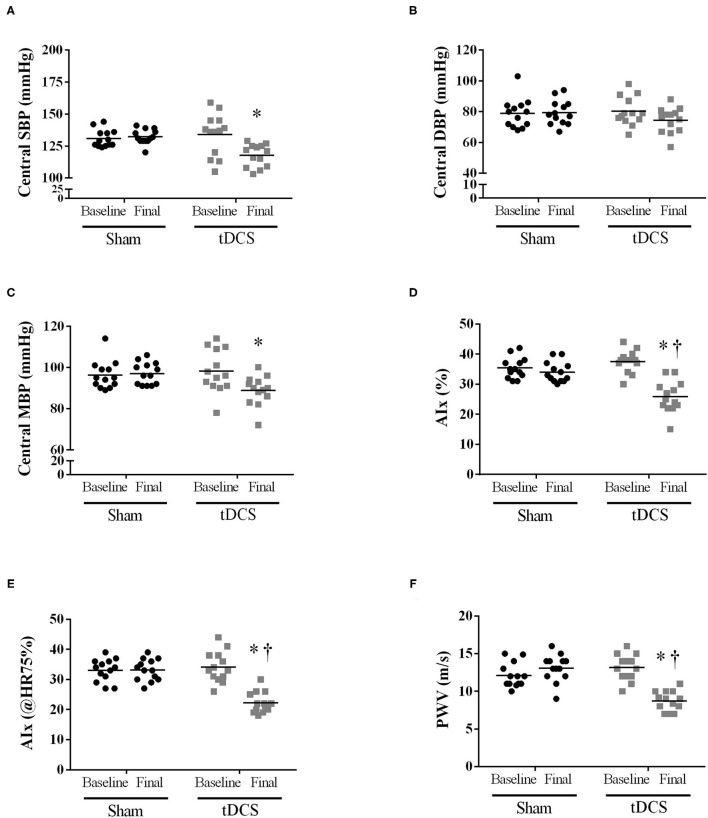
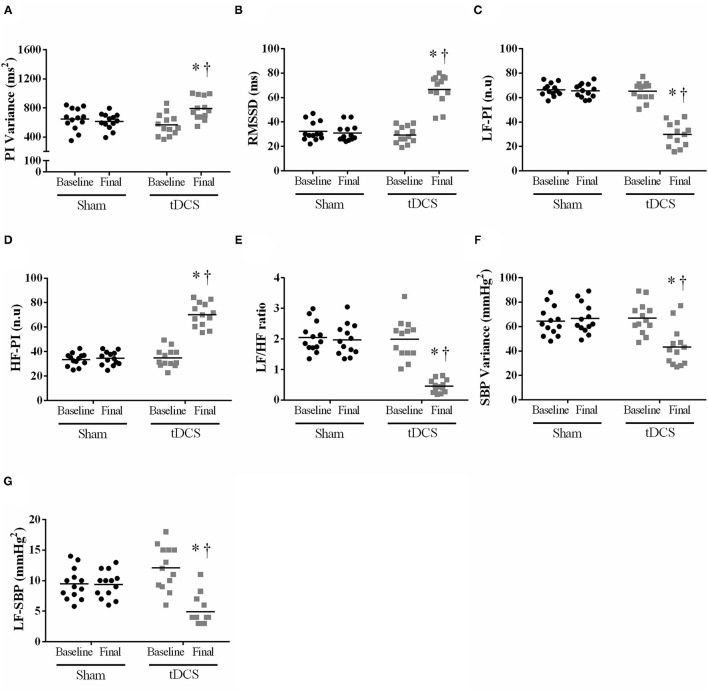
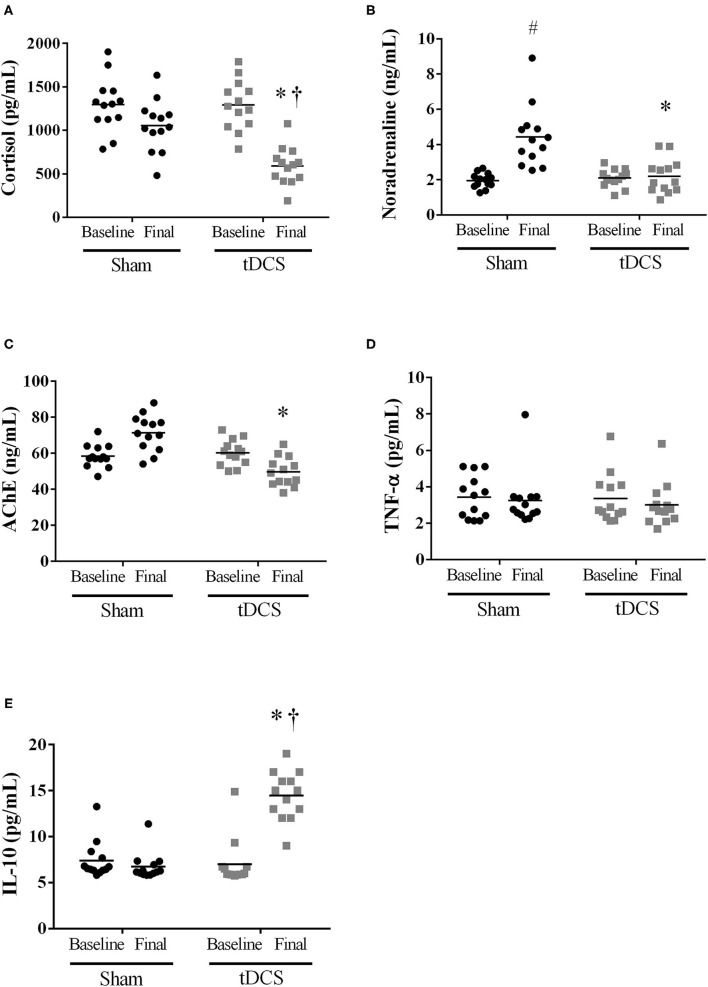
Previously, we demonstrated that acute transcranial direct current stimulation (tDCS) reduced blood pressure (BP) and improved autonomic modulation in hypertensives. We hypothesized that acute and short-term tDCS intervention can promote similar benefits in resistant hypertensive patients (RHT). We assessed the impact of one (acute intervention) and ten (short-term intervention) tDCS or SHAM (20 min, each) sessions on BP, pulse interval (PI) and systolic blood pressure variabilities, humoral mechanisms associated with BP regulation, and cytokines levels. True RHT subjects ( = 13) were randomly submitted to one and ten SHAM and tDCS crossing sessions (1 week of "washout"). Hemodynamic (Finometer, Beatscope), office BP, and autonomic variables (accessed through spectral analysis of the pulse-to-pulse BP signal, in the time and frequency domain - Fast Fourrier Transform) were measured at baseline and after the short-term intervention. 24 h-ambulatory BP monitoring was measured after acute and short-term protocols. Acute intervention: tDCS reduced BP, cardiac output, and increase high-frequency band of PI (vagal modulation to the heart). Short-term protocol: tDCS did not change BP and cardiac output parameters. In contrast, central systolic BP (-12%), augmentation index (-31%), and pulse wave velocity (34%) were decreased by the short-term tDCS when compared to SHAM. These positive results were accompanied by a reduction in the low-frequency band (-37%) and an increase of the high-frequency band of PI (+62%) compared to SHAM. These findings collectively indicate that short-term tDCS concomitantly improves resting cardiac autonomic control and pulse wave behavior and reduces central BP in RHT patients, https://ensaiosclinicos.gov.br/rg/RBR-8n7c9p.
此前,我们证明急性经颅直流电刺激(tDCS)可降低高血压患者的血压(BP)并改善自主神经调节。我们假设急性和短期tDCS干预对顽固性高血压患者(RHT)可产生类似益处。我们评估了一次(急性干预)和十次(短期干预)tDCS或假刺激(每次20分钟)治疗对血压、脉搏间期(PI)、收缩压变异性、与血压调节相关的体液机制以及细胞因子水平的影响。真正的RHT受试者(n = 13)被随机分为接受一次和十次假刺激及tDCS交叉治疗(1周的“洗脱期”)。在基线和短期干预后测量血流动力学指标(Finometer、Beatscope)、诊室血压和自主神经变量(通过逐搏血压信号在时域和频域的频谱分析获取——快速傅里叶变换)。在急性和短期治疗方案后进行24小时动态血压监测。急性干预:tDCS降低了血压、心输出量,并增加了PI的高频段(心脏的迷走神经调节)。短期治疗方案:tDCS未改变血压和心输出量参数。相比之下,与假刺激相比,短期tDCS使中心收缩压降低了12%、增强指数降低了31%、脉搏波速度降低了34%。与假刺激相比,这些积极结果伴随着低频段降低了37%以及PI高频段增加了62%。这些发现共同表明,短期tDCS可同时改善RHT患者静息时的心脏自主神经控制和脉搏波行为,并降低中心血压,https://ensaiosclinicos.gov.br/rg/RBR-8n7c9p 。