Liu Run-Xiang, Liu Huan
Department of Psychology, School of Public Policy and Administration, Nanchang University, Nanchang, China.
Mental Health Education Centre, Nanchang University, Nanchang, China.
Front Psychol. 2022 Mar 11;13:785639. doi: 10.3389/fpsyg.2022.785639. eCollection 2022.
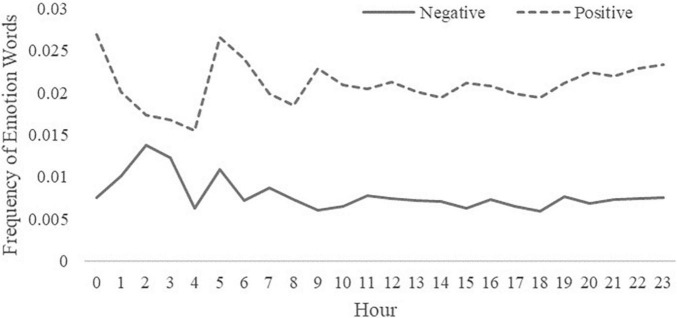
Emotional stability is of great importance for undergraduates and has significant predictive power for mental health. Emotions are associated with individuals' daily lives and routines. Undergraduates commonly post their opinions and feelings on social networks, providing a huge amount of data for studying their emotional states and rhythms. Based on the construction of the emotion dictionary of undergraduates' Tencent tweets (TTs)-a social network for users to share their life situations and express emotions and feelings to friends-we used big data text analysis technology to analyze the emotion words in 45,996 Tencent tweets published by 894 undergraduates. Then, we used hierarchical linear modeling to further analyze the daily rhythms of undergraduate students' emotions and how demographic variables are associated with the daily rhythmic changes. The results were as follows: (1) Undergraduates tweeted about more positive emotions than negative emotions (love was most common and fear was the least common); (2) The emotions in undergraduates' tweets changed considerably from 1 a.m. to 6 a.m., but were fairly stable during the day; (3) There was a rising trend in the frequency of using emotion words in Tencent tweets during the day as each hour progressed, and there was a higher increase in positive emotion than negative emotion; and (4) The word frequencies and daily rhythms of emotions varied depending on demographic variables. Gender was correlated with the frequencies of gratitude and the daily rhythms of anger. As the grade increased, the frequency of emotion words in most subcategories in TTs decreased and the fluctuation in daily rhythms became smaller. There was no significant difference in the frequency and daily rhythm of emotion words used in TTs based on having had a left-behind experience. The results of the present study provided emotion expression in social networks in Chinese collectivist culture. This study added new evidence to support the notion that positive and negative emotions are independent dimensions.
情绪稳定性对大学生至关重要,对心理健康具有显著的预测能力。情绪与个体的日常生活和日常活动相关。大学生通常会在社交网络上发表自己的观点和感受,为研究他们的情绪状态和节奏提供了大量数据。基于构建大学生腾讯微博(TTs)的情感词典——一个用户用于分享生活状况并向朋友表达情感和感受的社交网络——我们使用大数据文本分析技术,对894名大学生发布的45996条腾讯微博中的情感词汇进行了分析。然后,我们使用分层线性模型进一步分析大学生情绪的日常节奏以及人口统计学变量如何与日常节奏变化相关联。结果如下:(1)大学生发布的积极情绪微博多于消极情绪微博(爱最为常见,恐惧最不常见);(2)大学生微博中的情绪在凌晨1点到6点变化很大,但白天相当稳定;(3)随着时间推移,白天腾讯微博中使用情感词汇的频率呈上升趋势,积极情绪的增加幅度高于消极情绪;(4)情感词汇的词频和日常节奏因人口统计学变量而异。性别与感恩的频率以及愤怒的日常节奏相关。随着年级的升高,TTs中大多数子类别情感词汇的频率下降,日常节奏的波动变小。基于是否有留守儿童经历,TTs中使用情感词汇的频率和日常节奏没有显著差异。本研究结果呈现了中国集体主义文化中社交网络里的情绪表达情况。该研究为支持积极情绪和消极情绪是独立维度这一观点增添了新证据。