Department of Surgery and Cancer, Imperial College London, Hammersmith Hospital Campus, Du Cane Road, London, UK.
Department of Surgery, Mater Misericordiae University Hospital, Dublin, Ireland.
J Robot Surg. 2023 Feb;17(1):117-123. doi: 10.1007/s11701-022-01399-5. Epub 2022 Apr 2.
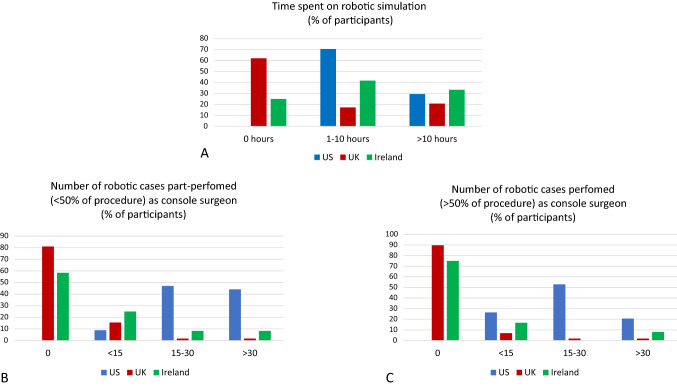
The uptake of robotic surgery is rapidly increasing worldwide across surgical specialties. However, there is currently a much higher use of robotic surgery in the United States of America (USA) compared to the United Kingdom (UK) and Ireland. Reduced exposure to robotic surgery in training may lead to longer learning curves and worse patient outcomes. We aimed to identify whether any difference exists in exposure to robotic surgery during general surgical training between trainees in the USA, UK and Ireland. Over a 15-week period from September 2021, a survey was distributed through the professional networks of the research team. Participants were USA, UK or Irish trainees who were part of a formal general surgical training curriculum. 116 survey responses were received. US trainees (n = 34) had all had robotic simulator experience, compared to only 37.93% of UK (n = 58) and 75.00% of Irish (n = 24) trainees (p < 0.00001). 91.18% of US trainees had performed 15 or more cases as the console surgeon, compared to only 3.44% of UK and 16.67% of Irish trainees (p < 0.00001). Fifty UK trainees (86.21%) and 22 Irish trainees (91.67%) compared to 12 US trainees (35.29%) do not think they have had adequate robotics training (p < 0.00001). Surgical trainees in the USA have had significantly more exposure to training in robotic surgery than their UK and Irish counterparts.
机器人手术在全球范围内的外科专业领域迅速普及。然而,与英国和爱尔兰相比,美国目前使用机器人手术的比例要高得多。在培训中接触机器人手术的机会减少可能导致学习曲线更长,患者预后更差。我们旨在确定美国、英国和爱尔兰的外科培训生在普通外科培训中接触机器人手术的情况是否存在差异。在 2021 年 9 月的 15 周内,通过研究团队的专业网络分发了一份调查。参与者是来自美国、英国或爱尔兰的培训生,他们都参加了正式的普通外科培训课程。共收到 116 份调查回复。美国的培训生(n=34)都有机器人模拟器的经验,而英国(n=58)和爱尔兰(n=24)的培训生只有 37.93%和 75.00%有过这种经历(p<0.00001)。91.18%的美国培训生作为控制台外科医生完成了 15 例或更多的手术,而英国和爱尔兰的培训生只有 3.44%和 16.67%(p<0.00001)。与 12 名美国培训生(35.29%)相比,50 名英国培训生(86.21%)和 22 名爱尔兰培训生(91.67%)认为他们没有接受过足够的机器人手术培训(p<0.00001)。与英国和爱尔兰的同行相比,美国的外科培训生在机器人手术培训方面的接触机会明显更多。