Faculty of Medicine, University of Nis, Nis, Serbia.
Clinical Center Nis, Clinic for Nephrology, Nis, Serbia.
Int Urol Nephrol. 2022 Oct;54(10):2695-2702. doi: 10.1007/s11255-022-03184-7. Epub 2022 Apr 2.
Patients with end-stage renal disease (ESRD) receiving hemodialysis (HD) often experience bleeding. However, mechanisms behind this bleeding tendency are incompletely understood but may involve platelet dysfunction. We, therefore, studied platelet-dependent thrombus formation in flowing whole blood inside a microchip coated with collagen, and its association with circulating von Willebrand factor (VWF).
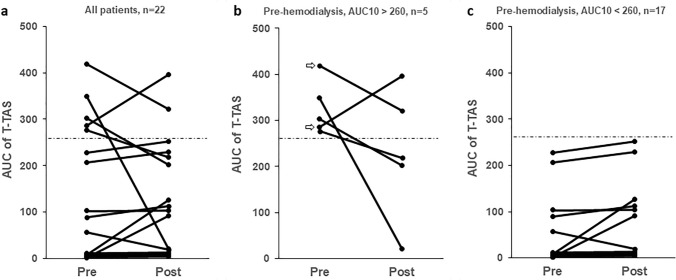
Blood samples were obtained in 22 patients before and after HD. The area under the 10 min flow pressure curve in a microchip (AUC10) reflecting total platelet thrombogenicity was measured, using the Total Thrombus-formation Analysis System (T-TAS01). AUC10 < 260 indicates platelet dysfunction. VWF activity and antigen in plasma were also assayed.
VWF levels were moderately elevated and increased further after HD (P < 0.01 or lower). In contrast, AUC10 before and after HD was < 260 in 17/22 patients and < 130 in 15/22 patients, with no statistically significant difference in pre- vs post-HD measurements, indicating reduced platelet thrombogenicity, but with some variability as 5/22 patients showed normal platelet responsiveness. AUC10 and VWF activity or antigen levels in plasma were not correlated, either before or after HD.
Most ESRD patients display moderate-to-severe platelet dysfunction as assessed by shear-induced platelet-dependent thrombus formation with T-TAS01. HD does not influence platelet function despite HD-induced elevations in VWF. T-TAS01 should be further evaluated as a tool in the assessment of bleeding risk in patients on HD.
接受血液透析(HD)的终末期肾病(ESRD)患者经常会出现出血。然而,这种出血倾向的机制尚不完全清楚,但可能涉及血小板功能障碍。因此,我们研究了在涂有胶原蛋白的微芯片内流动全血中血小板依赖性血栓形成及其与循环血管性血友病因子(VWF)的关系。
在 HD 前后从 22 例患者中采集血液样本。使用全血栓形成分析系统(T-TAS01)测量反映总血小板血栓形成性的微芯片内 10 分钟流动压力曲线下面积(AUC10)。AUC10<260 表明血小板功能障碍。还测定了血浆中的 VWF 活性和抗原。
VWF 水平中度升高,HD 后进一步升高(P<0.01 或更低)。相比之下,22 例患者中有 17/22 例在 HD 前后的 AUC10<260,15/22 例的 AUC10<130,HD 前后测量值无统计学差异,表明血小板血栓形成性降低,但存在一定变异性,因为有 5/22 例患者表现出正常的血小板反应性。AUC10 与血浆中的 VWF 活性或抗原水平在 HD 前后均无相关性。
通过 T-TAS01 评估剪切诱导的血小板依赖性血栓形成,大多数 ESRD 患者表现出中重度血小板功能障碍。尽管 HD 引起 VWF 升高,但 HD 并不影响血小板功能。T-TAS01 应进一步评估作为 HD 患者出血风险评估的工具。