Department of Developmental Psychology, University of Potsdam, Germany; Max Planck Institute for Human Cognitive and Brain Sciences, Leipzig, Germany.
Max Planck Institute for Human Cognitive and Brain Sciences, Leipzig, Germany; Laboratory for Biosignal Processing, Leipzig University of Applied Sciences, Germany.
Dev Cogn Neurosci. 2022 Apr;54:101104. doi: 10.1016/j.dcn.2022.101104. Epub 2022 Mar 28.
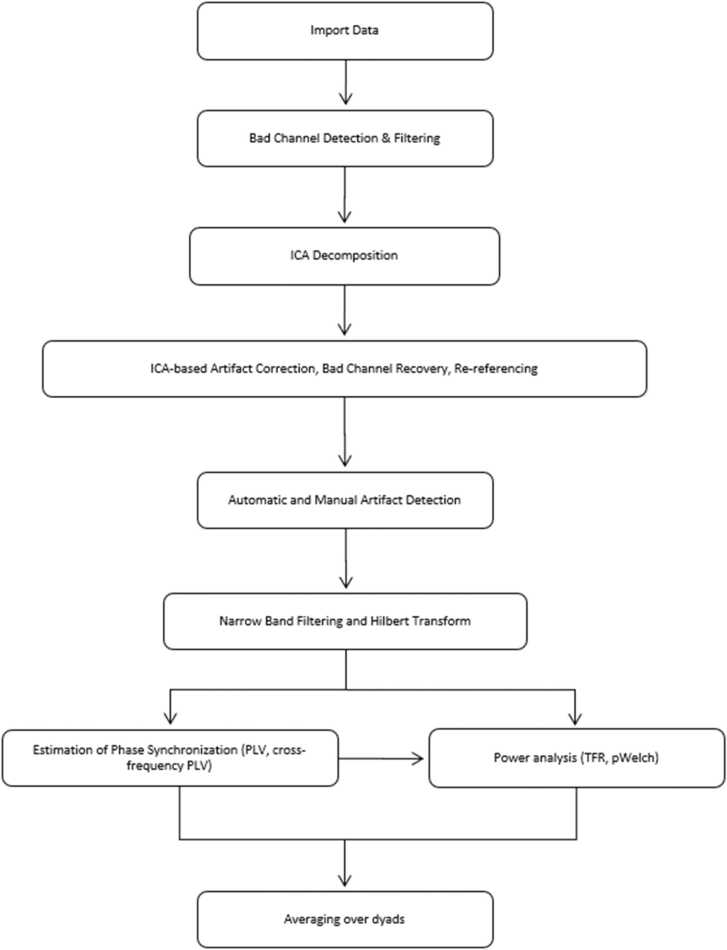
Cutting-edge hyperscanning methods led to a paradigm shift in social neuroscience. It allowed researchers to measure dynamic mutual alignment of neural processes between two or more individuals in naturalistic contexts. The ever-growing interest in hyperscanning research calls for the development of transparent and validated data analysis methods to further advance the field. We have developed and tested a dual electroencephalography (EEG) analysis pipeline, namely DEEP. Following the preprocessing of the data, DEEP allows users to calculate Phase Locking Values (PLVs) and cross-frequency PLVs as indices of inter-brain phase alignment of dyads as well as time-frequency responses and EEG power for each participant. The pipeline also includes scripts to control for spurious correlations. Our goal is to contribute to open and reproducible science practices by making DEEP publicly available together with an example mother-infant EEG hyperscanning dataset.
前沿的超扫描方法推动了社会神经科学的范式转变。它使研究人员能够在自然环境中测量两个或更多个体之间神经过程的动态相互对齐。对超扫描研究的兴趣不断增长,需要开发透明和经过验证的数据分析方法来进一步推动该领域的发展。我们开发并测试了一种双脑电图 (EEG) 分析管道,即 DEEP。在对数据进行预处理后,DEEP 允许用户计算相位锁定值 (PLV) 和跨频 PLV,作为双体间大脑相位对齐的指标,以及每个参与者的时频响应和 EEG 功率。该管道还包括用于控制虚假相关的脚本。我们的目标是通过将 DEEP 与示例母婴 EEG 超扫描数据集一起公开,为开放和可重复的科学实践做出贡献。