Carbon Claus-Christian, Held Marco Jürgen, Schütz Astrid
Department of Psychology, University of Bamberg, Bamberg, Germany.
Bamberg Graduate School of Affective and Cognitive Sciences (BaGrACS), Bamberg, Germany.
Front Psychol. 2022 Mar 17;13:856971. doi: 10.3389/fpsyg.2022.856971. eCollection 2022.
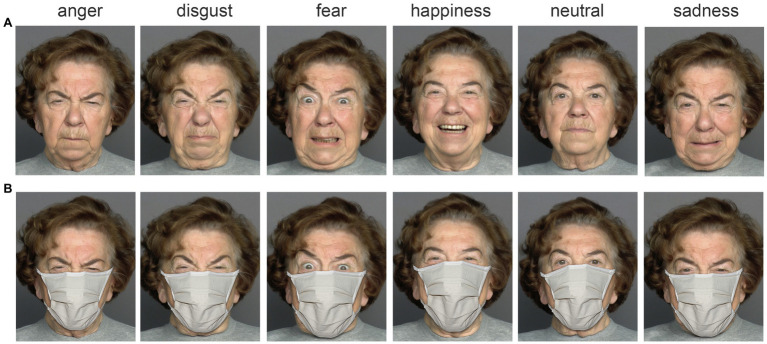
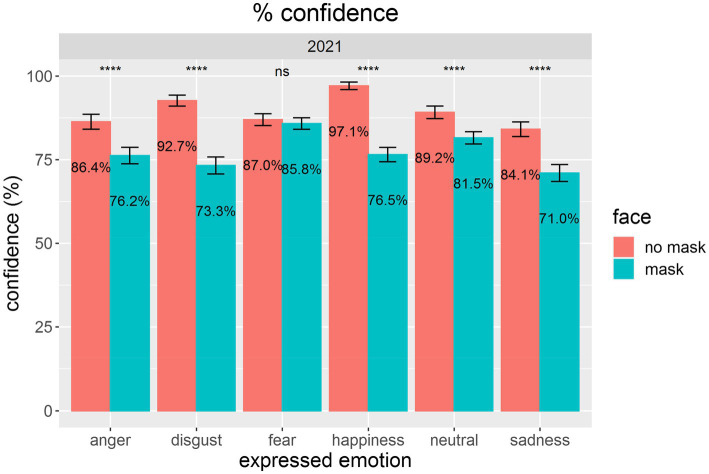
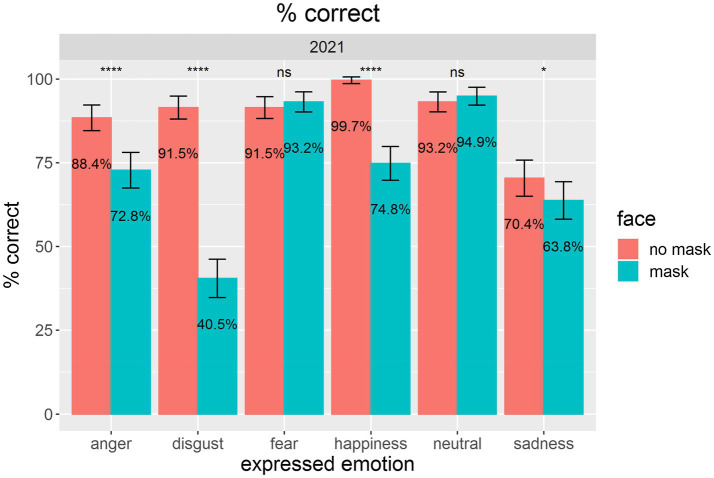
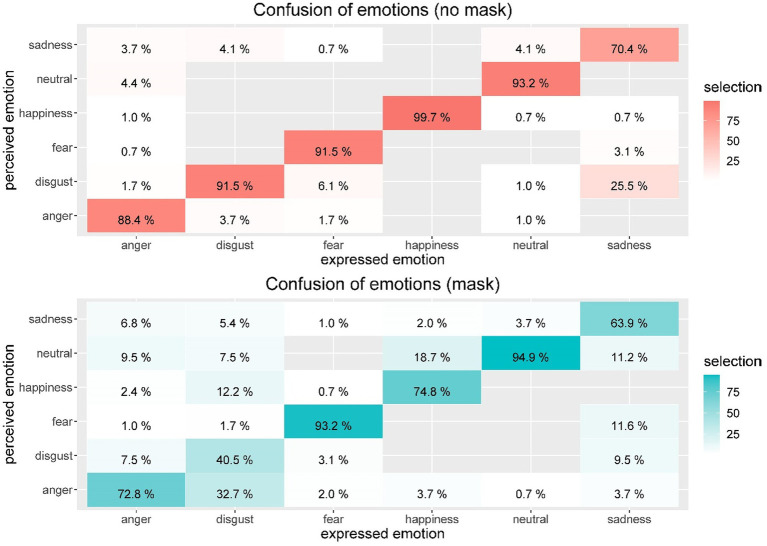
The ability to read emotions in faces helps humans efficiently assess social situations. We tested how this ability is affected by aspects of familiarization with face masks and personality, with a focus on emotional intelligence (measured with an ability test, the MSCEIT, and a self-report scale, the SREIS). To address aspects of the current pandemic situation, we used photos of not only faces but also of faces that were partially covered with face masks. The sample ( = 49), the size of which was determined by an power test, was recruited in Germany and consisted of healthy individuals of different ages [ = 24.8 (18-64) years]. Participants assessed the emotional expressions displayed by six different faces determined by a 2 (sex) × 3 (age group: young, medium, and old) design. Each person was presented with six different emotional displays (angry, disgusted, fearful, happy, neutral, and sad) with or without a face mask. Accuracy and confidence were lower with masks-in particular for the emotion disgust (very often misinterpreted as anger) but also for happiness, anger, and sadness. When comparing the present data collected in July 2021 with data from a different sample collected in May 2020, when people first started to familiarize themselves with face masks in Western countries during the first wave of the COVID-19 pandemic, we did not detect an improvement in performance. There were no effects of participants' emotional intelligence, sex, or age regarding their accuracy in assessing emotional states in faces for unmasked or masked faces.
从面部表情中解读情绪的能力有助于人类高效地评估社交情境。我们测试了熟悉口罩和个性方面如何影响这种能力,重点关注情商(通过能力测试MSCEIT和自我报告量表SREIS进行测量)。为了应对当前大流行形势的各个方面,我们不仅使用了面部照片,还使用了部分被口罩遮住的面部照片。样本(n = 49)的大小由功效检验确定,在德国招募,由不同年龄的健康个体组成[平均年龄 = 24.8(18 - 64)岁]。参与者评估了由2(性别)×3(年龄组:年轻、中年和老年)设计确定的六种不同面部所展示的情绪表达。每个人会看到六种不同的情绪展示(愤怒、厌恶、恐惧、快乐、中性和悲伤),有的面部有口罩,有的没有。戴口罩时的准确性和信心较低——尤其是对于厌恶情绪(经常被误判为愤怒),但对于快乐、愤怒和悲伤情绪也是如此。将2021年7月收集的当前数据与2020年5月从不同样本收集的数据进行比较时,当时在新冠疫情第一波期间西方国家的人们刚开始熟悉口罩,我们并未发现表现有所改善。在评估戴口罩或不戴口罩面部的情绪状态时,参与者的情商、性别或年龄对其准确性没有影响。