Wang Yinghui, Wang Yonggang, Han Xiaorong, Sun Jian, Li Cheng, Adhikari Binay Kumar, Zhang Jin, Miao Xiao, Chen Zhaoyang
Department of Cardiovascular Centre, The First Hospital of Jilin University, Changchun, China.
Department of Cardiology, Nepal APF Hospital, Kathmandu, Nepal.
Front Cardiovasc Med. 2022 Mar 17;9:727487. doi: 10.3389/fcvm.2022.727487. eCollection 2022.
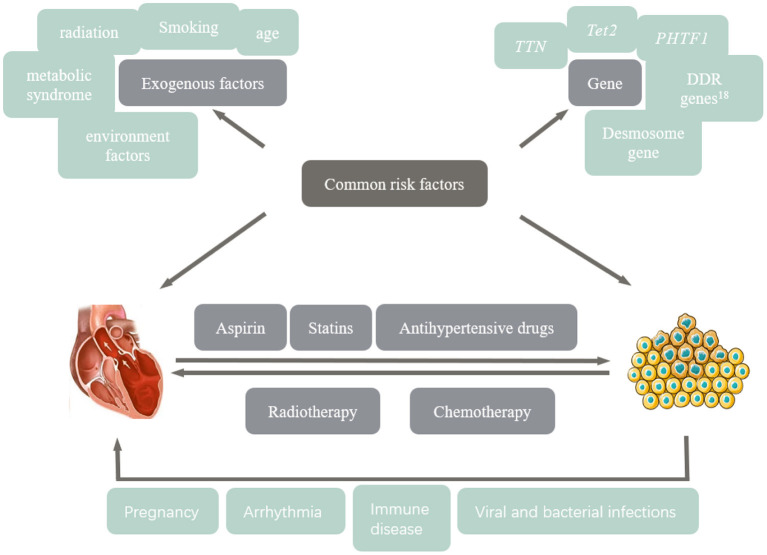
Cardiovascular disease (CVD) and cancer are the leading causes of death worldwide. With an increasing number of the elderly population, and early cancer screening and treatment, the number of cancers cases are rising, while the mortality rate is decreasing. However, the number of cancer survivors is increasing yearly. With the prolonged life span of cancer patients, the adverse effects of anti-tumor therapy, especially CVD, have gained enormous attention. The incidence of cardiovascular events such as cardiac injury or cardiovascular toxicity is higher than malignant tumors' recurrence rate. Numerous clinical studies have also shifted their focus from the study of a single disease to the interdisciplinary study of oncology and cardiology. Previous studies have confirmed that anti-tumor therapy can cause CVD. Additionally, the treatment of CVD is also related to the tumors incidence. It is well established that the increased incidence of CVD in cancer patients is probably due to an unmodified unhealthy lifestyle among cancer survivors or cardiotoxicity caused by anti-cancer therapy. Nevertheless, some patients with CVD have a relatively increased cancer risk because CVD and malignant tumors are highly overlapping risk factors, including gender, age, hypertension, diabetes, hyperlipidemia, inflammation, and obesity. With advancements in the diagnosis and treatment, many patients simultaneously suffer from CVD and cancer, and most of them have a poor prognosis. Therefore, clinicians should understand the relationship between CVD and tumors, effectively identify the primary and secondary prevention for these diseases, and follow proper treatment methods.
心血管疾病(CVD)和癌症是全球主要的死因。随着老年人口数量的增加以及癌症早期筛查和治疗的开展,癌症病例数量在上升,而死亡率在下降。然而,癌症幸存者的数量逐年增加。随着癌症患者寿命的延长,抗肿瘤治疗的不良反应,尤其是心血管疾病,受到了极大关注。心脏损伤或心血管毒性等心血管事件的发生率高于恶性肿瘤的复发率。许多临床研究也已将重点从单一疾病的研究转向肿瘤学和心脏病学的跨学科研究。先前的研究证实,抗肿瘤治疗可导致心血管疾病。此外,心血管疾病的治疗也与肿瘤发病率有关。众所周知,癌症患者心血管疾病发病率增加可能是由于癌症幸存者未改变的不健康生活方式或抗癌治疗引起的心脏毒性。然而,一些心血管疾病患者患癌症的风险相对增加,因为心血管疾病和恶性肿瘤有高度重叠的风险因素,包括性别、年龄、高血压、糖尿病、高脂血症、炎症和肥胖。随着诊断和治疗的进步,许多患者同时患有心血管疾病和癌症,而且他们中的大多数预后较差。因此,临床医生应了解心血管疾病与肿瘤之间的关系,有效识别这些疾病的一级和二级预防措施,并采用适当的治疗方法。