Baradaran Hediyeh, Gupta Ajay
Department of Radiology, University of Utah, Salt Lake City, UT, United States.
Department of Radiology, Weill Cornell Medicine, New York, NY, United States.
Front Cardiovasc Med. 2022 Mar 15;9:852173. doi: 10.3389/fcvm.2022.852173. eCollection 2022.
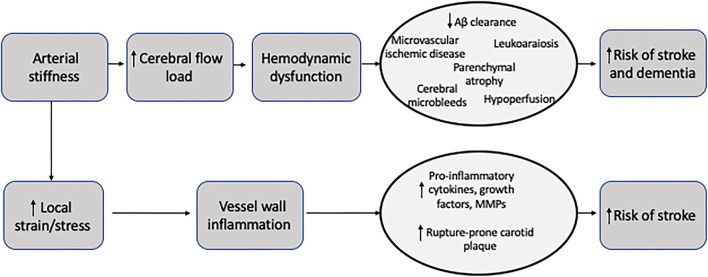
Arterial stiffness is an important measure of vascular aging and atherosclerosis. Though it is measured in many well-known epidemiologic cohort studies, arterial stiffness is often overlooked in routine clinical practice for a number of reasons including difficulties in measurement, variations in definition, and uncertainties surrounding treatment. Central arterial stiffness, a surrogate for aortic stiffness, is the most commonly measured marker of arterial stiffness. In addition to central stiffness, there are also a number of ultrasound based techniques to measure local vascular stiffness, including carotid stiffness. There is evidence that both local carotid stiffness and central arterial stiffness measures are associated with multiple cerebrovascular processes, including stroke and cognitive dysfunction. Mechanistic explanations supporting this association include increased flow load experienced by the cerebral microvasculature leading to cerebral parenchymal damage. In this article, we review definitions of carotid artery stiffness measures and pathophysiologic mechanisms underpinning its association with plaque development and downstream cerebral pathology. We will review the evidence surrounding the association of carotid stiffness measures with downstream manifestations including stroke, cerebral small vessel disease detected on brain MR such as white matter hyperintensities and covert brain infarctions, brain atrophy, and cognitive dysfunction. With consistent definitions, measurement methods, and further scientific support, carotid stiffness may have potential as an imaging-based risk factor for stroke and cognitive decline.
动脉僵硬度是血管老化和动脉粥样硬化的一项重要指标。尽管在许多著名的流行病学队列研究中都对其进行了测量,但由于测量困难、定义差异以及治疗方面的不确定性等多种原因,动脉僵硬度在常规临床实践中常常被忽视。中心动脉僵硬度作为主动脉僵硬度的替代指标,是最常测量的动脉僵硬度标志物。除了中心僵硬度外,还有多种基于超声的技术来测量局部血管僵硬度,包括颈动脉僵硬度。有证据表明,局部颈动脉僵硬度测量值和中心动脉僵硬度测量值均与多种脑血管病变相关,包括中风和认知功能障碍。支持这种关联的机制性解释包括脑微血管所承受的血流负荷增加导致脑实质损伤。在本文中,我们回顾了颈动脉僵硬度测量指标的定义以及其与斑块形成和下游脑部病变关联的病理生理机制。我们将回顾有关颈动脉僵硬度测量值与下游表现(包括中风、脑部磁共振成像检测到的脑小血管病,如白质高信号和隐匿性脑梗死、脑萎缩以及认知功能障碍)之间关联的证据。有了一致的定义、测量方法以及进一步的科学支持,颈动脉僵硬度可能有潜力成为基于影像学的中风和认知衰退风险因素。