Wang Wei-Ting, Chang Wei-Lun, Cheng Hao-Min
Division of Cardiology, Department of Internal Medicine, Taipei Veterans General Hospital, Taipei, Taiwan.
School of Medicine, National Yang Ming Chiao Tung University, Taipei, Taiwan.
Pulse (Basel). 2022 Nov 18;10(1-4):19-25. doi: 10.1159/000528147. eCollection 2022 Dec.
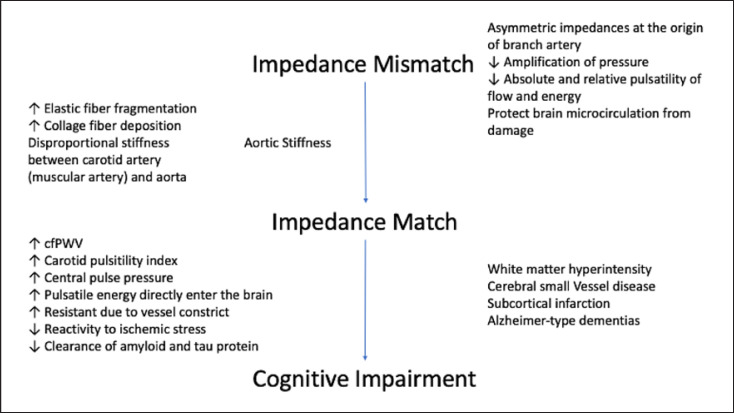
Aortic stiffness increases with age and is a robust predictor of cerebrovascular events and cognitive decline including Alzheimer's disease and other forms of dementia. Recent clinical studies have investigated the association between proximal aortic stiffness and pulsatile energy transmission that has deleterious effects on the cerebrovascular network in order to identify potential therapeutic targets. Aging causes disproportionate stiffening of the aorta compared with the carotid arteries, reducing protective impedance mismatches at their interface, increasing the transmission of destructive pulsatile pressure and energy to the cerebral circulation, and leading to cerebral small vessel disease. Thus, aortic stiffening and high-flow pulsatility are associated with alterations in the microvasculature of the brain, vascular endothelial dysfunction, and white matter damage, which contribute to impaired memory function with advancing age. Previous studies have also shown that silent lacunar infarcts and white matter hyperintensities are strongly associated with arterial stiffness. More and more evidence suggests that vascular etiologies, including aortic stiffness, impedance match, and microvascular damage, are associated with cognitive impairment and the pathogenesis of dementia. The measurement of arterial flow and pressure can help understand pulsatile hemodynamics and its impact on vital organs. Interventions that reduce aortic stiffness, such as improvement of the living environment, management of risk factors, and innovation and development of novel drugs, may reduce the risk for dementia.
主动脉僵硬度随年龄增长而增加,是脑血管事件和认知功能衰退(包括阿尔茨海默病和其他形式的痴呆症)的有力预测指标。最近的临床研究调查了升主动脉僵硬度与搏动能量传递之间的关联,搏动能量传递对脑血管网络具有有害影响,目的是确定潜在的治疗靶点。与颈动脉相比,衰老导致主动脉过度僵硬,减少了它们界面处的保护性阻抗失配,增加了破坏性搏动压力和能量向脑循环的传递,并导致脑小血管疾病。因此,主动脉僵硬度增加和高流量搏动性与脑微血管系统改变、血管内皮功能障碍和白质损伤有关,这些因素会随着年龄增长导致记忆功能受损。先前的研究还表明,无症状腔隙性脑梗死和白质高信号与动脉僵硬度密切相关。越来越多的证据表明,包括主动脉僵硬度、阻抗匹配和微血管损伤在内的血管病因与认知障碍和痴呆症的发病机制有关。测量动脉血流和压力有助于了解搏动血流动力学及其对重要器官的影响。降低主动脉僵硬度的干预措施,如改善生活环境、管理危险因素以及创新和开发新型药物,可能会降低患痴呆症的风险。