Yeo Huimin, Chong Connie Wan Hui, Chen Elijah Weihua, Lim Ze Qin, Ng Qing Yong, Yan Benedict, Chu Justin Jang Hann, Chow Vincent T K, Alonso Sylvie
Infectious Diseases Translational Research Programme, Department of Microbiology and Immunology, Yong Loo Lin School of Medicine, National University of Singapore, Singapore, Singapore.
Immunology Programme, Life Sciences Institute, National University of Singapore, Singapore, Singapore.
Front Microbiol. 2022 Mar 17;13:821976. doi: 10.3389/fmicb.2022.821976. eCollection 2022.
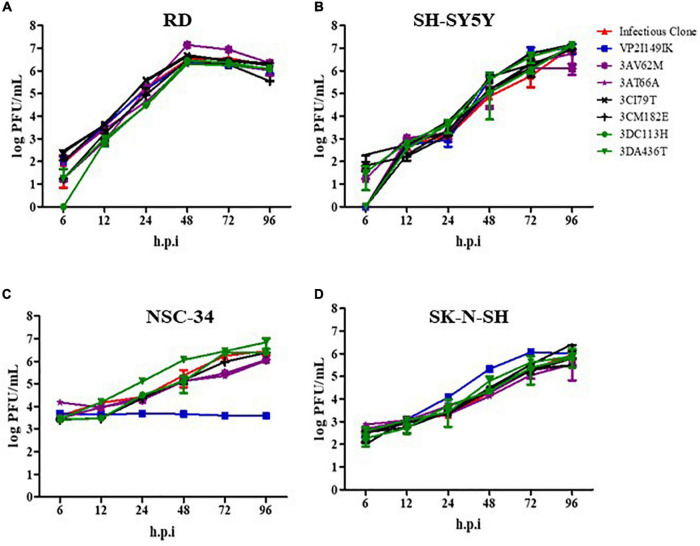
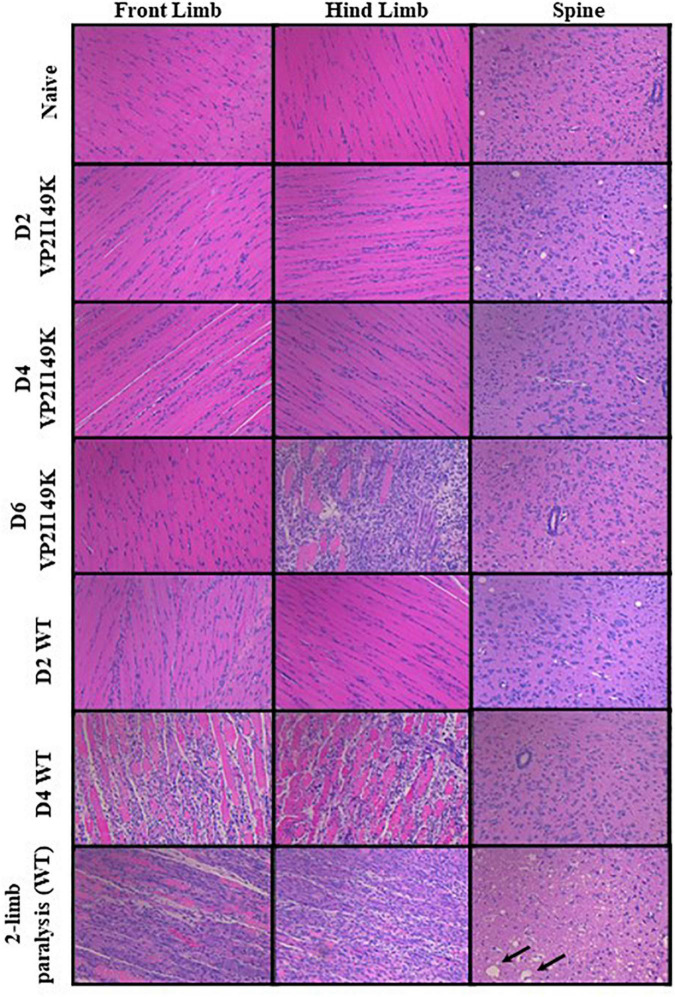
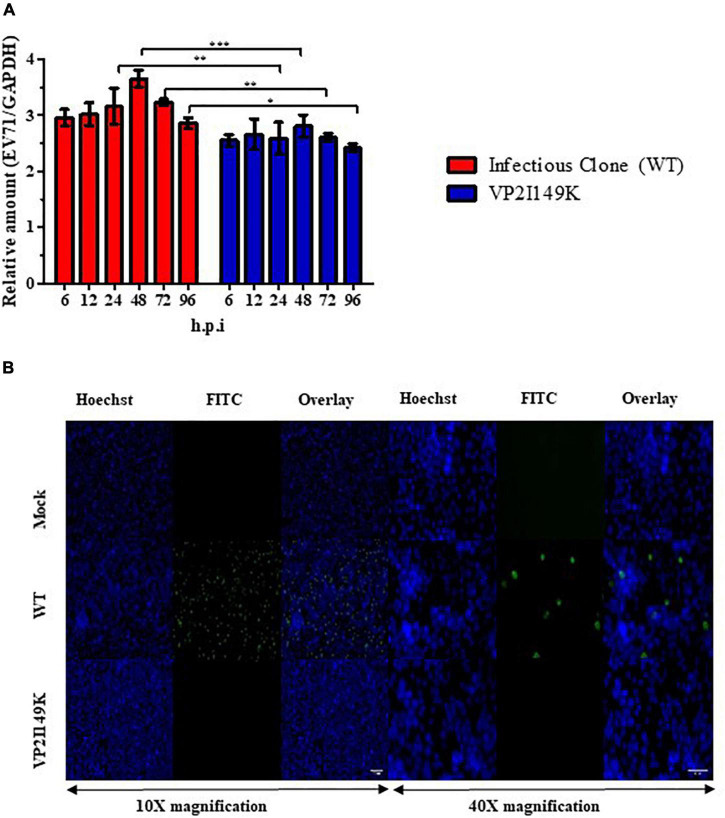
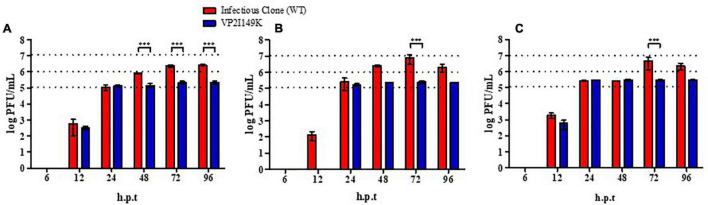
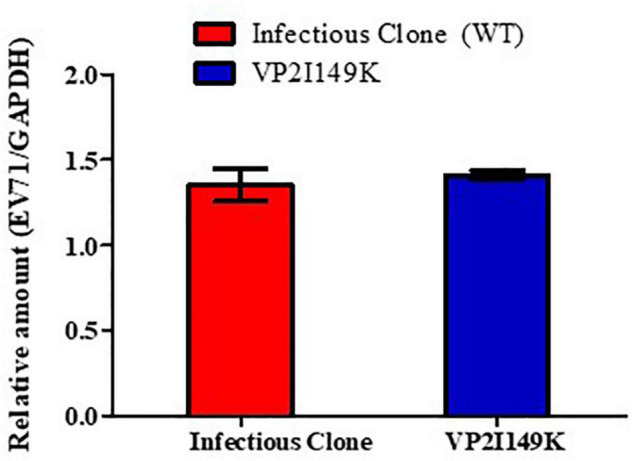
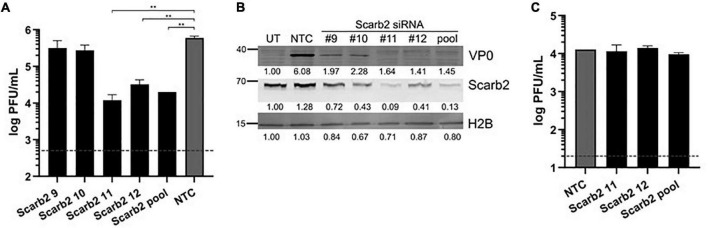
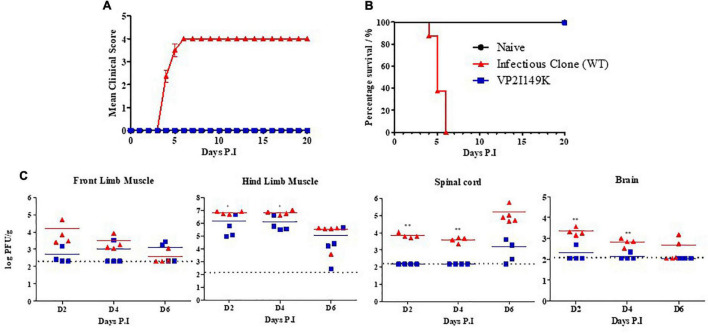
Enterovirus 71 (EV-A71) causes hand, foot, and mouth disease (HFMD) in children and has been associated with neurological complications. With no specific treatment and a monovalent vaccine limited to the Chinese market, HFMD remains a serious public health concern and an economic burden to affected societies. The molecular mechanisms underpinning EV-A71 neurovirulence have yet to be fully elucidated. In this work, we provide experimental evidence that a single amino acid substitution (I to K) at position 149 in structural protein VP2 of a non-mouse-adapted EV-A71 strain completely and specifically abrogated its infectivity in murine motor neuron-like NSC-34 cells. We showed that VP2 I149K mutant was impaired in murine SCARB2-mediated entry step but retained the ability to attach at the cell surface. , VP2 I149K mutant was fully attenuated in a symptomatic mouse model of progressive limb paralysis. While viral titers in limb muscles were comparable to mice infected with parental wild-type strain, significantly lower viral titers were measured in the spinal cord and brain, with minimal tissue damage, therefore indicating that VP2 I149K mutant is specifically impaired in its ability to invade the central nervous system (CNS). This study highlights the key role of amino acid at position 149 in VP2 in EV-A71 neurovirulence, and lends further support that the EF loop of VP2 represents a potential therapeutic target.
肠道病毒71型(EV - A71)可导致儿童手足口病(HFMD),并与神经并发症有关。由于缺乏特效治疗方法,且单价疫苗仅限于中国市场,手足口病仍然是一个严重的公共卫生问题,给受影响的社会带来经济负担。EV - A71神经毒力的分子机制尚未完全阐明。在这项研究中,我们提供了实验证据,即非小鼠适应的EV - A71毒株结构蛋白VP2第149位的单个氨基酸替换(I到K)完全且特异性地消除了其在小鼠运动神经元样NSC - 34细胞中的感染性。我们发现VP2 I149K突变体在小鼠SCARB2介导的进入步骤中受损,但保留了在细胞表面附着的能力。此外,VP2 I149K突变体在进行性肢体麻痹的有症状小鼠模型中完全减毒。虽然肢体肌肉中的病毒滴度与感染亲本野生型毒株的小鼠相当,但在脊髓和脑中测得的病毒滴度明显较低,组织损伤最小,因此表明VP2 I149K突变体在侵入中枢神经系统(CNS)的能力方面存在特异性缺陷。这项研究突出了VP2中第149位氨基酸在EV - A71神经毒力中的关键作用,并进一步支持VP2的EF环代表一个潜在的治疗靶点。