Almurisi Nasr, Tadisetty Srinivasulu
ECE Department, College of Engineering and Technology, Kakatiya University, Warangal, India.
J Ambient Intell Humaniz Comput. 2022;13(10):4681-4703. doi: 10.1007/s12652-021-03515-z. Epub 2022 Mar 26.
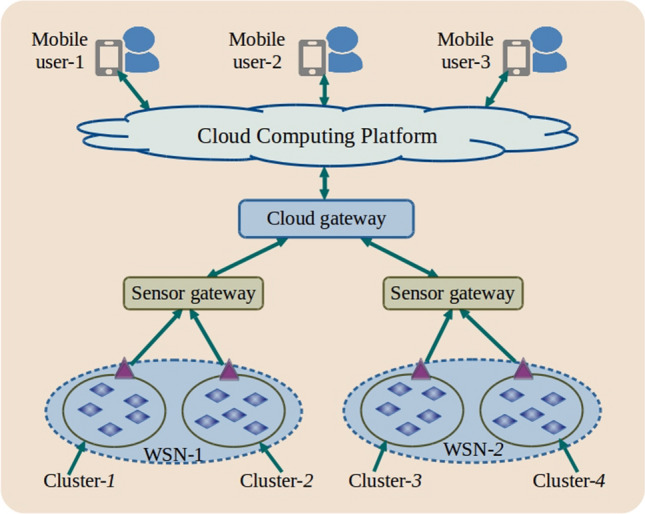
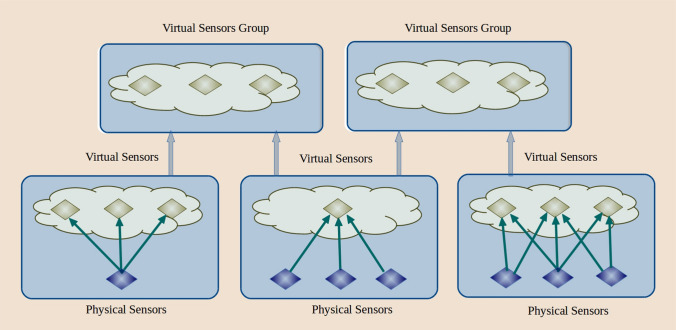
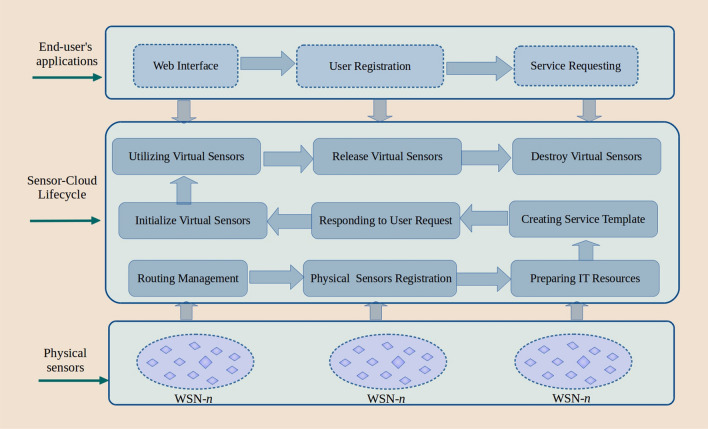
Internet of Things (IoT) is an ever-growing technology that enables advanced communication among millions of various devices to provide ubiquitous services without human intervention. The potential growth of electronic devices in sensing systems has led to the realization of IoT paradigm where applications depend on sensors to interact with the environment and collect data in a real-time scenario. Nowadays, smart applications require fast data acquisition, parallel processing, and dynamic resource sharing. Unfortunately, these requirements can not be supported efficiently with traditional Wireless Sensor Networks (WSN) due to the deficiency of computing resources and the lack of resource-sharing. Therefore, it is not recommended to develop innovative applications based on these constrained devices without further enhancement and improvement. Hence, this article explores a coeffective solution based on Cloud Computing and Virtualization Techniques to address these challenges. Cloud computing provides efficient computing resources and huge storage space, while the virtualization technique allows resources to be virtualized and shared between various applications. Integrating IoT-WSN with the Cloud-based Virtualization Environment will eliminate the drawbacks and limitations of conventional networks and facilitate the development of novel applications in a more flexible way. Furthermore, this article reviews the recent trends in IoT-WSN, virtualization techniques, and cloud computing. Also, we present the integration process of sensor networks with Cloud-based Virtualization and propose a new general architecture view for the Sensor-Cloud paradigm, and discuss its key elements, basic principles, lifecycle operation, and outline its advantages and disadvantages. Finally, we review the state-of-the-art, present the major challenges, and suggest future work directions.
物联网(IoT)是一种不断发展的技术,它能使数百万种不同设备之间进行先进的通信,从而在无需人工干预的情况下提供无处不在的服务。传感系统中电子设备的潜在增长促使物联网范式得以实现,在这种范式下,应用程序依赖传感器与环境进行交互,并在实时场景中收集数据。如今,智能应用需要快速的数据采集、并行处理和动态资源共享。不幸的是,由于计算资源的不足和资源共享的缺乏,传统无线传感器网络(WSN)无法有效地支持这些需求。因此,不建议在没有进一步增强和改进的情况下基于这些受限设备开发创新应用。因此,本文探索了一种基于云计算和虚拟化技术的协同有效解决方案来应对这些挑战。云计算提供了高效的计算资源和巨大的存储空间,而虚拟化技术允许资源被虚拟化并在各种应用之间共享。将物联网 - 无线传感器网络与基于云的虚拟化环境集成将消除传统网络的缺点和限制,并以更灵活的方式促进新型应用的开发。此外,本文回顾了物联网 - 无线传感器网络、虚拟化技术和云计算的最新趋势。我们还展示了传感器网络与基于云的虚拟化的集成过程,并为传感器云范式提出了一种新的通用架构视图,讨论了其关键要素、基本原理、生命周期操作,并概述了其优缺点。最后,我们回顾了当前的技术水平,提出了主要挑战,并建议了未来的工作方向。