Department of Computer Engineering, Faculty of Computer Science, Universidade da Coruña, 15071 A Coruña, Spain.
Sensors (Basel). 2018 Aug 13;18(8):2660. doi: 10.3390/s18082660.
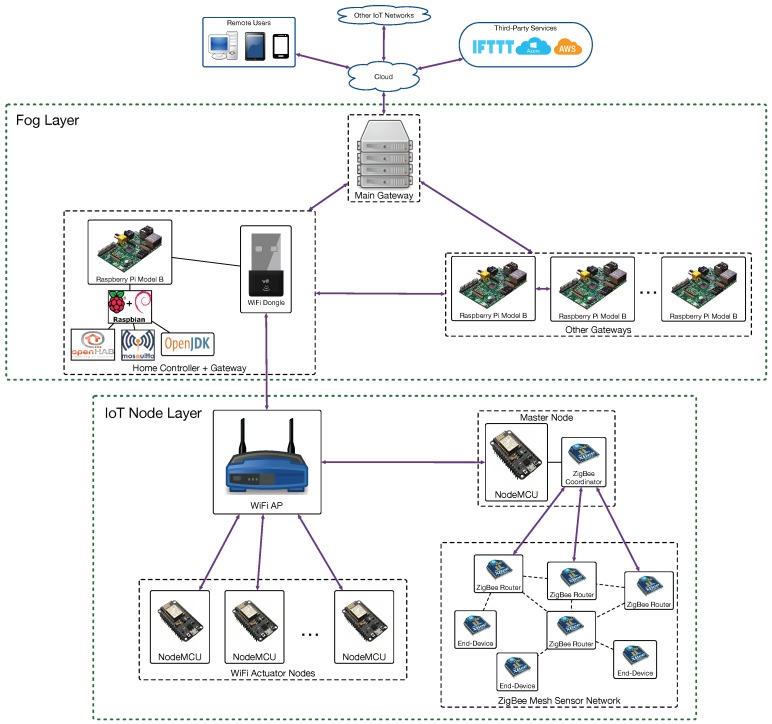
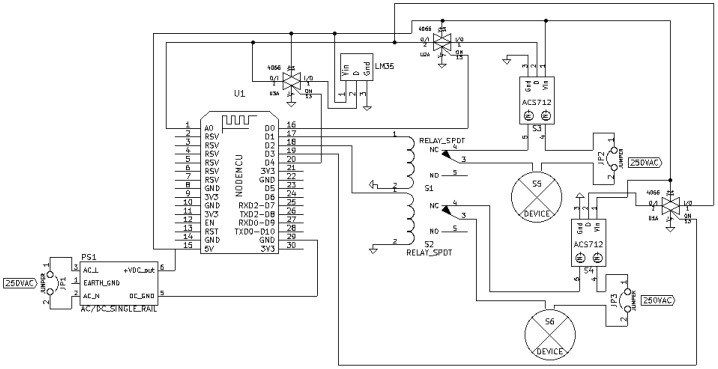
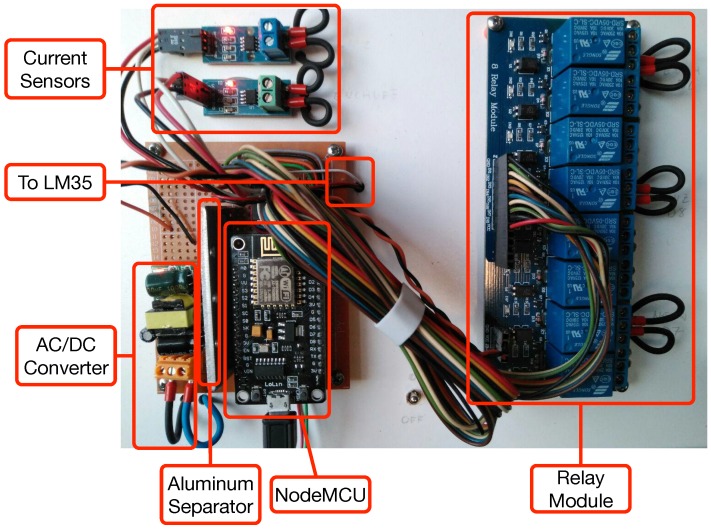
In recent years, the improvement of wireless protocols, the development of cloud services and the lower cost of hardware have started a new era for smart homes. One such enabling technologies is fog computing, which extends cloud computing to the edge of a network allowing for developing novel Internet of Things (IoT) applications and services. Under the IoT fog computing paradigm, IoT gateways are usually utilized to exchange messages with IoT nodes and a cloud. WiFi and ZigBee stand out as preferred communication technologies for smart homes. WiFi has become very popular, but it has a limited application due to its high energy consumption and the lack of standard mesh networking capabilities for low-power devices. For such reasons, ZigBee was selected by many manufacturers for developing wireless home automation devices. As a consequence, these technologies may coexist in the 2.4 GHz band, which leads to collisions, lower speed rates and increased communications latencies. This article presents ZiWi, a distributed fog computing Home Automation System (HAS) that allows for carrying out seamless communications among ZigBee and WiFi devices. This approach diverges from traditional home automation systems, which often rely on expensive central controllers. In addition, to ease the platform's building process, whenever possible, the system makes use of open-source software (all the code of the nodes is available on GitHub) and Commercial Off-The-Shelf (COTS) hardware. The initial results, which were obtained in a number of representative home scenarios, show that the developed fog services respond several times faster than the evaluated cloud services, and that cross-interference has to be taken seriously to prevent collisions. In addition, the current consumption of ZiWi's nodes was measured, showing the impact of encryption mechanisms.
近年来,无线协议的改进、云服务的发展以及硬件成本的降低为智能家居开启了一个新时代。雾计算是实现这一目标的一项关键技术,它将云计算扩展到网络边缘,从而能够开发新型物联网 (IoT) 应用和服务。在物联网雾计算范式下,物联网网关通常用于与物联网节点和云进行消息交换。WiFi 和 ZigBee 是智能家居中首选的通信技术。WiFi 已经非常流行,但由于其高能耗和缺乏针对低功耗设备的标准网状网络功能,其应用受到限制。出于这些原因,许多制造商选择 ZigBee 来开发无线家庭自动化设备。因此,这些技术可能会在 2.4GHz 频段共存,从而导致碰撞、降低速度和增加通信延迟。本文提出了 ZiWi,这是一种分布式雾计算家庭自动化系统 (HAS),允许 ZigBee 和 WiFi 设备之间进行无缝通信。这种方法与传统的家庭自动化系统不同,后者通常依赖于昂贵的中央控制器。此外,为了简化平台的构建过程,只要有可能,系统就会使用开源软件(节点的所有代码都可在 GitHub 上获得)和商用现货 (COTS) 硬件。在一些代表性的家庭场景中获得的初步结果表明,开发的雾服务的响应速度比评估的云服务快几倍,并且必须认真考虑交叉干扰以防止碰撞。此外,还测量了 ZiWi 节点的当前功耗,展示了加密机制的影响。