Caminear Michael W, Harrington Brittney S, Kamdar Rahul D, Kruhlak Michael J, Annunziata Christina M
Women's Malignancies Branch, National Cancer Institute, National Institutes of Health, Bethesda, MD, United States.
Center for Cancer Research (CCR) Confocal Microscopy Core Facility, Laboratory of Cancer Biology and Genetics, Center for Cancer Research, National Cancer Institute (NIH), Bethesda, MD, United States.
Front Oncol. 2022 Mar 17;12:762820. doi: 10.3389/fonc.2022.762820. eCollection 2022.
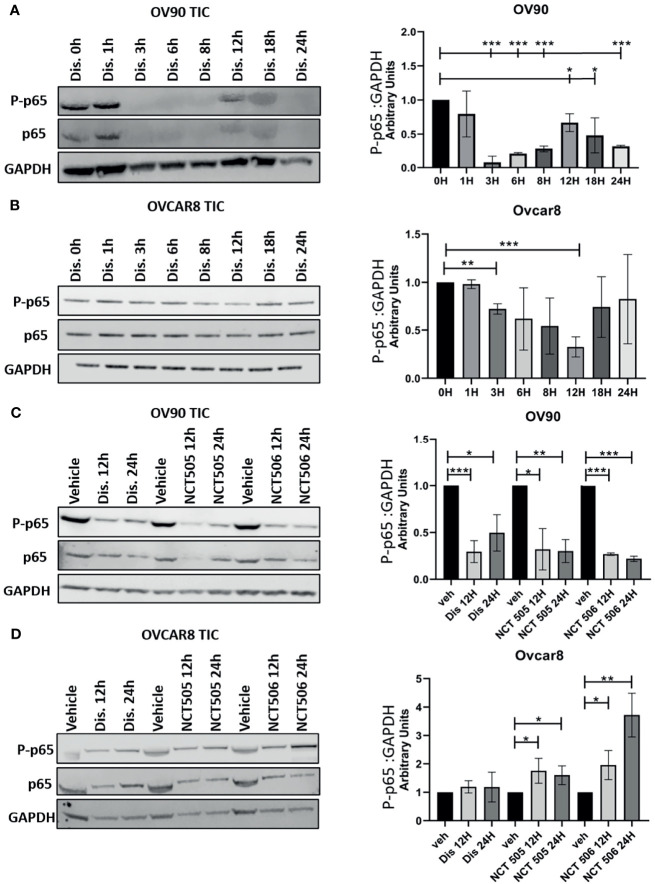
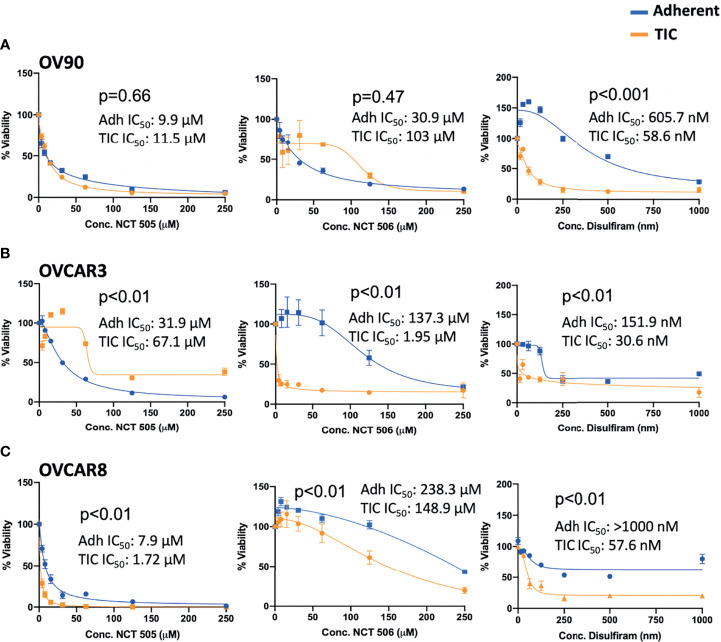
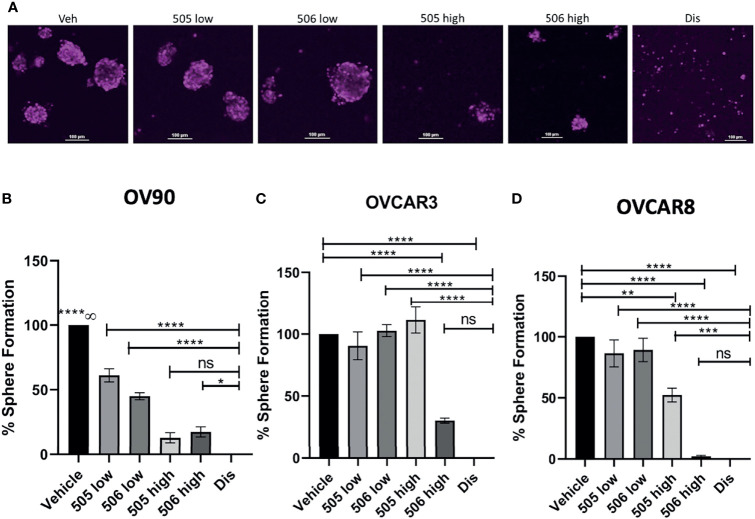
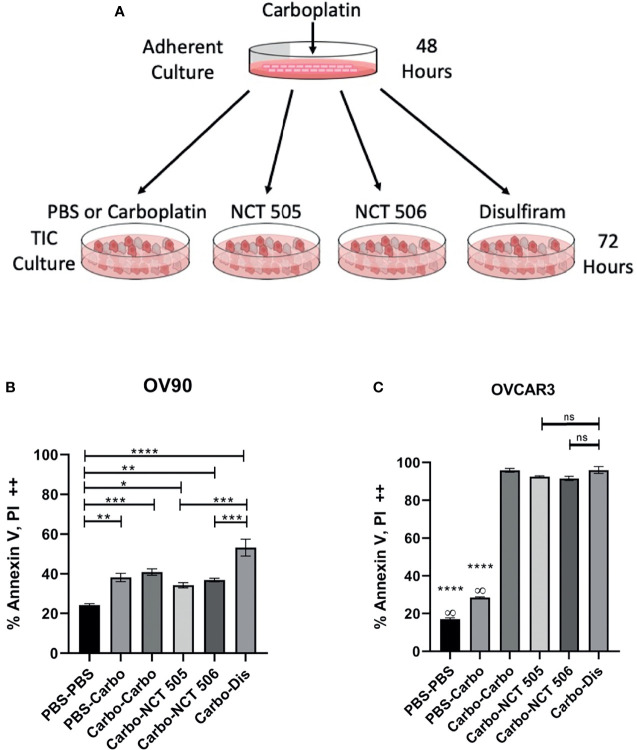
Epithelial ovarian cancer (EOC) is a global health burden and remains the fifth leading cause of cancer related death in women worldwide with the poorest five-year survival rate of the gynecological malignancies. EOC recurrence is considered to be driven by the survival of chemoresistant, stem-like tumor-initiating cells (TICs). We previously showed that disulfiram, an ALDH inhibitor, effectively targeted TICs compared to adherent EOC cells in terms of viability, spheroid formation, oxidative stress and also prevented relapse in an model of EOC. In this study we sought to determine whether specific targeting of ALDH isoenzyme ALDH1A1 would provide similar benefit to broader pathway inhibition by disulfiram. NCT-505 and NCT-506 are isoenzyme-specific ALDH1A1 inhibitors whose activity was compared to the effects of disulfiram. Following treatment with both the NCTs and disulfiram, the viability of TICs versus adherent cells, sphere formation, and cell death in our relapse model were measured and compared in EOC cell lines. We found that disulfiram decreased the viability of TICs significantly more effectively versus adherent cells, while no consistent trend was observed when the cells were treated with the NCTs. Disulfiram also affected the expression of proteins associated with NFκB signaling. Comparison of disulfiram to the direct targeting of ALDH1A1 with the NCTs suggests that the broader cellular effects of disulfiram are more suitable as a therapeutic to eradicate TICs from tumors and prevent EOC relapse. In addition to providing insight into a fitting treatment for TICs, the comparison of disulfiram to NCT-505 and -506 has increased our understanding of the mechanism of action of disulfiram. Further elucidation of the mechanism of disulfiram has the potential to reveal additional targets to treat EOC TICs and prevent disease recurrence.
上皮性卵巢癌(EOC)是一项全球性的健康负担,仍然是全球女性癌症相关死亡的第五大主要原因,在妇科恶性肿瘤中五年生存率最差。EOC复发被认为是由具有化疗抗性的、干细胞样肿瘤起始细胞(TICs)的存活所驱动。我们之前表明,与贴壁EOC细胞相比,二硫仑(一种ALDH抑制剂)在活力、球体形成、氧化应激方面能有效靶向TICs,并且在EOC模型中还能预防复发。在本研究中,我们试图确定特异性靶向ALDH同工酶ALDH1A1是否会像二硫仑对更广泛途径的抑制那样带来类似的益处。NCT - 505和NCT - 506是同工酶特异性的ALDH1A1抑制剂,将它们的活性与二硫仑的作用效果进行了比较。在用NCTs和二硫仑处理后,在EOC细胞系中测量并比较了我们的复发模型中TICs与贴壁细胞的活力、球体形成以及细胞死亡情况。我们发现,与贴壁细胞相比,二硫仑能更有效地显著降低TICs的活力,而当细胞用NCTs处理时未观察到一致的趋势。二硫仑还影响与NFκB信号传导相关的蛋白质表达。将二硫仑与用NCTs直接靶向ALDH1A1进行比较表明,二硫仑更广泛的细胞效应更适合作为一种疗法,从肿瘤中根除TICs并预防EOC复发。除了深入了解针对TICs的合适治疗方法外,将二硫仑与NCT - 505和 - 506进行比较还增加了我们对二硫仑作用机制的理解。进一步阐明二硫仑的作用机制有可能揭示治疗EOC TICs和预防疾病复发的其他靶点。