Guan Bao, Wang Jie, Li Xuesong, Lin Lin, Fang Dong, Kong Wenwen, Tian Chuangyu, Li Juan, Yang Kunlin, Han Guanpeng, Wu Yucai, He Yuhui, Peng Yiji, Yu Yanfei, He Qun, He Shiming, Gong Yanqing, Zhou Liqun, Tang Qi
Department of Urology, Peking University First Hospital, Beijing, China.
Institute of Urology, Peking University, Beijing, China.
Front Oncol. 2022 Mar 16;12:774202. doi: 10.3389/fonc.2022.774202. eCollection 2022.
Whole-exon sequencing (WES) is a commercially available tool for hereditary disease testing. However, little is known about hereditary upper-tract urothelial carcinoma (UTUC) in the Chinese population. This study aims to investigate the prevalence of Lynch syndrome (LS) in UTUC patients with high-risk features and identify the germline mutations of genetic predisposition gene mutations in those patients.
In total, 354 consecutive UTUC patients undergoing surgery were universally recruited, of whom 108 patients under 60 years old or with a personal/family history of cancer underwent universal immunohistochemistry staining to detect the expression of mismatch repair (MMR) proteins (MLH1, MSH2, MSH6 and PMS2). Patients with deficient or weak MMR protein staining or meeting the Amsterdam II criterion were defined as suspected LS patients, who further experienced microsatellite instability (MSI) (BAT25, BAT26, BAT40, D2S123, D5S346, D17S250) detection and performed WES analysis to explore germline pathogenic/likely pathogenic (P/LP) alterations.
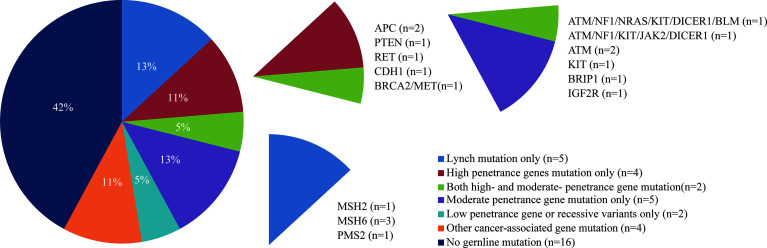
Of 108 patients, 90 (83.3%) cases were included due to younger than 60 years, and 18 cases due to personal/family history. IHC staining identified 21 patients with deficient MMR protein staining and 15 cases with weak MMR protein staining. Three cases met the Amsterdam II criterion but with proficient MMR protein staining. Finally, WES analysis was performed in 38 suspected LS patients and P/LP germline mutations were identified in 22 individuals. Genetic testing confirmed 5 LS cases, including 3 cases with novel mutations. MSI-harboring tumor was discovered in 4 LS cases, one of whom had weak MMR protein staining. Germline P/LP variants in DNA damage repair genes were found in 11 cases. In addition, we found that 11 patients had high- or moderate- penetrance P/LP mutations other than MMR genes. The common P/LP variants in high- or moderate-penetrance genes were 4 in ATM, 3 in MSH6 and KIT, and 2 in APC, NF1 and DICER.
We identified approximately 11% of UTUC cases as suspected LS and at least 1.4% patients with confirmed LS-associated UTUC. In addition, broader germline genetic testing could be considered to screen for cancer severity in hereditary UTUC patients.
全外显子测序(WES)是一种用于遗传性疾病检测的商业可用工具。然而,对于中国人群中的遗传性上尿路尿路上皮癌(UTUC)了解甚少。本研究旨在调查具有高危特征的UTUC患者中林奇综合征(LS)的患病率,并确定这些患者中遗传易感性基因突变的胚系突变。
共纳入354例连续接受手术的UTUC患者,其中108例60岁以下或有个人/家族癌症病史的患者接受了全面的免疫组化染色,以检测错配修复(MMR)蛋白(MLH1、MSH2、MSH6和PMS2)的表达。MMR蛋白染色缺失或减弱或符合阿姆斯特丹Ⅱ标准的患者被定义为疑似LS患者,这些患者进一步进行微卫星不稳定性(MSI)(BAT25、BAT26、BAT40、D2S123、D5S346、D17S250)检测并进行WES分析,以探索胚系致病性/可能致病性(P/LP)改变。
108例患者中,90例(83.3%)因年龄小于60岁被纳入,18例因个人/家族病史被纳入。免疫组化染色鉴定出21例MMR蛋白染色缺失患者和15例MMR蛋白染色减弱患者。3例符合阿姆斯特丹Ⅱ标准但MMR蛋白染色正常。最后,对38例疑似LS患者进行了WES分析,在22例个体中鉴定出P/LP胚系突变。基因检测确诊了5例LS病例,其中3例为新突变。在4例LS病例中发现了MSI-H肿瘤,其中1例MMR蛋白染色减弱。在11例患者中发现了DNA损伤修复基因中的胚系P/LP变异。此外,我们发现11例患者除MMR基因外还有高或中度外显率的P/LP突变。高或中度外显率基因中常见的P/LP变异在ATM中有4例,在MSH6和KIT中有3例,在APC、NF1和DICER中有2例。
我们将约11%的UTUC病例鉴定为疑似LS,至少1.4%的患者确诊为LS相关的UTUC。此外,可考虑进行更广泛的胚系基因检测,以筛查遗传性UTUC患者的癌症严重程度。