Department of Health, Kaohsiung City Government, Kaohsiung City, Taiwan.
National Mosquito-Borne Diseases Control Research Center, National Health Research Institutes, Miaoli County, Taiwan.
Front Public Health. 2022 Mar 17;10:778736. doi: 10.3389/fpubh.2022.778736. eCollection 2022.
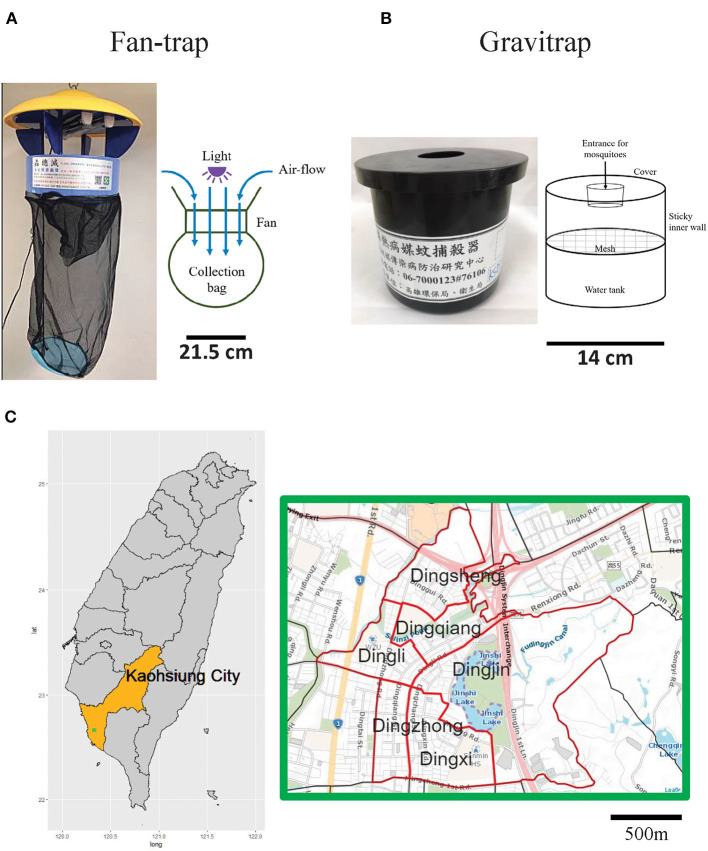
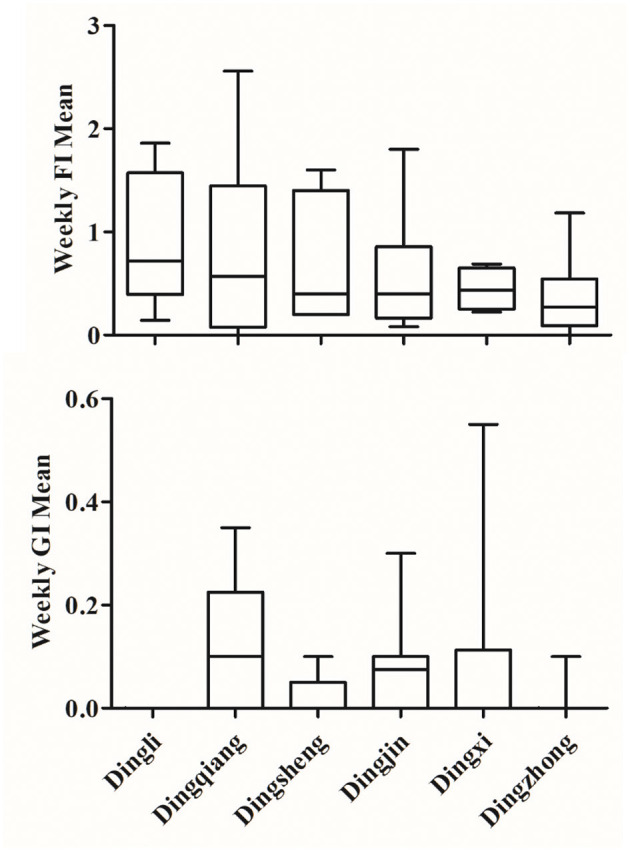
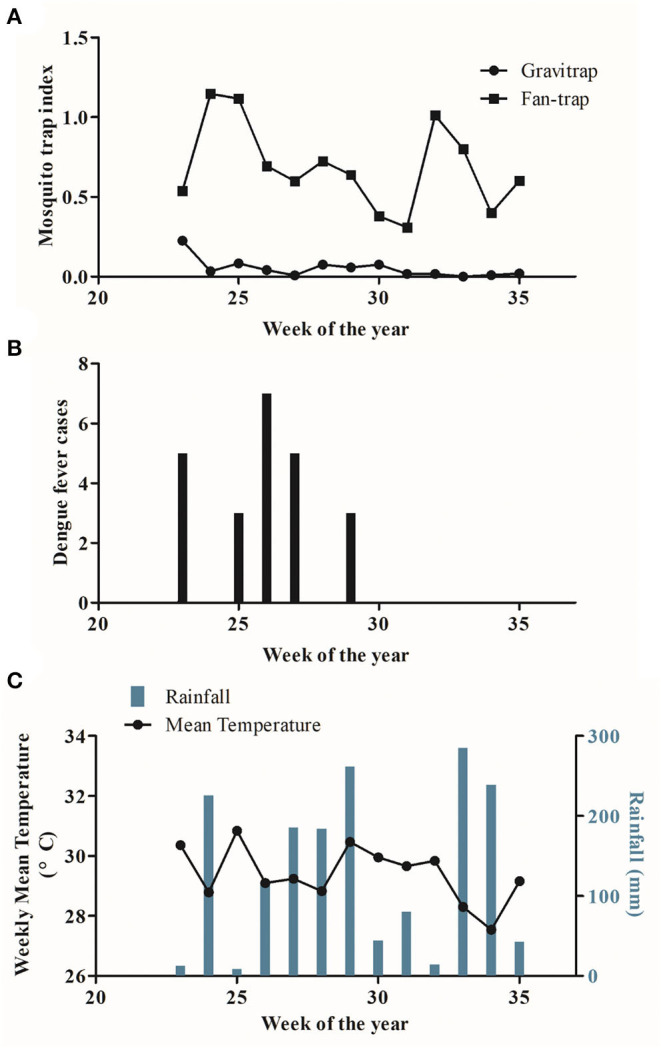
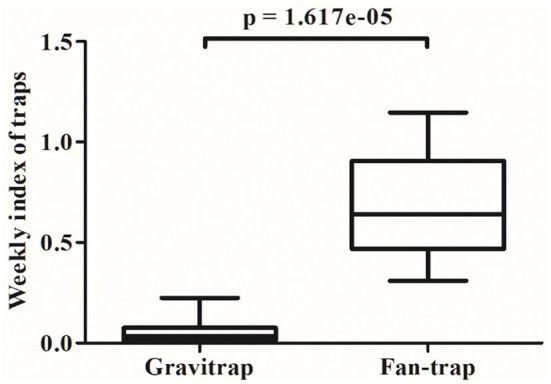
A key component of integrated vector management strategies is the efficient implementation of mosquito traps for surveillance and control. Numerous trap types have been created with distinct designs and capture mechanisms, but identification of the most effective trap type is critical for effective implementation. For dengue vector surveillance, previous studies have demonstrated that active traps utilizing CO attractant are more effective than passive traps for capturing mosquitoes. However, maintaining CO supply in traps is so labor intensive as to be likely unfeasible in crowded residential areas, and it is unclear how much more effective active traps lacking attractants are than purely passive traps. In this study, we analyzed capture data collected in 2019 from six urban areas in Kaohsiung City to compare mosquito catch rates between (passive) gravitraps and (active) fan-traps. The average gravitrap index (GI) and fan-trap index (FI) values were 0.68 and 3.39 respectively at peak catch times from June to August 2019, with consistently higher FI values calculated in all areas studied. We compared trap indices to reported cases of dengue fever and correlated them with weekly fluctuations in temperature and rainfall. We found that FI trends aligned more closely with case numbers and rainfall than GI values, supporting the use of fan-traps for mosquito surveillance and control as part of broader vector management strategies. Furthermore, combining fan-trap catch data with rapid testing for dengue infections may improve the early identification and prevention of future disease outbreaks.
综合蚊媒管理策略的一个关键组成部分是高效实施蚊媒监测和控制的诱蚊器。已经创建了许多具有不同设计和捕获机制的诱蚊器类型,但确定最有效的诱蚊器类型对于有效实施至关重要。在登革热媒介监测方面,之前的研究表明,利用 CO 引诱剂的主动诱蚊器比被动诱蚊器更有效地捕获蚊子。然而,在诱蚊器中维持 CO 供应非常耗费人力,因此在人口密集的居民区可能不可行,而且不清楚缺乏引诱剂的主动诱蚊器比纯被动诱蚊器有效多少。在这项研究中,我们分析了 2019 年在高雄市六个城区收集的捕获数据,比较了(被动)重力诱蚊器和(主动)风扇诱蚊器的蚊子捕获率。2019 年 6 月至 8 月的高峰捕获期,重力诱蚊器指数(GI)和风扇诱蚊器指数(FI)的平均值分别为 0.68 和 3.39,在所有研究区域均计算出更高的 FI 值。我们将诱蚊器指数与登革热报告病例进行了比较,并将其与每周的温度和降雨量波动进行了关联。我们发现,FI 趋势与病例数量和降雨量的相关性比 GI 值更为密切,支持将风扇诱蚊器用于蚊子监测和控制,作为更广泛的蚊媒管理策略的一部分。此外,将风扇诱蚊器的捕获数据与登革热感染的快速检测相结合,可能有助于早期发现和预防未来的疾病爆发。