Zhu Sipin, Hu Xiaoyong, Bennett Samuel, Xu Jiake, Mai Yuliang
Department of Orthopaedics, The Second Affiliated Hospital and Yuying Children's Hospital of Wenzhou Medical University, Wenzhou, China.
Guangdong Provincial Key Laboratory of Industrial Surfactant, Guangdong Research Institute of Petrochemical and Fine Chemical Engineering, Guangdong Academy of Sciences, Guangzhou, China.
Front Cell Dev Biol. 2022 Mar 16;10:823354. doi: 10.3389/fcell.2022.823354. eCollection 2022.
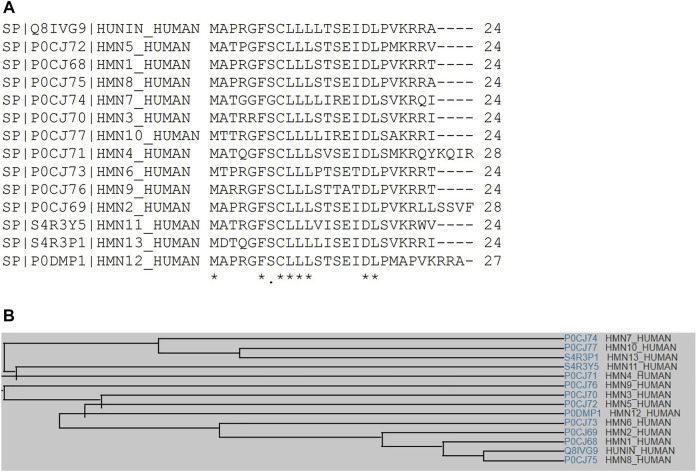
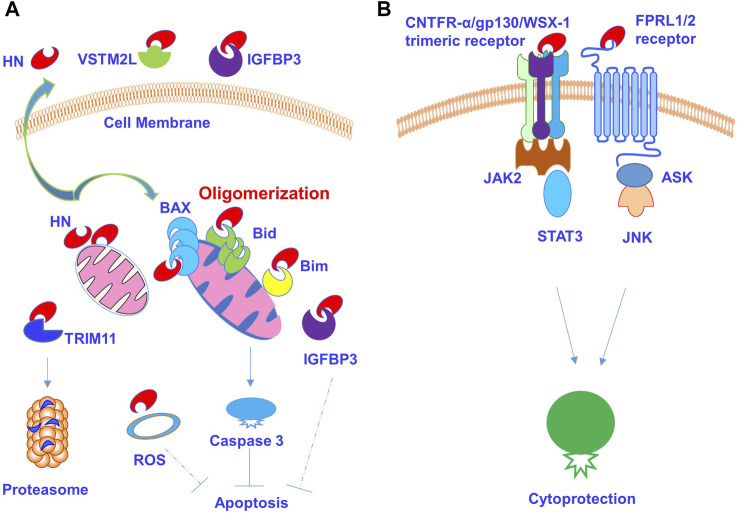
Humanin (HN) belongs to a member of mitochondrial-derived peptides (MDPs) which are encoded by mitochondrial genes. HN shares sequence homology with thirteen HN-like proteins, named MTRNR2L1 to MTRNR2L13, which encompass 24-28 amino acid residues in length. HN mediates mitochondrial status and cell survival by acting an intracellular mechanism, or as a secreted factor via extracellular signals. Intracellularly, it binds Bcl2-associated X protein (BAX), Bim and tBid, and IGFBP3 to inhibit caspase activity and cell apoptosis. When released from cells as a secreted peptide, HN interacts with G protein-coupled formyl peptide receptor-like 1 (FPRL1/2) to mediate apoptosis signal-regulating kinase (ASK) and c-Jun N-terminal kinase (JNK) signalling pathways. Additionally, it interacts with CNTFR-α/gp130/WSX-1 trimeric receptors to induce JAK2/STA3 signalling cascades. HN also binds soluble extracellular proteins such as VSTM2L and IGFBP3 to modulate cytoprotection. It is reported that HN plays a role in neuronal disorders such as Alzheimer's disease, as well as in diabetes mellitus, infertility, and cardiac diseases. Its roles in the skeletal system are emerging, where it appears to be involved with the regulation of osteoclasts, osteoblasts, and chondrocytes. Understanding the molecular structure and role of HN in neural and skeletal diseases is vital to the application of HN in tissue regeneration.
人胰岛素(HN)属于线粒体衍生肽(MDPs)成员,由线粒体基因编码。HN与13种类HN蛋白具有序列同源性,这些蛋白命名为MTRNR2L1至MTRNR2L13,长度为24 - 28个氨基酸残基。HN通过细胞内机制或作为细胞外信号分泌因子来介导线粒体状态和细胞存活。在细胞内,它与Bcl2相关X蛋白(BAX)、Bim和tBid以及IGFBP3结合,以抑制半胱天冬酶活性和细胞凋亡。当作为分泌肽从细胞中释放时,HN与G蛋白偶联的甲酰肽受体样1(FPRL1/2)相互作用,介导凋亡信号调节激酶(ASK)和c-Jun N端激酶(JNK)信号通路。此外,它与CNTFR-α/gp130/WSX-1三聚体受体相互作用,诱导JAK2/STA3信号级联反应。HN还与可溶性细胞外蛋白如VSTM2L和IGFBP3结合,以调节细胞保护作用。据报道,HN在阿尔茨海默病等神经疾病以及糖尿病、不孕症和心脏病中发挥作用。它在骨骼系统中的作用正在显现,似乎参与破骨细胞、成骨细胞和软骨细胞的调节。了解HN在神经和骨骼疾病中的分子结构和作用对于HN在组织再生中的应用至关重要。