
变应性鼻炎中的白细胞介素-4/白细胞介素-13轴:血清细胞因子水平升高及与紧密连接分子表达的负相关
IL-4/IL-13 Axis in Allergic Rhinitis: Elevated Serum Cytokines Levels and Inverse Association With Tight Junction Molecules Expression.
作者信息
Nur Husna Siti Muhamad, Md Shukri Norasnieda, Tuan Sharif Sharifah Emilia, Tan Hern Tze Tina, Mohd Ashari Noor Suryani, Wong Kah Keng
机构信息
Department of Immunology, School of Medical Sciences, Universiti Sains Malaysia, Kubang Kerian, Malaysia.
Department of Otorhinolaryngology, Head and Neck Surgery, School of Medical Sciences, Universiti Sains Malaysia, Kubang Kerian, Malaysia.
出版信息
Front Mol Biosci. 2022 Mar 17;9:819772. doi: 10.3389/fmolb.2022.819772. eCollection 2022.
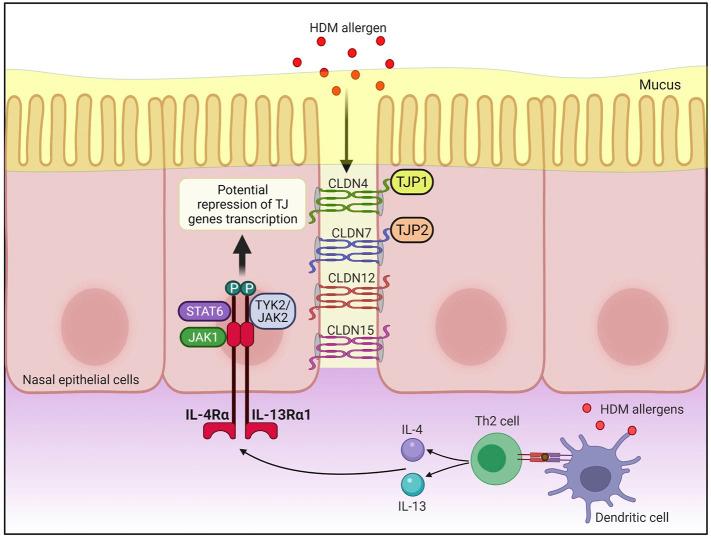
The IL-4/IL-13 axis is involved in the pathogenesis of allergic rhinitis (AR). In this study, we investigated the serum cytokines levels of IL-4, IL-5, IL-6, and IL-13 in AR patients, and the transcript expression levels of their receptors (, , and ) in nasal epithelial cells of AR patients non-allergic controls. Nasal epithelial cells and blood samples of non-allergic controls ( = 30) and AR patients ( = 30) were collected to examine mRNA expression and serum cytokines levels, respectively. Bioinformatics analyses of IL-4/IL-13 receptor heterodimer association with tight junction (TJ) and JAK/STAT signaling genes were conducted in a gene expression profiling (GEP) dataset (GSE44037) of AR patients ( = 12) and healthy controls ( = 6). Serum IL-4, IL-5, IL-6 or IL-13 levels, and transcript expression were significantly higher in AR patients compared with non-allergic controls. IL-4 and IL-13 serum levels were positively correlated with expression in AR patients but not in non-allergic controls. In the GEP dataset (GSE44037), six TJ (, , , , , and ) genes' expressions were negatively correlated, respectively, with IL-4Rα/IL-13Rα1 heterodimeric receptor expression in AR patients and not in control samples. These six TJ genes contributed to the significant enrichment of tight junction Gene Ontology (GO ID: 0070160). Lastly, STATs DNA binding motif analysis showed that each of these TJ genes contains STATs binding consensus sequence within intronic and intergenic regions. Our results suggest that increased IL-4/IL-13 serum cytokines levels may contribute to decreased TJs expression via IL-4Rα/IL-13Rα1 heterodimeric receptor in nasal epithelium of AR patients.
白细胞介素-4/白细胞介素-13轴参与变应性鼻炎(AR)的发病机制。在本研究中,我们调查了AR患者血清中白细胞介素-4、白细胞介素-5、白细胞介素-6和白细胞介素-13的细胞因子水平,以及AR患者和非变应性对照者鼻上皮细胞中它们受体(、、和)的转录表达水平。收集非变应性对照者(n = 30)和AR患者(n = 30)的鼻上皮细胞和血样,分别检测mRNA表达和血清细胞因子水平。在AR患者(n = 12)和健康对照者(n = 6)的基因表达谱(GEP)数据集(GSE44037)中,对白细胞介素-4/白细胞介素-13受体异二聚体与紧密连接(TJ)和JAK/STAT信号基因的关联进行了生物信息学分析。与非变应性对照者相比,AR患者血清白细胞介素-4、白细胞介素-5、白细胞介素-6或白细胞介素-13水平以及转录表达显著更高。AR患者血清白细胞介素-4和白细胞介素-13水平与表达呈正相关,而非变应性对照者中无此相关性。在GEP数据集(GSE44037)中,6个TJ(、、、、和)基因的表达分别与AR患者而非对照样本中白细胞介素-4受体α/白细胞介素-13受体α1异二聚体受体表达呈负相关。这6个TJ基因促成了紧密连接基因本体(GO ID:0070160)的显著富集。最后,STATs DNA结合基序分析表明,这些TJ基因中的每一个在基因内和基因间区域都包含STATs结合共有序列。我们的结果表明,AR患者鼻上皮中血清白细胞介素-4/白细胞介素-13细胞因子水平升高可能通过白细胞介素-4受体α/白细胞介素-13受体α1异二聚体受体导致TJ表达降低。


 Zotero 插件