Department of Immunology, School of Medical Sciences, Universiti Sains Malaysia, 16150, Kubang Kerian, Kelantan, Malaysia.
Hospital Universiti Sains Malaysia, Jalan Raja Perempuan Zainab II, 16150, Kubang Kerian, Kelantan, Malaysia.
Sci Rep. 2021 Jan 13;11(1):1245. doi: 10.1038/s41598-020-79208-y.
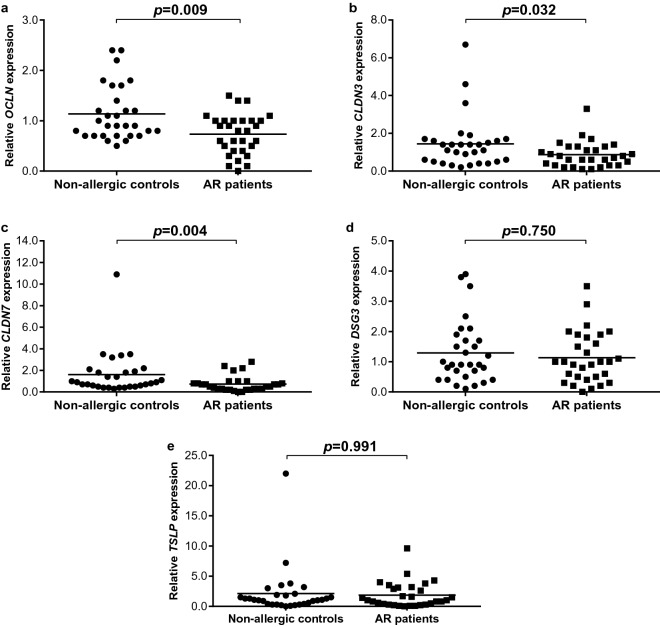
The breakdown of nasal epithelial barrier occurs in allergic rhinitis (AR) patients. Impairment of cell junction molecules including tight junctions (TJs) and desmosomes plays causative roles in the pathogenesis of AR. In this study, we investigated the transcript expression levels of TJs including occludin (OCLN), claudin-3 and -7 (CLDN3 and CLDN7), desmoglein 3 (DSG3) and thymic stromal lymphopoietin (TSLP) in AR patients (n = 30) and non-allergic controls (n = 30). Nasal epithelial cells of non-allergic controls and AR patients were collected to examine their mRNA expression levels, and to correlate with clinico-demographical and environmental parameters. We demonstrated that the expression of OCLN (p = 0.009), CLDN3 (p = 0.032) or CLDN7 (p = 0.004) transcript was significantly lower in AR patients compared with non-allergic controls. No significant difference was observed in the expression of DSG3 (p = 0.750) or TSLP (p = 0.991) transcript in AR patients compared with non-allergic controls. A significant association between urban locations and lower OCLN expression (p = 0.010), or exposure to second-hand smoke with lower CLDN7 expression (p = 0.042) was found in AR patients. Interestingly, none of the TJs expression was significantly associated with having pets, frequency of changing bedsheet and housekeeping. These results suggest that defective nasal epithelial barrier in AR patients is attributable to reduced expression of OCLN and CLDN7 associated with urban locations and exposure to second-hand smoke, supporting recent findings that air pollution represents one of the causes of AR.
变应性鼻炎(AR)患者的鼻上皮屏障会发生破裂。细胞连接分子(包括紧密连接(TJ)和桥粒)的损伤在 AR 的发病机制中起因果作用。在这项研究中,我们研究了 TJ 包括闭合蛋白(OCLN)、claudin-3 和 -7(CLDN3 和 CLDN7)、桥粒蛋白 3(DSG3)和胸腺基质淋巴细胞生成素(TSLP)在 AR 患者(n=30)和非变应性对照组(n=30)中的转录表达水平。收集非变应性对照组和 AR 患者的鼻上皮细胞,以检测其 mRNA 表达水平,并与临床人口统计学和环境参数相关。我们表明,与非变应性对照组相比,AR 患者的 OCLN(p=0.009)、CLDN3(p=0.032)或 CLDN7(p=0.004)的转录表达明显降低。在 AR 患者中,DSG3(p=0.750)或 TSLP(p=0.991)的转录表达与非变应性对照组相比无显著差异。在 AR 患者中,城市环境与 OCLN 表达降低(p=0.010)之间存在显著相关性,或者暴露于二手烟与 CLDN7 表达降低(p=0.042)之间存在显著相关性。有趣的是,在 AR 患者中,没有任何一种 TJ 的表达与养宠物、床单更换频率和家务清洁有关。这些结果表明,AR 患者的鼻上皮屏障缺陷归因于 OCLN 和 CLDN7 的表达降低,这与城市环境和暴露于二手烟有关,这支持了最近的发现,即空气污染是 AR 的原因之一。