Godolphin Peter J, Bath Philip M, Montgomery Alan A
MRC Clinical Trials Unit at UCL, Institute of Clinical Trials and Methodology, University College London, London, UK.
Stroke Trials Unit, Mental Health & Clinical Neuroscience, University of Nottingham, Nottingham, UK.
Int J Stroke. 2023 Feb;18(2):154-162. doi: 10.1177/17474930221094682. Epub 2022 May 10.
Central adjudication of outcomes is common in randomized clinical trials in stroke. The rationale for adjudication is clear; centrally adjudicated outcomes should have less random and systematic errors than outcomes assessed locally by site investigators. However, adjudication brings added complexities to a clinical trial and can be costly.
To assess the evidence for outcome adjudication in stroke trials.
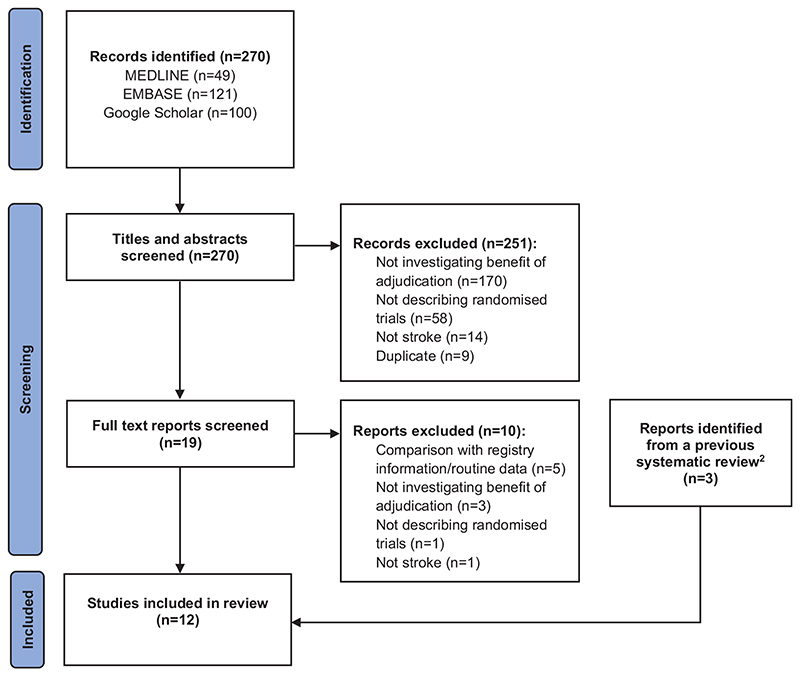
We identified 12 studies evaluating central adjudication in stroke trials. The majority of these were secondary analyses of trials, and the results of all of these would have remained unchanged had central adjudication not taken place, even for trials without sufficient blinding. The largest differences between site-assessed and adjudicator-assessed outcomes were between the most subjective outcomes, such as causality of serious adverse events. We found that the cost of adjudication could be upward of £100,000 for medium to large prevention trials. These findings suggest that the cost of central adjudication may outweigh the advantages it brings in many cases. However, through simulation, we found that only a small amount of bias is required in site investigators' outcome assessments before adjudication becomes important.
Central adjudication may not be necessary in stroke trials with blinded outcome assessment. However, for open-label studies, central adjudication may be more important.
在中风的随机临床试验中,对结果进行集中判定很常见。判定的基本原理很明确;与由各研究点的研究者在当地评估的结果相比,集中判定的结果随机误差和系统误差应更小。然而,判定给临床试验带来了额外的复杂性,而且成本可能很高。
评估中风试验中结果判定的证据。
我们确定了12项评估中风试验中集中判定的研究。其中大多数是试验的二次分析,而且即便没有进行集中判定,所有这些研究的结果也不会改变,即使对于那些没有充分设盲的试验也是如此。研究点评估的结果与判定者评估的结果之间最大的差异存在于最主观的结果之间,比如严重不良事件的因果关系。我们发现,对于中大型预防试验,判定成本可能超过10万英镑。这些发现表明,在很多情况下,集中判定的成本可能超过其带来的优势。然而,通过模拟,我们发现,在判定变得重要之前,研究点研究者对结果的评估只需存在少量偏差即可。
在对结果进行设盲评估的中风试验中,集中判定可能没有必要。然而,对于开放标签研究,集中判定可能更为重要。