National Institute of Cancer Research, National Health Research Institutes, Tainan, Taiwan.
Standard and Interoperability Lab, Smart Healthcare Center of Excellent Taiwan, Taipei, Taiwan.
JMIR Public Health Surveill. 2022 Apr 26;8(4):e32411. doi: 10.2196/32411.
COVID-19 is an ongoing global pandemic caused by SARS-CoV-2. As of June 2021, 5 emergency vaccines were available for COVID-19 prevention, and with the improvement of vaccination rates and the resumption of activities in each country, verification of vaccination has become an important issue. Currently, in most areas, vaccination and reverse transcription polymerase chain reaction (RT-PCR) test results are certified and validated on paper. This leads to the problem of counterfeit documents. Therefore, a global vaccination record is needed.
The main objective of this study is to design a vaccine passport (VP) validation system based on a general blockchain architecture for international use in a simulated environment. With decentralized characteristics, the system is expected to have the advantages of low cost, high interoperability, effectiveness, security, and verifiability through blockchain architecture.
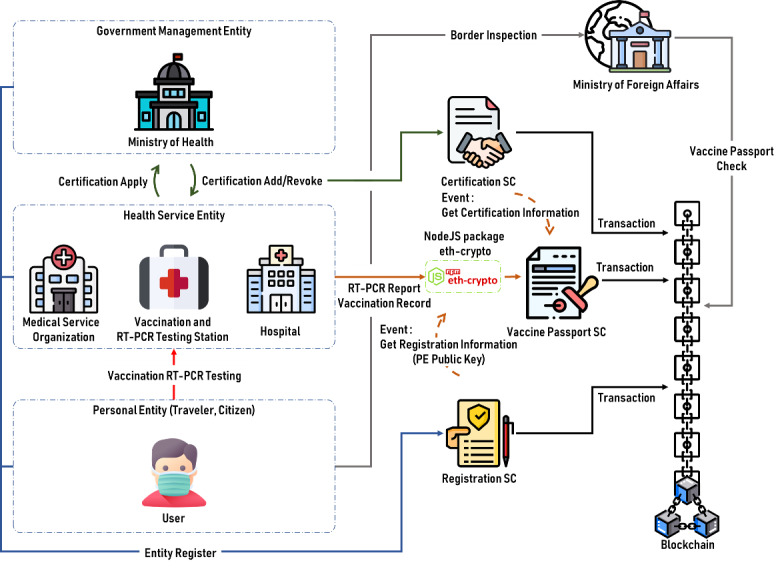
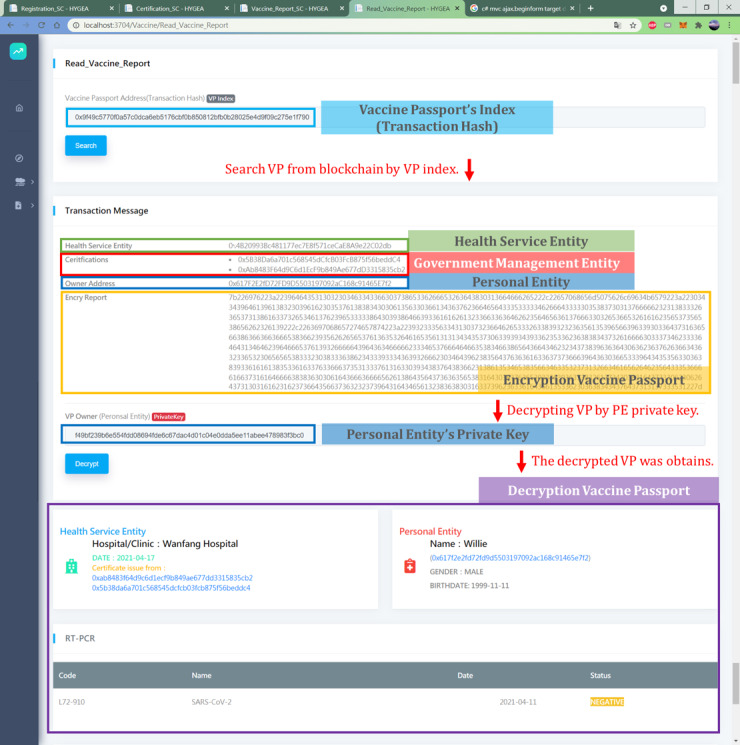
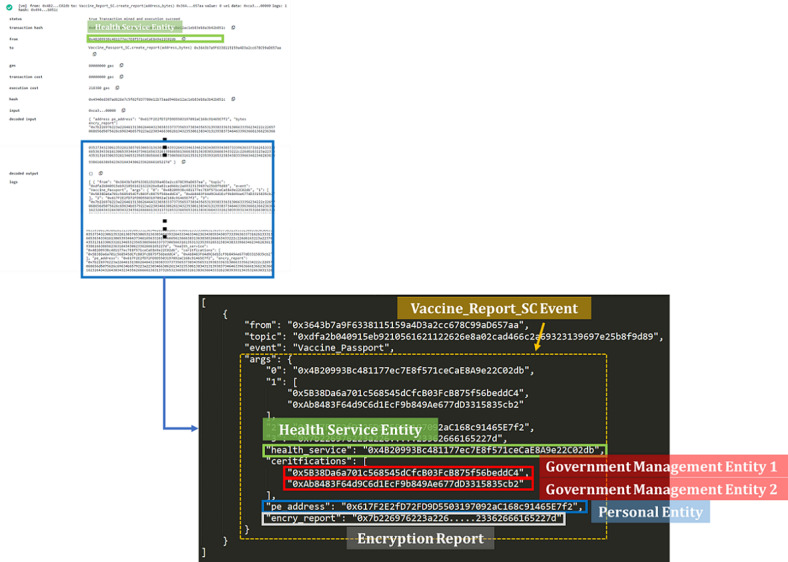
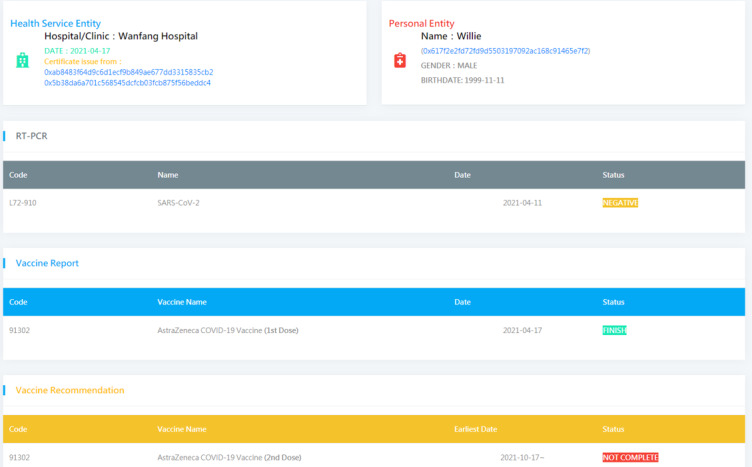
The blockchain decentralized mechanism was used to build an open and anticounterfeiting information platform for VPs. The contents of a vaccination card are recorded according to international Fast Healthcare Interoperability Resource (FHIR) standards, and blockchain smart contracts (SCs) are used for authorization and authentication to achieve hierarchical management of various international hospitals and people receiving injections. The blockchain stores an encrypted vaccination path managed by the user who manages the private key. The blockchain uses the proof-of-authority (PoA) public chain and can access all information through the specified chain. This will achieve the goal of keeping development costs low and streamlining vaccine transit management so that countries in different economies can use them.
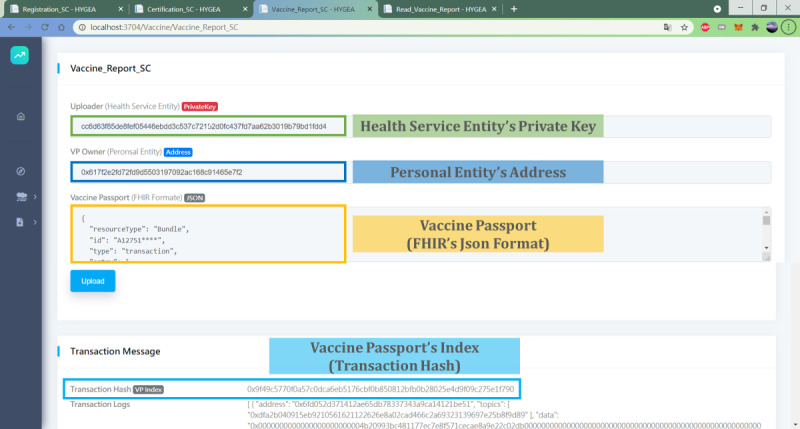
The openness of the blockchain helps to create transparency and data accuracy. This blockchain architecture contains a total of 3 entities. All approvals are published on Open Ledger. Smart certificates enable authorization and authentication, and encryption and decryption mechanisms guarantee data protection. This proof of concept demonstrates the design of blockchain architecture, which can achieve accurate global VP verification at an affordable price. In this study, an actual VP case was established and demonstrated. An open blockchain, an individually approved certification mechanism, and an international standard vaccination record were introduced.
Blockchain architecture can be used to build a viable international VP authentication process with the advantages of low cost, high interoperability, effectiveness, security, and verifiability.
COVID-19 是由 SARS-CoV-2 引起的持续全球大流行。截至 2021 年 6 月,有 5 种紧急疫苗可用于 COVID-19 预防,随着接种率的提高和各国活动的恢复,疫苗接种验证已成为一个重要问题。目前,在大多数地区,疫苗接种和逆转录聚合酶链反应(RT-PCR)检测结果都在纸质文件上进行认证和验证。这导致了伪造文件的问题。因此,需要建立一个全球疫苗接种记录。
本研究的主要目的是设计一个基于通用区块链架构的疫苗护照(VP)验证系统,以便在模拟环境中供国际使用。该系统具有去中心化的特点,预计将通过区块链架构具有低成本、高互操作性、有效性、安全性和可验证性的优势。
使用区块链去中心化机制构建用于 VP 的开放且防篡改信息平台。根据国际快速医疗互操作性资源(FHIR)标准记录疫苗接种卡的内容,并使用区块链智能合约(SC)进行授权和身份验证,以实现对各种国际医院和接种人群的分层管理。区块链存储由管理私钥的用户管理的加密接种路径。区块链使用权威证明(PoA)公有链,并可通过指定链访问所有信息。这将实现保持低开发成本和简化疫苗运输管理的目标,从而使不同经济水平的国家都能使用它们。
区块链的开放性有助于创建透明度和数据准确性。该区块链架构共包含 3 个实体。所有批准都发布在 Open Ledger 上。智能证书实现授权和身份验证,加密和解密机制保证数据保护。这一概念验证展示了区块链架构的设计,它可以以可承受的价格实现准确的全球 VP 验证。在本研究中,建立并展示了一个实际的 VP 案例。引入了开放的区块链、个人批准的认证机制和国际标准的疫苗接种记录。
区块链架构可以用于构建具有低成本、高互操作性、有效性、安全性和可验证性的可行国际 VP 身份验证流程。